JD Vance: “Covert Pressure on Iran Continues; All Options Are on the Table”
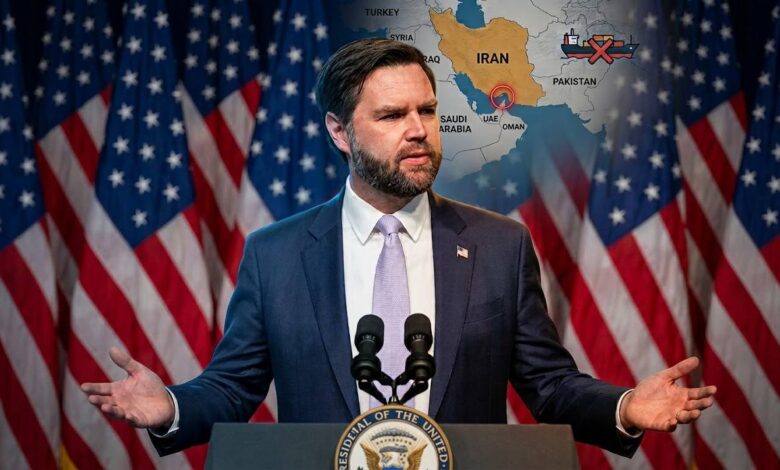
The U.S. Vice President announced that Washington will use a range of economic, military, diplomatic, and even “covert” tools to increase pressure on Iran, revealing secret cooperation between several regional countries and the United States against Tehran. JD Vance also stated that Washington will not engage in talks with Tehran unless Iran halts attacks on commercial shipping in the Strait of Hormuz, and simultaneously refused to set a specific timeline for ending the confrontation. His remarks came at a time when the U.S. is simultaneously investigating an attack on a wedding ceremony in southern Iran, in which, according to published reports, at least five civilians were killed and dozens injured.
JD Vance, the U.S. Vice President, announced at a White House press briefing the continuation of multilateral pressure by the Donald Trump administration on Iran, stating that Washington, in addition to economic, military, and diplomatic pressure, has other “covert” options at its disposal—options whose details the U.S. government will not disclose for now.
Vance’s remarks came as tensions between the U.S. and Iran have entered a prolonged and heightened phase, with maritime security in the Strait of Hormuz remaining one of the primary points of contention between the two countries. Vance claimed that Iran’s attacks on commercial vessels have increased pressure on energy markets and fuel prices.
In response to reporters’ questions about gasoline prices in the United States, he said: “The reason gasoline prices are so high right now is because the Iranians are shooting at commercial shipping.”
Vance also stated regarding the volume of oil transfers through the Strait of Hormuz: “Just yesterday, we moved approximately 15 million barrels through the Strait of Hormuz.”
According to international media reports, Vance said at Thursday’s press briefing that the U.S. escorted approximately 15 million barrels of oil through the waterway on Wednesday. However, independent maritime traffic data shows that vessel traffic through the Strait of Hormuz has not yet returned to pre-conflict levels. Washington claims that American military efforts to keep the energy transfer route open have prevented a more widespread crisis in the global market.
Vance claimed that Iran is gradually losing its ability to use the Strait of Hormuz as a pressure lever. He stated: “The Iranians are starting to understand that their control over the Strait of Hormuz has effectively been lost, and this leverage becomes less valuable every day.”
He then addressed Iran directly, saying: “My advice to the Iranians is to stop acting like crazy people and stop shooting at commercial shipping.” American media reports on Vance’s remarks also emphasized that he views the gradual erosion of Iran’s impact on energy flow through the Strait of Hormuz as part of Washington’s strategy.
One of the most important aspects of Vance’s remarks concerned tools that the U.S. government does not provide public information about. Vance stated: “Economic, military, diplomatic, and covert pressure—all are on the table.”
He also added: “We have many additional tools at our disposal. The President uses some of them and doesn’t use others.”
In another part of the press briefing, Vance refrained from detailing the Trump administration’s strategy, saying that publicly announcing American plans could limit the President’s decision-making power. International media outlets assessed these remarks as a sign that Washington is keeping its hands free to use a broad range of tools against Tehran, ranging from sanctions and economic pressure to military and covert actions.
In response to a question about Washington’s efforts to isolate Iran, Vance claimed that cooperation with the U.S. is much more extensive than what is publicly visible. He stated: “Countries are secretly helping America punish Iran. If you look at Turkey, Azerbaijan, the UAE, Saudi Arabia, Qatar, and many other countries in the Arab coalition of the Persian Gulf, there are many countries. Sometimes they are unwilling to say so publicly, but secretly they are doing many good things to help us ensure that the Iranians pay a price for shooting at commercial shipping.”
This claim received widespread coverage in reports published after the press briefing. In addition to regional countries, Vance also referenced China, stating that Beijing has cooperated with some Washington requests regarding Iran.
He said of China: “China has responded positively to some American requests regarding Iran.” He also added: “I think the People’s Republic of China has definitely behaved much more responsibly than the Iranians.”
However, the issue of Chinese cooperation with American pressure policy is complex, and media reports on Beijing-Tehran economic relations show that China remains one of Iran’s major oil buyers; therefore, Vance’s remarks do not necessarily mean China’s full alignment with Washington’s pressure policy.
At the press briefing, Vance was also asked about the possibility of U.S. support for opponents of the Islamic Republic. He refrained from providing details and said: “Of course, I’m not going to talk about that.”
This response, combined with Vance’s direct reference to the existence of “covert pressure,” drew media attention to aspects of the American strategy that the Trump administration is unwilling to publicly explain. However, Vance provided no specific details about the type or potential scope of support for groups opposed to Iran’s government.
Vance also announced that under current circumstances, direct negotiations with Iran are not on Washington’s agenda. He stated: “We are not talking to the Iranians and we won’t talk to them unless they stop shooting at commercial shipping.”
According to Vance, the U.S. is unwilling to set a predetermined deadline for ending the confrontation. He said: “We are not setting an artificial timeline for ending the conflict with Iran.” He then repeated: “We are not setting an artificial timeline.”
Vance also explained: “It would be irresponsible if we were to outline our strategy and timeline to a country like Iran.”
This position was announced at a time when the U.S. government faces pressure to clarify the ultimate goal and timeline for ending its military operations against Iran. When asked whether the confrontation could end before the U.S. midterm elections in November, Vance even refrained from using the word “war” to describe the current situation.
One of the most controversial parts of the press briefing came when Vance was asked about the duration of the confrontation. In response to this question, he said: “I don’t call the current situation a war.”
He claimed: “Major combat operations lasted about six weeks, and we destroyed nuclear facilities, defense industrial bases, as well as a large portion of their conventional military capability.”
He also said: “Iran’s ability to disrupt normal life for Americans is very limited. We are confident that our homeland is secure.” He added: “The Iranians will try to do many things that they don’t have the capability to do.”
He also emphasized in another part of his remarks: “If you consider Iran’s ability to disrupt normal life for Americans, in my view it is very limited. It’s not zero, but it’s very limited.”
American media outlets in their reports have emphasized that Vance’s remarks about the situation “not being war” came at a time when sporadic attacks and confrontations between the two sides continue to be reported.
Another section of the press briefing was devoted to an attack that published reports link to a wedding ceremony in southern Iran.
In this incident, according to Reuters reporting, five people including a four-year-old child were killed and nearly 70 were injured. American officials have stated that they are investigating the incident, while analysis of weapons and images from the scene published by Reuters has raised the possibility of a direct hit by an American weapon. The U.S. has not formally accepted responsibility for the attack on the ceremony.
Regarding this incident, Vance said: “In this particular case, I don’t think we have information that proves something one way or the other.” He also stated: “The United States never targets civilians in war! We are investigating the matter.”
Reuters reporting indicates that American officials are investigating the incident, and meanwhile the U.S. military has emphasized that it does not intentionally target civilians. However, evidence about the type of ammunition and point of impact that has been published has made this incident one of the most sensitive disputed cases in recent American military operations.
The sum total of Vance’s remarks indicates that the Trump administration currently has no intention of announcing a specific timeframe for ending military and economic pressure against Iran. Washington, on one hand, emphasizes reducing Iran’s ability to impact energy markets and the Strait of Hormuz, and on the other hand, says it has more options for applying pressure.
Meanwhile, Vance’s remarks about secret cooperation between regional countries and the U.S., reluctance to engage in direct negotiations with Tehran, and the possibility of using covert tools show that Washington wants to keep part of its strategy against Iran outside the public sphere.
However, America’s claims about the return of oil flow through the Strait of Hormuz to near pre-conflict levels are not entirely consistent with some independent maritime data. Published reports show that the number of vessels transiting the Strait remains below pre-conflict levels, and this fact indicates that the Hormuz crisis remains unresolved for the global energy market and maritime security.
Under such circumstances, the position announced by Washington is clear: pressure will continue until Iran halts attacks on commercial shipping, without setting a deadline and while preserving economic, military, diplomatic, and covert options. In contrast, the fate of possible negotiations, the real level of regional countries’ cooperation with the U.S., and the scope of Washington’s covert actions remain shrouded in ambiguity.