“Jomeh Narouei,” Baloch Prisoner, Dies in Prison as Medical Care is Delayed
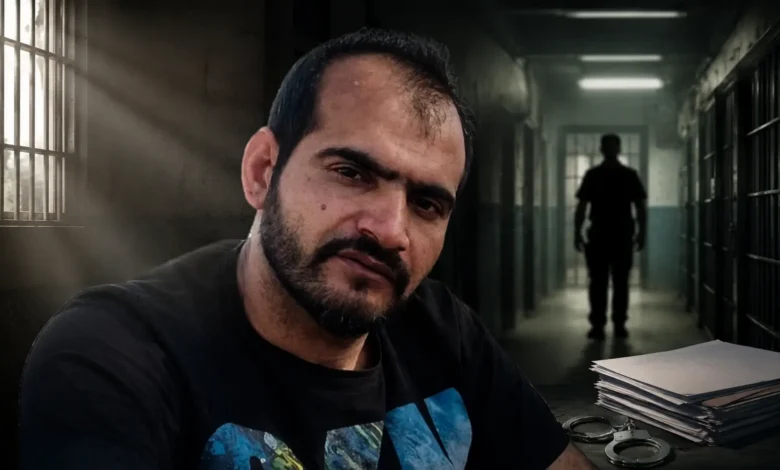
The death of “Jomeh Narouei,” a 35-year-old Baloch prisoner and father of five children in Kerman Central Prison, has once again raised serious questions about the health and dignity of prisoners in Iran. According to human rights sources, the prisoner was transferred to the prison clinic several times in the days before his death, but ultimately died of a heart attack while being transferred to a hospital after his physical condition deteriorated. If verified by an independent investigation, this account would demonstrate a dangerous disregard for one of the most basic human rights: the right to medical care.
Jomeh Narouei, a 35-year-old prisoner from Zahedan, was married with five children. He died in Kerman Central Prison. The human rights organization Hengaw has reported that he lost his life following a cardiac arrest while being transferred from the prison clinic to Shafa Hospital in Kerman.
According to a report by “Haalash,” Narouei’s physical condition had severely deteriorated in the days leading to his death, and he was transferred to the prison clinic multiple times. According to this report, after one day of hospitalization in the clinic, he was returned to the general ward on September 25 (Shahrivar 3), even though his health condition remained poor. A few days later, on September 29 (Shahrivar 7), his condition worsened again and he was transferred back to the clinic.
Published reports indicate that Narouei was kept in the prison clinic until the following morning, but his transfer to an equipped medical facility outside the prison did not occur before the cardiac arrest happened. After suffering a heart attack, he was transferred to Shafa Hospital in Kerman, but died during this transfer.
Narouei had been imprisoned in Kerman since 2024 on charges related to drug-related offenses. However, a notable point in the published reports is that his release bail had recently been accepted, and his family hoped that after his release, they could pursue his medical treatment outside the prison. Yet this freedom, which could have been an opportunity for him to continue living and receive treatment, never became a reality.
In such circumstances, the issue is not merely the legal case of one prisoner; the issue is the right of a human being to live and receive medical care.
A prisoner, regardless of any crime he may have committed, does not lose his humanity upon entering prison. A court conviction may limit his freedom, but it should not deprive him of human dignity, the right to health, the right to receive medical services, or the right to humane treatment.
This principle applies even to someone who has committed a serious crime. Punishment is not a license to disregard human life. If the published reports about Jomeh Narouei’s condition and the delay in his transfer to the hospital are accurate, a serious question arises: why was a prisoner with a history of physical deterioration and repeated visits to the clinic not transferred to an equipped medical facility before his condition reached a critical stage?
The answer to this question is not merely the responsibility of Narouei’s family, but a public and human responsibility. Prisoners in Iran often live behind walls through which society’s access to what happens inside is limited. When illness, death, or allegations of medical negligence occur in prisons, families typically lack immediate access to complete information, medical records, and the precise course of treatment of their loved ones. This very issue underscores the necessity of transparency and independent oversight of prisons.
Regarding Jomeh Narouei, human rights sources have called for an independent investigation into the process of medical care, the reason for the delay in his transfer to the hospital, and a clear determination of the circumstances that led to his death.
From a Christian perspective, this is not merely a human rights issue; it is directly related to the concept of human dignity. Christianity does not define a person solely on the basis of his errors and failures. In the view of Scripture, the value of a human being derives from the fact that he is recognized as a being created in the image and likeness of God.
For this reason, even when a person is imprisoned and even when serious charges are leveled against him, his human dignity cannot be stripped away.
Jesus Christ says in the Gospel of Matthew: “Whatever you did for one of the least of these brothers of mine, you did for me.” This perspective confronts society with a difficult responsibility: how we treat the weakest and most vulnerable people reveals part of the moral truth of our society.
A prisoner, due to being behind bars, has his voice heard less often. His ability to defend his rights is more limited, and in many cases, his fate depends on the decisions of guards, prison officials, and the judicial system. For this reason, the government’s responsibility toward prisoners is even greater. One whose freedom has been taken away should not also have his health and life abandoned to oblivion.
This matter becomes even more significant in the case of Jomeh Narouei, because according to reports, he died while his family was awaiting his release on bail. In other words, his death occurred under circumstances in which the possibility of his release and continued treatment outside the prison apparently had been made available. His five children now have no father, and these five children will likely ask themselves why their father, a man who was in prison, could not receive the same medical care that every other person deserves.
In recent years, numerous reports have been published about inadequate medical conditions, delays in sending sick prisoners to medical facilities, and deaths of prisoners in Iranian prisons. The death of Jomeh Narouei falls within this framework of concerns; although determining precise responsibility in this case requires independent investigation and access to medical documents and testimony from informed individuals, one principle should not require investigation: no human being is deprived of his right to be human by virtue of being imprisoned.
The Christian community also cannot remain indifferent to the suffering of prisoners. Defending human dignity does not mean approving a crime or acquitting a criminal; rather, it means accepting the fact that justice, without human dignity, can become another form of violence.
If a person has committed a crime, he must be held accountable under the law; but if that same person becomes ill, he must be treated. If he is placed in danger of death, efforts must be made to save his life, and if the day comes when his return to society becomes possible, there must also be an opportunity for reform and restitution. This is the point where justice can be accompanied by mercy.
The death of Jomeh Narouei should not remain merely a brief news item amid the flood of news from Iran. This death should keep alive a question that Iranian society has repeatedly been forced to ask: behind prison walls, who is responsible for the lives of people whose voices are heard less often?
If Jomeh Narouei’s death resulted from delays in medical care, officials must be held accountable and his family has the right to know the truth, because justice is not merely the execution of a sentence; justice is also the protection of human life and dignity.