Statement by Over 100 Iranian Activists: Iran’s People Should Not Be Forced to Choose Between Foreign War and Domestic Repression
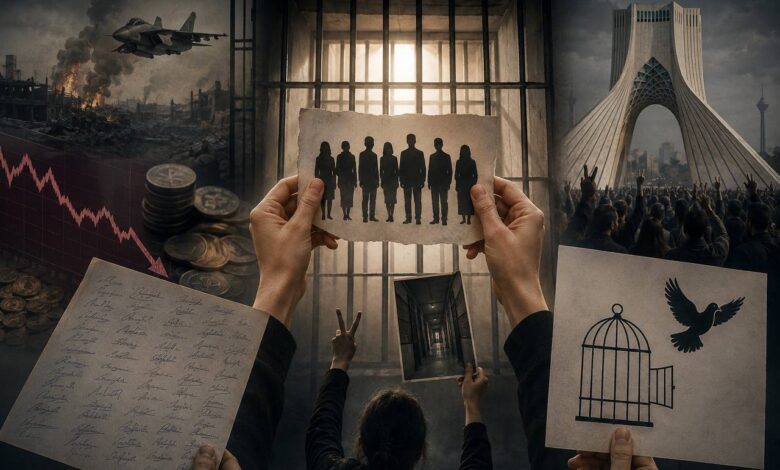
More than 100 former political prisoners, human rights activists, writers, journalists, academics, and civil society activists in Iran and abroad have issued a joint statement declaring that the Iranian people should not be forced to choose between military attacks and foreign economic pressures on one hand and government repression on the other. The statement, released in support of a recent letter published by The Guardian regarding Iranian political prisoners, emphasizes the need to stop executions, free political prisoners, and end war and collective punishment of the Iranian people.
This statement was issued in response to a letter published in The Guardian on August 20, 2026, under the title “To Iran’s Political Prisoners, Caught Between the Two Blades of a Scissors.” In that letter, more than 20 academics, writers, political activists, and former political prisoners expressed concern about the condition of detainees in Iran while simultaneously condemning both the Islamic Republic’s repression and military attacks by the United States and Israel against Iran.
The authors of The Guardian letter had argued that Iranian political prisoners find themselves in a situation where they face imprisonment, torture, execution, and government repression on one hand, while war and foreign attacks threaten their lives and those of other Iranian citizens on the other. They called for an end to executions, the release of political prisoners, and an end to war and sanctions by the United States and Israel.
However, the use of the metaphor “the two blades of a scissors” quickly became a point of contention and criticism. Critics argued that this expression could create a kind of political or moral equivalence between Islamic Republic repression and foreign attacks. In response, supporters of the letter argue that the expression was not intended to equate the parties involved, but rather to describe the situation of people simultaneously experiencing the consequences of two forms of violence.
The new statement enters the debate at precisely this point, attempting to clarify the distinction between “simultaneously condemning two forms of violence” and “equating them.”
The signatories have explicitly stated: “The Iranian people should not be forced to choose between foreign military-economic aggression and state repression.”
They have also addressed criticisms raised regarding the “two blades of a scissors” metaphor, writing: “The use of the metaphor ‘the two blades of a scissors’ to describe the predicament that Iranians simultaneously face with war and government repression does not mean treating these two as morally or politically equivalent.”
The statement then emphasizes that condemning different forms of violence does not necessarily mean equating their origins, nature, or objectives. Within this framework, the signatories have listed examples of what they consider domestic repression: from executions and imprisonment of opponents to mandatory hijab, censorship, restrictions on civil society, and pressure on ethnic and religious minorities.
Another section of the statement reads: “Iran’s history attests to various forms of foreign intervention—Iran’s history also attests to state repression, before and after the 1357 Revolution—including the repression of political prisoners, executions, mandatory hijab as a form of gender apartheid, censorship, repression of civil society, religious minorities and systemic oppression against Kurds, Baluchis, Arabs and Turks in Iran. Justice, freedom, and democracy should not be postponed or sacrificed in the name of the Islamic Republic’s ‘anti-imperialist resistance’ against foreign enemies.”
The signatories have also emphasized that a government can simultaneously be the target of foreign attack and continue to repress its own citizens domestically. From their perspective, accepting one of these realities should not lead to dismissing the other.
This debate has become a serious point of contention in Iranian public discourse and among political and human rights activists, particularly since the publication of The Guardian letter. Some critics argue that comparing the two situations can diminish the distinction between the Iranian government’s responsibility for domestic repression and the responsibility of foreign powers for military operations. In response, supporters of the letter argue that their starting point is the situation of victims, not a comparison of power or the political responsibility of states.
Some analyses published after The Guardian letter have also recalled that the metaphor “the two blades of scissors” was used among political prisoners and their families before the letter’s publication. In an analysis of this debate, “Farah Mokhtari-Zadeh” references the writing of “Keyvan Mehtadi,” a labor activist and former political prisoner, after an attack on Evin Prison, where he wrote of concerns about prisoners caught “between the two blades of scissors.” Similarly, “Siamak Namazi,” a former political prisoner, had reported using the same expression to describe the situation of detainees during attacks.
On the other hand, the publication of The Guardian letter did not face only support, and critical reactions also emerged among political and civil movements. Some critics specifically argued that placing the Islamic Republic on one side of the scissors and the United States and Israel on the other could conceptually create a kind of “false symmetry.” In response to this criticism, supporters of the letter have emphasized that the text did not intend to compare the power, history, or responsibility of these actors, but rather focused on the situation of Iranian prisoners and citizens.
The new statement has also addressed specific demands beyond the theoretical debate about the scissors metaphor. The signatories have called for an immediate halt to executions, the release of all political prisoners, an end to war, and prevention of collective punishment of the Iranian people. The text supporting The Guardian letter centered on these same demands and called on the international civil society to support Iranian political prisoners.
Among the signatories of the new statement are figures such as “Saeid Madani,” “Mohammad Habibibi,” “Mohammad-Reza Nikfar,” “Nasim Khakssar,” “Ali Banouazizi,” “Touraj Atabaki,” “Mansoura Behkish,” “Nahid Taghvai,” “Nire Towhidi,” “Reza Khandan,” “Atena Daemi,” “Faraj Sarkouhian,” “Parastou Forouhar,” and “Kazem Alamdari.”
The significance of this statement lies not only in the number of signatories but in the attempt to present a position that opposes both extremes: according to the signatories, opposition to foreign war should not be interpreted as support for domestic repression, and opposition to Islamic Republic repression should not require support for foreign military attacks.
Finally, the signatories have attempted to redirect the debate from choosing between two sides to the situation of people caught in the midst of this crisis. Their core message is that freedom, justice, and human rights should not be postponed to an uncertain future because of war or claims to counter a foreign enemy, just as opposition to foreign attack should not lead to ignoring the repression and violation of the rights of citizens within Iran.