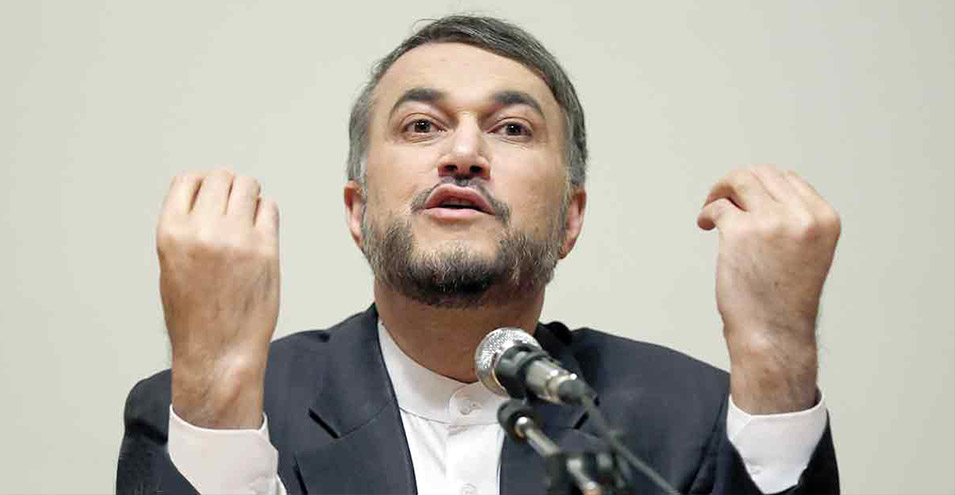
Iran’s Deputy Foreign Minister says that when ISIS forces were 50 kilometers away from Iran’s borders, timely action by the Islamic Republic prevented damage. He added that without Iran’s “advisory” assistance, Syria would have been lost.
Hossein Amirabdollahian, the Arab and African Affairs Deputy at Iran’s Foreign Ministry, provided explanations at a session titled “Syria’s Developments and Future Scenarios” regarding Iran’s support for Assad, the Syria crisis, ISIS movements in Iraq, and domestic security.
According to ISNA, Amirabdollahian said: “If it weren’t for the vigilance of our military and law enforcement security apparatus, perhaps today we would be talking about explosions by terrorist groups in our metro stations in Tehran, but all of this stopped fifty kilometers away from our borders and we did not allow them to enter the country.”
Amirabdollahian, in explaining the importance of the Syria crisis for the Islamic Republic system, referred to the connection between developments in Iraq and Syria, and said that the system’s timely action against terrorist groups prevented entry into a “vulnerability point”: “Our military and security sectors concluded that during developments within Syria and ISIS movements, with support from regional and extraregional actors, certain insecurities from Syria would enter Iraq. This growing capacity created by ISIS in Iraq threatened our national security as well.”
This is not the first time that Islamic Republic officials have spoken about preventing ISIS from entering Iran’s borders. Ahmad Reza Pourdastan, Commander of Ground Forces, acknowledged in autumn 2015: “Last year ISIS approached Iran’s western borders from Iraq’s Diyala province, and we warned that if they crossed our 40-kilometer red line, they would face a decisive response.”
The Ministry of Intelligence has also reported several times on the arrest of teams affiliated with ISIS at Iran’s western and eastern borders, but this is the first time that an official from the Foreign Ministry has linked the extent of the danger of ISIS infiltration to potential bombings in Tehran’s metro.
Green Berets and “Advisory Mission”
The “Syria’s Developments and Future Scenarios” session was held on Wednesday, April 28 at Allameh Tabatabai University. Amirabdollahian again emphasized that Iran does not send military forces to Syria: “At the present stage, no combat fighters have entered Syria, but rather the advisors who were going to Syria from the Revolutionary Guards are now elite military advisory personnel entering Syria, and at times due to their proximity to the operational field, we encounter their martyrdom.”
This explanation refers to the deployment of Iranian Army reconnaissance forces to Syria, known as Green Berets. It was first reported in mid-April when Ali Arasteh, Coordination Deputy of the Ground Forces Commander, announced the deployment of a group of green berets from the 65th Reconnaissance Battalion as advisors in Syria.
Kamal Pombari, Training Deputy of Iran’s Ground Forces Commander, announced on Sunday, April 18: “The Army, by the command and order of the Supreme Commander of the Armed Forces, has undertaken an advisory mission role to work alongside the Revolutionary Guards.”
“We Did Not Allow Terrorists to Overthrow Syria’s System”
Hossein Amirabdollahian, in response to a question about the reason for deploying Army forces to Syria, said they were sent at the formal request of that country’s government and “solely for fighting terrorism” to Syria “to prevent the overthrow of Bashar Assad by terrorists and to not further endanger our region and national security.”
He considered the increase in the number of “Iran’s advisory forces” in Syria as dependent on growing developments and regional needs, and emphasized that the Islamic Republic “did not allow terrorists to overthrow Syria’s political and legal system.”
The Foreign Ministry Deputy, in another part of his remarks about Syria’s future and Assad’s fate, addressed the ignorance of many countries about Damascus’s developments: “In contrast to Iran, Russia, China, Lebanon, and even countries like Egypt and Algeria believe that decisions about Syria should not be made in New York, Munich, and Vienna, but rather the Syrian people should do so.”
Amirabdollahian added that Iran does not support the idea that Bashar Assad be Syria’s permanent president, but first the matter of terrorists in Syria must be clarified: “Perhaps it would not be very rational for us to make a deal on Bashar Assad when no suitable replacement has been found for him.”
Ali Akbar Velayati, the Supreme Leader’s Senior Advisor on International Affairs, said a few days earlier in a meeting with Syria’s Ambassador in Tehran that Iranian forces are present in that country at the request of Syria’s government, and the Islamic Republic will only accept the results of Geneva negotiations if it is not against “the interests of the Syrian people.”
Velayati previously emphasized that Bashar Assad is a red line for the Islamic Republic. He stated in December 2015, upon returning from Syria on Iran’s state radio and television, that the Syria crisis is a “small international war” and added that Iran does not intend to leave Assad’s back empty “on the battlefield and in the political field.”
Source: Deutsche Welle