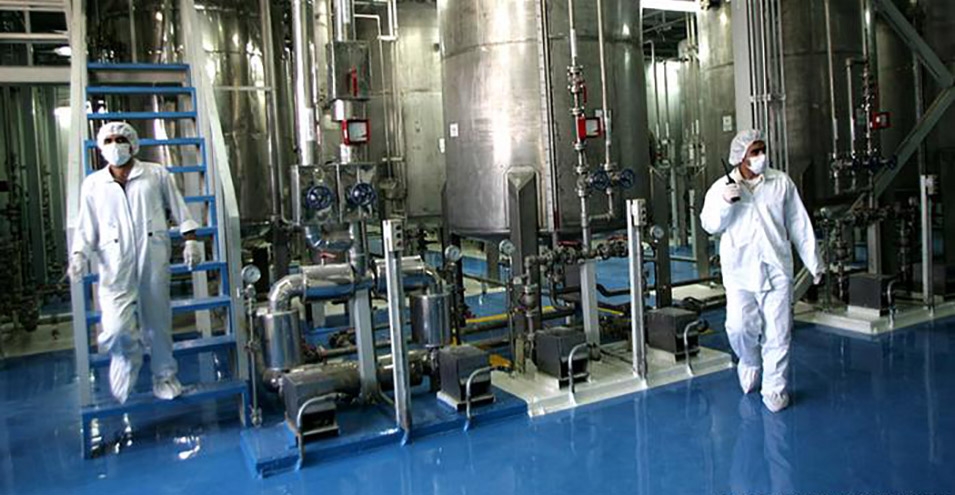
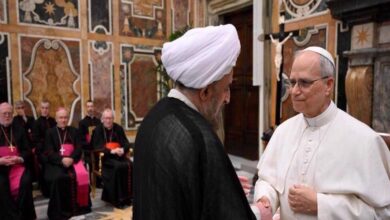
Headquarters of the Imam’s Decree: Major Economic Plunderer and Rival to the Revolutionary Guards
Its name came into the spotlight when it entered into oil contracts. Neither the purchase of shares in telecommunications nor its construction activities had done so, nor was it at the time it entered banking activities, and not when it launched the Talia credit mobile phone service. “Tadebirgroup Economic Development Group”……. However, it became a headline when one of its newly established subsidiaries, in its first contract, took over the development of an oil field.
After that, analysis began and “Tadebirgroup” with its subsidiaries came under media attention. When the ceremony to begin construction of the Peace Pipeline in Pakistani soil was held, the name “Tadebirgroup” as its builder made the news. Is this news true? Which organization is “Tadebirgroup Economic Group” affiliated with? How does it earn income and how does it spend? What companies are the six major subsidiaries of “Tadebirgroup Economic Development Group”? You will read the answers to these questions.
So the audience has little knowledge of the activities of this large economic organization. Just as they don’t know much about the activities of “Barekat Foundation.” A large charitable foundation that is established under the supervision of the Headquarters of the Imam’s Decree to empower deprived areas and engage in public welfare activities. Also for the benefit of the needy and for underprivileged areas. How much income does “Tadebirgroup Economic Development Group” with all its companies have? How much does “Barekat Foundation” spend?
This headquarters began operations on the 27th of Ordibehesht 1368 (approximately one month before the death of Ayatollah Khomeini) through a decree to Messrs. Habibollah Asgaroladi, Mehdi Karroubi, and Hassan Sane’i to take control of all funds and assets of unknown owner, ownerless inheritance, assets regarding khumsand exit from liability, and assets placed under the authority of the Supreme Jurisprudent through the implementation of Article 49 of the Constitution and other laws. The mentioned individuals were authorized by Ayatollah Khomeini to take any measures they deemed appropriate in all dimensions of selling, maintaining, and administering them, or to place part of these authorities under the Ministry of Economy and Finance. This headquarters was obligated through this decree to spend all resulting income in the matters prescribed by Islamic law, including Shahid Foundation, June 15th Foundation, Housing Foundation, Relief Committee, Welfare Organization, Shahid Rajaei Plan, and the Foundation for the Disabled of the Islamic Revolution, and other matters of their choice. After Ayatollah Khomeini’s death, the presidency of the headquarters was transferred by Seyyed Ali Khamenei in 1373 to Mohammad Sharaetmadari, and then in 1376 Dr. Mohammad Javad Irvani took this position. Mohammad Makhber has held the presidency of the headquarters since 1386 until now.
The Dual Legal Nature of the Headquarters
The Headquarters of the Imam’s Decree, organizationally consists of two sections: a judicial section and an economic enterprise. The judicial section has laws approved by the Islamic Consultative Assembly, and the economic section has been organized by order of Seyyed Ali Khamenei. The financial resources of the economic section are provided by the judicial section and its economic activities. To the extent that this headquarters even pays taxes in the field of its economic activities. This is while according to Article 44 of the Iranian Islamic Republic Constitution, Iran’s economic system is based on three sectors: public, cooperative, and private, and no other economic sector operating under the supervision of the leadership has been defined.
The dual judicial and economic nature of the headquarters violates the fundamental principles of systems based on separation of powers, as in such systems the judiciary is independent from the legislative and executive branches. According to Article 57 of the Constitution of the Islamic Republic of Iran, the legislative, executive, and judicial powers are independent of each other.
Contradiction in the Implementation of Article 49
According to Article 49 of the Constitution, the government is obligated to take wealth resulting from usury, seizure, bribery, embezzlement, theft, gambling, misuse of endowments, misuse of monopolies and government dealings, sale of barren and unowned lands, establishment of places of corruption and other unlawful matters and return it to the rightful owner, and if the owner is unknown, to the Treasury. This ruling must be executed by the government through investigation, research, and religious proof.
However, according to Article 8 of the law on the implementation of Article 49 of the Constitution of the Islamic Republic of Iran, approved 1363/05/17 during the second session of the Islamic Consultative Assembly presided over by Akbar Hashemi Rafsanjani, the court, after confirming that the assets and property of natural or legal persons are unlawful, if the amount is known and if the owner is identified, must return it to its owner, but if the owner is not identified, it is placed under the authority of the Supreme Jurisprudent, and if the amount is not known, if the owner is identified, it must be settled with the owner, but if the owner is not identified, the khums of the property must be placed under the authority of the Supreme Jurisprudent.
The contradiction of this approval in the method of implementation with Article 49 of the Constitution is clear.
Duplication with the Organization for the Collection and Sale of Transferred Property
The law establishing the Organization for the Collection and Sale of Transferred Property and its bylaws were approved on 1370/11/7 by the third session of the Islamic Consultative Assembly presided over by Mehdi Karroubi.
The duties stipulated in Article 1 of the law establishing the Organization for the Collection and Sale of Transferred Property and its bylaws overlap with the legal duties of the headquarters, which constitutes a kind of duplication in the implementation of the Constitution.
The Head of the Judiciary at that time, Sadegh Larijani, through circular No. 100/15658/9000 dated 27/3/1392, transferred a large portion of the legal duties of the Organization for the Collection and Sale of Transferred Property to the Headquarters of the Imam’s Decree, and considered that headquarters as the only authorized entity regarding assets related to the Supreme Jurisprudent. Furthermore, it expanded assets under the authority of the Supreme Jurisprudent to include: assets of unknown owner, ownerless, heirless inheritance, smuggled goods without owner and fugitive owners, assets deposited in free and special economic zones, abandoned assets, assets and properties of missing persons, assets regarding khums and exit from liability and implementation of Article 49 of the Constitution and other laws under the authority of the Supreme Jurisprudent.
Exclusion from Inspection and Audit by the General Inspection Organization
The activities of the headquarters, based on Clause 2 of the law listing public non-governmental institutions and organizations approved 1373/04/29 during the fourth session of the Islamic Consultative Assembly presided over by Ali Akbar Nategh-Nouri, which states: (the implementation of the law regarding public institutions and organizations under the supervision of the Supreme Jurisprudent will be with the permission of His Eminence) are not subject to the oversight of the General Inspection Organization except in accordance with Section B of Article 2 of the law establishing the General Inspection Organization if inspection is requested by the leadership.
Furthermore, the headquarters does not fall under any of the provisions of Article 2 of the law establishing the General Inspection Organization, which defines the inspection jurisdiction of that organization.
Tax Exemption
According to Article 78 of the law amending certain provisions of the government’s financial regulations law (2) dated 1393/12/13 during the ninth session of the Islamic Consultative Assembly for establishing educational justice and implementing Article 30 of the Constitution and equipping all educational institutions with priority to deprived areas and villages, the Holy Shrine of Imam Reza, and those economic institutions and enterprises as subsidiaries of the armed forces and the Headquarters of the Imam’s Decree and other executive bodies that had not paid taxes until the passage of this law, became obligated to pay direct taxes and value-added tax.
However, on the other hand, Section (4) of Article (2) of the law amending the direct tax law approved 27/5/1394 during the ninth session of the Islamic Consultative Assembly exempts foundations and institutions of the Islamic Revolution with permission from Ayatollah Khomeini and Seyyed Ali Khamenei from paying direct taxes.
The regulation for handling files of Article 49 was announced on 1379/03/10 by the Head of the Judiciary at that time, Seyyed Mahmoud Hashemi Shahroudi, based on delegated authorities from the leadership.
According to circular dated 1388/05/14, the Head of the Judiciary at that time, Seyyed Mahmoud Hashemi Shahroudi, stipulated that rulings and decisions issued in cases that are instances of assets under the authority of the Supreme Jurisprudent be issued and announced in the name of the Headquarters of the Imam’s Decree.
Through an order dated 1393/06/03, Sadegh Amoli Larijani, Head of the Judiciary, appointed Gholamhossein Mohseni Ejei as the head and member of the supervision and follow-up committee for Article 49 files of the Constitution.
In 1386, with the arrival of Mohammad Makhber, a new approach to social and economic activities for the headquarters was initiated by Ali Khamenei with the goal of facilitating public participation, especially entrepreneurs, inventors, and the country’s elites, with priority given to deprived segments of society in disadvantaged areas of the country……………………….!!!!!!!!!!!!!! which not only has not been realized to date, but has also led to the execution of many entrepreneurs.
The economic section of the Headquarters of the Imam’s Decree is not recognized among public non-governmental institutions because it does not appear in the law listing public non-governmental institutions and organizations approved 1373/04/29 during the fourth session of the Islamic Consultative Assembly presided over by Ali Akbar Nategh-Nouri.
Part of the organizational structure of the economic section of the headquarters was published by the U.S. Department of the Treasury in 2002
Barekat Foundation
The income resulting from the implementation of Article 49 of the Constitution of the Islamic Republic of Iran and also income from the headquarters’ economic activities, which are carried out under the name of the private sector, are spent in an institution called Barekat Foundation.
Barekat Foundation began operations in Azar 1386, two months after Mohammad Makhber took office. According to Shahin Shayan Arani, the first CEO of this foundation, “according to the announced policies, work only in hamlets and remote and deprived areas of the country” is on this foundation’s agenda. The activities of Barekat Foundation take place in the social sphere. The selected headline for the 2015 annual report of this foundation was “from mosque building to anti-poverty.”
Tadebirgroup Economic Development Group
This group is the revenue-generating arm of the headquarters in the form of the private sector. The subsidiaries of Tadebirgroup Economic Development Group are the following holding companies:
- Tadebirgroup Energy Development Group which is a shareholder of the following companies:
- Pars Oil Company (public joint stock) – 75%
- Bahman Geno Company (private joint stock) – 80%
- Persia Industrial and Gas Development Company – 100%
- Qaedbassir Petrochemical Production Company (public joint stock) – 80%
- Northern Drilling Company (public joint stock) – 10%
- Tadebirgroup Drilling Development Company (private joint stock) – 100%
- Rey Niroo Engineering Company (private joint stock) – 100%
- Abadan Power Generation Company (public joint stock) – 75%
- Modarran Chemistry Chemical Company (private joint stock) – 100%
- Tadebirgroup Parsian Refining Company (private joint stock) – 80%
- Pars Bazargan Company (private joint stock)
- Mabeen Electronics Expansion Company of Iran which is a shareholder of the following companies:
- Mabeen Trust Development Company which is a shareholder of the following companies:
- Mabeen Company
- Mabeen Economic Mehr Company
- Iran Telecommunications Company
- Iran Mobile Telecommunications Company (Hamrah Aval)
- KazInterCom
- Iranians Net Company
- Asman Media Company
- Raymon Media Company
- Ariatel Telecommunications Development Company
- Talia Communications Expansion Company
- Mabeen Integrated Telecommunications Development Company
- Mabeen One Kish Company
- Rahkam Iranians Communications Company
- Mabeen Khavar Technologists Company
- Mabeen Trust Development Company which is a shareholder of the following companies:
- Tadebirgroup Industrial and Mining Development Company
- Karun Phosphate Products Complex Company
- Iranians Mining Development Company
- Tomorrow’s Industrial and Mining Development Company
- Tadebirgroup Investment Company which is a shareholder of the following companies:
- Pardis Investment Company
- Iran and East Leasing Company
- Iran and East Company
- Silk Production and Export Company
- Tous Farming Management Company
- Tomorrow’s Tadebirgroup Brokerage Company
- Barekat Pharmaceutical Company which is a shareholder of the following companies:
- Herbi Farmed (medicinal plants)
- Alborz Persian Drug Research and Technology Fund Institute
- Barekat Pharmaceutical Industrial Park
- Biosan Farmed Company
- Cell Tech Farmed Company
- Barekat Tel Company (health call center)
- Ati Farmed Pharmaceutical Company
- Shafa Farmed Company (center for production of raw materials for various antibiotics from living cells) (producing approximately 14% of all essential medicines in the country)
- Alborz Distribution Company (confiscated) (belonging to Kazem Khosrowshahi) (with 9000 covered warehouses)
- Tollidaro Pharmaceutical Company (confiscated) (belonging to Kazem Khosrowshahi)
- Alborz Elevation Investment Company
- Sobhan Pharmaceutical Group
- Alborz Bulk Raw Materials Production Company
- Alborz Medicine Company (pre-filled syringes named Prefield)
- Sobhan Medicine Company (confiscated)
- Sobhan Oncology Company (Sobhan Oncology Drug Manufacturing Plant in Rasht City) (confiscated)
- Iran Medicine Company (confiscated)
- KBC Company (confiscated – one of the giants of drug imports to Iran)
- Tadebirgroup Management Consultants and Strategic Studies Group
- Tadebirgroup Building Development Group which is a shareholder of the following companies:
- Hope Development and Construction Company
- Behsaz Home Building Company of Tehran
- Pars Future Development Company
- Tadebirgroup Innovators Development and Construction Company (Farahzad Innovators Development and Construction)
- Omid Ranj Hospitality Company of Kish
- Tadebirgroup Construction and Development Company
- Aria Royal Building Company (private joint stock)
This headquarters was involved in 1388, along with several other companies, in purchasing a major portion of shares in Iran Telecommunications Company, which caused numerous legal ambiguities and objections. Prior to that, in 1379, this headquarters purchased 48% of Pars Oil shares, which was called the largest stock exchange transaction during that period.
It should be known that the method of confiscation and sale of assets that has been entrusted to the above institution according to the governmental order in Article 49 of the Constitution has always been subject to debate. However, a look at the five-year activity of that headquarters regarding the sale of assets and the way auctions were held for the general public is worth contemplation. Also, the order for confiscation in favor of the above organization is only carried out by judicial authorities and based on legal and judicial proceedings and with the determination of religious judges.
The rumor of announcing the assets of the above headquarters by the CEO of its properties and real estate organization does not align with the reality of non-pricing of confiscated assets and properties and the return of some of them to their rightful owners by judicial authorities. From the perspective of critics and opponents, the mere continuation of this headquarters’ activities to this day, when it started from the beginning with a one-year time limit, is itself thought-provoking.
Also, according to those who seek a comprehensive review of this headquarters’ activities, in the year 70 and with the issuance of an order by Seyyed Ali Khamenei for the confiscation of assets of members of the Pahlavi dynasty, Jews and other minorities, and even Muslim migrants, without a lawyer or representative for asset guardianship, the headquarters’ performance acquired special conditions. According to them, of approximately ten thousand files pursued in the headquarters in recent years, only 50 percent were related to members of the former regime, and about 50 percent were related to Muslim Iranians who emigrated, left the country, and had no affiliation with the former regime, and their assets were confiscated solely because of residing outside the country.
In fact, one of the main causes of this deviation is the benefit obtained by ruling judges from confiscated assets, and in some cases they were accused of purchasing one to five properties in exchange for approximately 10 to 30 percent of their value, and it was claimed that the headquarters’ officials were not only dissatisfied with this phenomenon but also encouraged and approved it.
Apart from serious legal and religious ambiguities and objections to the seizure of assets of citizens who reside in other countries for various reasons, the costs of this action for the system’s reputation, by creating a base for opponents, causing dissatisfaction against the system, forming circles of corruption and mafia gangs for asset seizure under the guise of Article 49 and the headquarters, and its consequences, creating pollution in the judicial apparatus, enforcement officers and the headquarters have been heavy, and the need for reconsideration is evident.
Furthermore, the provisions of Article 49 were not only the pursuit of confiscation of assets of the former regime’s members (even though its implementation from the perspective of critics was very incomplete and only about one-fourth of all assets throughout the country was carried out), and with the passage of years since the adoption of the Constitution, serious work has not been done toward implementing other provisions, and this doubles the need for reconsideration in the structure of the entire headquarters.
- Oil Contracts
- Contract for the development of the northern section of the shared Yaran field (shared with Iraq): valued at $600 million, which was concluded in the form of previous oil contracts with the Persia Industrial and Gas Development Company (a subsidiary of the Headquarters of the Imam’s Decree).
- Contract for the development of the shared Yaran field and the Kupal and Maron fields: the contract amount was not officially announced, but the Tasnim News Agency previously announced its value as $2.5 billion. This agreement was signed between Gholamreza Manouchehri, deputy of the National Iranian Oil Company, and Naji Saadoun, CEO of the Persia Industrial and Gas Development Company (based on the new model of Iran’s oil contracts).
The oil company affiliated with the Headquarters of the Imam’s Decree is one of eight Iranian companies whose authority has been confirmed by the Ministry of Oil for oil exploration and production activities.
- Economic Sector Assets
This headquarters is one of the largest economic enterprises in Iran. In November 2013, Reuters news agency, in a series of analytical articles based on official documents and evidence and assessment of property values, shares of companies and institutions affiliated with this entity, estimated the value of assets under the control of the Headquarters of the Imam’s Decree at approximately $95 billion.
Previously, the head of the headquarters announced the value of real estate and properties under the organization’s control as fifty thousand billion tomans.
On June 4, 2013, the U.S. Department of the Treasury, through Executive Order 13599, placed the Headquarters of the Imam’s Decree under sanctions. This sanction was issued in strengthening executive orders issued in accordance with the D’Amato Law.
On the basis of this, in the list published on January 16, 2016, the Headquarters of the Imam’s Decree was not included in the sanction list known as the SDN List and was also not subject to secondary sanctions, but U.S. citizens were obligated to block the interests or benefits of the Headquarters of the Imam’s Decree.
In July 2010, the European Union placed the then-head of the Headquarters of the Imam’s Decree, Mohammad Makhber, on the list of persons or legal entities likely to be involved in Iran’s nuclear program and ballistic missiles, but two years later removed him from the list without any explanation.
In fact, the officials of the Islamic Republic of Iran’s government have endeavored from the beginning of their regime that each in their own way has become a power mafia and has seized Iranian assets and economy in every way they could. Dozens of organizations and institutions such as the Islamic Revolutionary Guards Corps, the Headquarters of the Imam’s Decree, … have emerged, each of which has played a role in plundering and looting Iran in one form or another.
With a cursory glance, it is clear that the Headquarters of the Imam’s Decree, under the direct presidency of Ali Khamenei, the Supreme Leader of the Islamic Revolution of Iran, is administered, and according to some sources, is a powerful arm of Khamenei.
The capital of this organization is currently $95 billion. $52 billion of this capital is allocated to lands whose owners (officials and authorities of the former monarchical regime, as well as national minorities and opponents of the Islamic Republic, ….) were and therefore confiscated by the regime, and $43 billion of it is also the value of companies that this headquarters has established or purchased.
As mentioned, the Headquarters of the Imam’s Decree was established in 1368 and according to Article 49 of the Constitution of the Islamic Republic as approved by the 1364 Iranian parliament. This organization began its activities from 1368 by order of Ayatollah Khomeini. In 1368 (1989), Ayatollah Khomeini, through a two-paragraph order, asked Habibollah Asgaroladi (who died some time ago) to, in cooperation with Mehdi Karroubi and Hassan Sane’i, implement the provision that was included in the Constitution in 1364. According to Article 49, the property and assets of the authorities and associates of the former monarchical regime should be identified and confiscated, otherwise they should be sold and their proceeds distributed to organizations and foundations affiliated with the Supreme Leader of Iran such as the “Martyrs Foundation,” the “June 15 Foundation,” the “Imam Khomeini Relief Committee.” As stipulated in the said law, this headquarters had only one year to complete this work and should have been dismantled in late 1369. But now, after 24 years, it continues its activities. Following Khomeini’s death and Khamenei’s assumption of the leadership position, this headquarters did not cease its activities with Khamenei’s cooperation. In fact, Ali Khamenei sought through this action to achieve a kind of financial independence against the government through this organization.
The Iranian parliament four years ago, through an approval, exempted the Headquarters of the Imam’s Decree from any financial and property audit. In this parliamentary approval, it stated that centers and organizations affiliated with the leader are not subject to any audit and inspection, except with the leader’s permission.
The Headquarters of the Imam’s Decree, in cooperation with the Revolutionary Court, has confiscated all lands and properties whose owners are among religious minorities, opponents of the Islamic Republic, or elements of the former regime, or uses force to seize and confiscate them. In the mentioned report, the confiscation of properties and assets of Iranian Bahais by the Headquarters of the Imam’s Decree has been mentioned, in such a way that they have either been forced to repurchase their properties from the regime or forced to abandon them.
This organization, as its name indicates, is affiliated with the leadership and Seyyed Ali Khamenei is responsible for its supervision, and the parliament and the Administrative Audit Court, which are defined in the Iranian Constitution as two oversight bodies, have no authority over this organization.
Most of the officials of this organization were previously government officials and ministers or trustworthy to Ali Khamenei.
Properties and Lands: According to information, this organization owns confiscated properties and lands estimated to be worth $52 billion. The owners of all these properties and lands are opponents of the Islamic Republic as well as national and religious minorities.
Workshops and Companies: The total value of workshops and companies under the supervision of the Headquarters of the Imam’s Decree is estimated at $43 billion. Because this organization has extensive operational authority, it operates in all fields from oil and gas, banking, automobile manufacturing, pharmaceuticals to foreign relations.
According to information, four years ago the group of companies “Mabeen Trust Development,” which owns 38% of its shares by the Headquarters of the Imam’s Decree, purchased 50% of Iran Telecommunications Company for 7,800 billion tomans, and after this transaction, one of the headquarters’ managers took the position of CEO of Iran Telecommunications Company.
Another company in which the headquarters has a stake is Parsian Bank, of which 25% of shares belong to the headquarters. Although according to information, the Headquarters of the Imam’s Decree, in most companies, owns less than half of the shares, but because it is supported by Iran’s Supreme Leader, in all companies and enterprises in which it has a share, it has the final say.
Most of the production and economic activities of the headquarters are carried out by a group known as the Tadebirgroup Economic Development Group. Tadebirgroup owns six companies, each operating in a specific field. Such as the Tadebirgroup Building Development Group, which is supervised by Mohammad Saidi Kia, former Minister of Construction and Housing. Also the Tadebirgroup Energy Development Group, which is supervised by Gholamhossein Nozari, former Minister of Oil of Iran. One of this company’s important contracts is the $600 million contract for the “Yaran” oil field, which was recently concluded between them and Iran’s Ministry of Oil.
Aref Norouzi, a former official of the Headquarters of the Imam’s Decree, stated in a 1378 interview with Fars News Agency that the headquarters’ profit in the stock market is 800 billion tomans. He adds that it currently owns 25% of the shares of Parsian Bank, 20% of the shares of Bank Mellat, 15% of the shares of Entrepreneur Bank, and about 10% of the shares of Iran Khodro.
Reuters Agency reports that three years ago the headquarters purchased the “Rey” group of companies. This group consists of 25 different companies, each operating in different fields such as energy, transportation, banking, and ostrich farming. According to the U.S. Department of the Treasury, the value of “Rey” companies is approximately forty billion dollars.
The headquarters reports that it turns over all of its income in various economic fields to another group of the Headquarters of the Imam’s Decree called the Barekat Institute, and the Barekat Institute uses it for production in Iran. Which is actually nothing more than a justification.
In general, it can be said that the Headquarters of the Imam’s Decree is a government in the shadows. Because most of the officials of this headquarters are among former ministers and powerful authorities of Iran who receive orders directly from Iran’s Supreme Leader. The Headquarters of the Imam’s Decree is in fierce competition with the Islamic Revolutionary Guards Corps in all economic and political fields. For this reason, it can be said that Iran’s government is divided into several poles, each seeking its share of income and power in Iran.
The Headquarters of the Imam’s Decree is one of Iran’s financial-economic cartels. In the past 5 years, it has been the only competitor to the Islamic Revolutionary Guards Corps in many economic activities. The Headquarters of the Imam’s Decree, because it is affiliated with Khamenei, enjoys very strong economic and security rents and has been kept away from any oversight and criticism.
The Headquarters of the Imam’s Decree is a governmental institution and not a state institution that operates directly under the supervision of the Supreme Leadership. This headquarters was established by Khomeini’s order in 1989 with a one-year time limit to identify and confiscate the assets of those affiliated with Iran’s former political regime, but this headquarters, following Khamenei’s order from 1991, in addition to confiscating the assets of the Pahlavi family associates, also confiscated the assets of Jews and all those who had emigrated abroad (without the presence and knowledge of their lawyers).
It is regrettable to know:
The Head of the Judiciary, through a circular to judicial authorities across the country, stated: The Headquarters of the Imam’s Decree is the only authorized entity regarding assets related to the Supreme Jurisprudent.
The text of this circular is as follows:
To judicial authorities across the country
In view of the order dated 6/2/68 of the Imam (peace be upon him) and the order dated 16/6/1368 of the Supreme Leader and other orders of His Eminence regarding assets under the authority of the Supreme Jurisprudent, the following is hereby announced to courts and prosecutors to take appropriate action:
1 – Since to date no permission has been granted by the Supreme Leader for the Organization for the Collection and Sale of Transferred Property mentioned in Article 3 of the law establishing the Organization for the Collection and Sale of Transferred Property and its bylaws approved in 1370, the Headquarters of the Imam’s Decree is the only authorized entity regarding assets related to the Supreme Jurisprudent.
2 – Assets under the authority of the Supreme Jurisprudent include: assets of unknown owner, ownerless, heirless inheritance, smuggled goods without owner and fugitive owner, and assets deposited in free and special economic zones, abandoned assets, assets and properties of missing persons, assets regarding khums and exit from liability and implementation of Article 49 of the Constitution and other laws under the authority of the Supreme Jurisprudent.
3 – Courts are obligated to review the assets remaining from those convicted in Article 49 cases whose ruling was issued in favor of other institutions but have not yet been identified, administered, or seized, and to issue supplementary rulings in favor of the Headquarters of the Imam’s Decree.
Overseeing the proper implementation of this circular is the responsibility of the Chief Justices of the provinces.
Sadegh Amoli Larijani – Head of the Judiciary
This headquarters was also instrumental in the execution of several major entrepreneurs in the country, including Mr. Mehrdad Khosrowshahi.
The matter was exposed and became public in a way no one would have thought. The publication of an advertisement for the sale of properties of the Aria Group (owned by Amir Mansoor Aria) in the Hamshahri newspaper coincided with another four-page advertisement by the Headquarters of the Imam’s Decree across 25 provinces of the country. This coincidence led to the media identifying Aria Group’s assets with the headquarters’ assets, and even the Iranian state broadcast emphasized the sale of Aria Group’s assets in 25 provinces. Apparently, following the publication of a confusing and incorrect report in the Mehr news agency and the Islamic Republic’s state broadcast in the 20:30 program on November 14, 1392, which is also a widely watched program, it was announced that the assets of the convicted case of 3 thousand billion tomans, namely Mehrdad Amir Khosrowshahi, were put up for sale across 25 provinces of the country. Among them, several multi-story buildings were shown in that program, and the correspondent of the 20:30 program insisted on implying to viewers that these buildings belonged to the convicted 3-thousand-billion-toman case, while none of the buildings shown belonged to the Aria Group and might be among the buildings the headquarters had put up for sale.
Among the buildings in the headquarters’ property advertisement were properties such as Niagara Cinema, which belonged to the heirs of the late Fardin, and the heirs of the late Ali Hatami also owned three shares of this cinema, which was introduced as an asset of the Aria Group, and even one media outlet published a headline that Mehrdad Khosrowshahi was partners with Ali Hatami in this cinema. While part of this cinema property belonged to the headquarters, which was advertised in row 65 of the advertisement. Also, another property opposite the British Embassy, in row 56 of the same advertisement, was introduced as Mehrdad’s asset. In the 20:30 program, very many properties with very high figures and prices were attributed to Mehrdad Khosrowshahi and the Aria Group.
Given the Iranian state broadcast’s record throughout the banking corruption case trial, which never agreed to reflect even a small part of the defendant’s defense and his lawyer’s arguments in a completely one-sided manner, it has proceeded to publish false and exaggerated claims and blackening against his client and the Aria Group. This time too, in a way manipulating public opinion and attributing ownership of dozens of properties across 25 provinces to them, contrary to enlightening the public, it is seeking to facilitate the means of misleading the public and decision-makers from reality. In the Iranian state broadcast programs, never was there any mention of the 17,000 workers employed in the complexes managed by Mehrdad Amir Khosrowshahi. It is interesting that in an unprofessional move, the 20:30 program tried to implant in the minds of viewers the wrong idea that Mehrdad used the funds received from banks to purchase urban properties, and these funds were diverted from legitimate purposes from the production cycle and were used in the land and housing market games. While the LC funds in question were used to revive previously bankrupt state companies and the establishment and launch of new production units.
And by orchestrating media emotional manipulation, while cunningly sidelining a successful entrepreneur and seizing his assets, they continue on this path.