Arghavan Falahi One Step Away from Execution; Supreme Court Confirms Death Sentence
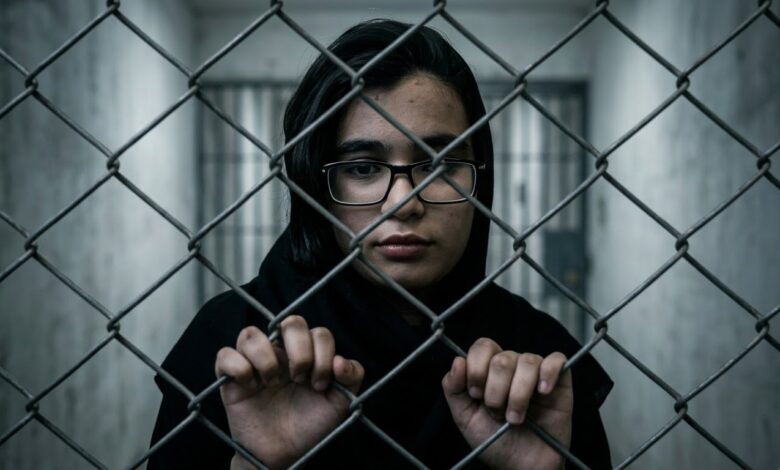
The death sentence of “Arghavan Falahi,” a political prisoner, has been confirmed by the Supreme Court of the Islamic Republic; a verdict that, following months of detention in Evin Prison’s security wards, multiple reports of pressure and torture to extract confessions, and a process that human rights organizations have deemed a violation of fair trial procedures, now places her at imminent risk of execution.
Arghavan Falahi, a young political prisoner held in Evin Prison, now faces serious danger of execution following the confirmation of her death sentence by the country’s Supreme Court. News of the verdict confirmation was released on August 21, 2026; the sentence was previously issued in June of this year by Branch 15 of Tehran’s Revolutionary Court, presided over by Abolqasem Salwati. The primary charge in the case has been labeled as “moharebeh” (armed rebellion against the state).
According to human rights reports, the court, citing Article 287 of the Islamic Penal Code, has brought the charge of “moharebeh” in connection with alleged membership in anti-government groups and armed activities. Reports have also indicated that security agencies attempted during interrogations to build a case against Falahi centered on allegations of her involvement in an alleged plot to assassinate two judges, “Mohammad Moghiseh” and “Ali Razini.” However, these allegations and case details cannot be independently verified through official judicial sources.
Published reports regarding Arghavan Falahi’s condition paint a disturbing picture of her detention and interrogation process. According to human rights reports, following her arrest in early 2025, she was transferred to security wards 209 and 241 of Evin Prison and spent months in solitary confinement under interrogation. Sources close to the case have reported severe physical and psychological pressure and attempts to extract forced confessions.
The Women’s Committee of the National Council of Resistance of Iran also reported that Falahi spent approximately five months in solitary confinement and was subjected to interrogation and physical and psychological torture during this period. These allegations have been raised by sources affiliated with opponents of the Islamic Republic.
However, concerns about her detention conditions are not limited to sources opposed to the Islamic Republic. Human Rights Watch, in August 2025, while reviewing the situation of prisoners following an Israeli attack on Evin Prison, also mentioned Arghavan Falahi and reported that she was held in Ward 209 and, following a prisoner strike, had only one brief contact with her family; according to that report, she had told her family that she was being held in a dark cell and did not even know where she was.
Arghavan Falahi’s current case is not her first experience with the Islamic Republic’s security apparatus. She was previously arrested during the “Woman, Life, Freedom” protests in 2022, alongside family members.
In that case, she was convicted by Branch 26 of Tehran’s Revolutionary Court, presided over by “Iman Afshari,” on charges including “assembly and conspiracy” and “propaganda against the system,” and sentenced to two years imprisonment. She was released after completing her sentence.
Now, just a few years after her release, a new case with a far more serious charge has resulted in a death sentence.
What makes Arghavan Falahi’s case increasingly troubling is not merely the issuance of a death sentence; it is the question of how a political case has led to an irreversible death penalty.
Human rights reports speak of prolonged periods of solitary confinement, restrictions on effective access to a lawyer, intensive interrogations, and allegations of forced confessions. Such allegations, if true, directly undermine the credibility of the trial process and the possibility of genuine defense for an accused.
Under such circumstances, the use of capital punishment for a political prisoner, particularly when security-related charges and allegations of forced confessions are involved in the case, is not merely an ordinary judicial decision; it is a serious test of the credibility of the Islamic Republic’s judicial system and its commitment to the most basic principles of the right to life and fair trial.
For a society that has witnessed the execution of protesters and political opponents in recent years, the confirmation of Arghavan Falahi’s sentence once again raises the concern that capital punishment can become a tool for the political elimination of dissidents.
From the perspective of human rights and also from the perspective of the fundamental Christian value of the sanctity of human life, taking a human life should be the final point of a completely transparent and fair judicial process, not the result of a case in which serious questions have been raised about interrogation methods, access to a lawyer, and the credibility of evidence.
Now that the Supreme Court has confirmed Arghavan Falahi’s death sentence, the opportunity to prevent a possible execution has become more limited than ever. The international community, human rights organizations, democratic governments, churches, and Christian leaders who speak for human dignity and the right to life cannot remain mere spectators in the face of such a case.
Arghavan Falahi is now not just a name on a list of political prisoners; she is a human being, approximately 25 years old, whose life faces an irreversible decision. The confirmation of the death sentence is not the end of a case; it is the beginning of a phase in which every day of silence can carry an irreplaceable cost.