20-Year Prison Sentence for “Mohammad Ebrahimi” and Arrest of University Professor; Crackdown on Protesters Continues
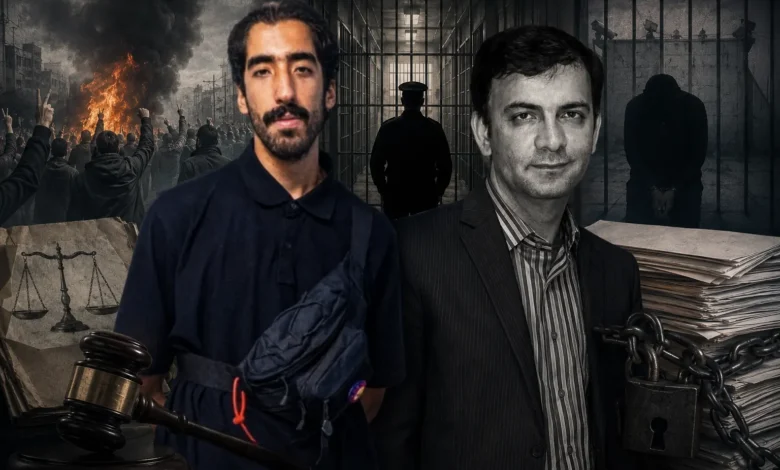
Nine months after the onset of protests in December in Iran, arrests, heavy sentences, and execution of punishments against protesters continue; from Mohammad Ebrahimi’s conviction to 20 years imprisonment in primary court to the recent arrest of Mahdi Saadoundi, a professor at Isfahan University of Art, these cases signal the continuation of the Islamic Republic’s security policy to suppress protests and create a climate of fear in society.
While approximately 9 months have passed since the widespread protests of December 1404 (late December 2025) in Iran, the cases of protesters remain open within the Islamic Republic’s security and judicial apparatus, and new reports of arrests, heavy sentences, criminal convictions, and executions are released daily.
The protests that began in December 1404 (late December 2025) and quickly spread to various Iranian cities faced extensive suppression by security forces. Now, months after the streets have quieted, judicial action against protesters and critics continues; an issue that critics of the government view as part of a policy of creating fear and social deterrence.
One of the latest examples is the case of “Mohammad Ebrahimi,” a graduate of painting from the University of Science and Culture. According to human rights organizations, Ebrahimi, who was arrested during the December protests, was sentenced to 20 years imprisonment in Branch 26 of Tehran’s Revolutionary Court under the presiding judge “Iman Afshari.” The charge against him was stated as “operational activities for a hostile country and against national security.”
Ebrahimi was arrested on January 27, 2026, in Tehran and after transfer to Evin Prison, was moved to Tehran’s Greater Prison; where according to human rights reports, he is serving his sentence.
However, regarding the final fate of his sentence, a distinction must be made between the primary ruling and the appellate stage. Iran International reported that Ebrahimi’s initial 20-year sentence was reduced to 15 years in the appellate court. Therefore, the 20-year figure refers to the primary sentence from the Revolutionary Court, and the latest published report from the appellate stage indicates 15 years imprisonment.
However, Ebrahimi’s case is not the only example of this wave. In the most recent case, “Mahdi Saadoundi,” a faculty member of the Architecture Department at Isfahan University of Art, was arrested on August 25 (3 Shahrivar) following a security force raid on his residence. According to reports, Saadoundi, who holds a doctorate in architecture from Shahid Beheshti University and has been a faculty member and professor at Isfahan University of Art since 2009, was transferred to an unknown location following his arrest. At the time of report publication, neither the detaining agency, nor the charges, nor his place of detention had been specified.
The arrest of a university professor under circumstances where no information about the reason has yet been released presents a picture of the continuation of the security environment in Iran; an environment whose scope has not been limited to protesters present on the streets but in various cases has encompassed civil activists, academics, artists, and critics.
In recent days, reports from Hengaw have also covered other cases of arrests and execution of sentences. This human rights organization, in its list of recent news, reported the execution of 9 prisoners in six Iranian prisons, execution of other prisoners’ sentences, as well as new arrests in various provinces.
The Hrana news agency has also recently reported on the issuance of death sentences for some of those arrested during the December protests and the execution of heavy sentences against protesters. The collection of these reports shows that the end of widespread protester presence on the streets did not mean the end of the government’s treatment of them.
What has been most criticized by human rights activists during this period is the continuation of criminal prosecution of protesters rather than addressing their social demands. In such an approach, the arrest of a protester, the issuance of a lengthy prison sentence, a death sentence, or execution of a sentence can go beyond punishing an individual and become a message to others: protest will carry a heavy price.
This is what critics of the Islamic Republic’s security policies refer to as “rule through fear”; a policy whose objective is not merely punishing the arrested individual, but creating deterrence among families, students, workers, artists, academics, and other social groups.
From this perspective, the continuation of issuing heavy sentences months after the end of street protests shows that the file of December protests remains a security matter for the government.
The case of Mahdi Saadoundi, alongside the sentences issued for protesters, raises another question: has the security environment created following the protests also expanded into academic and scientific spheres?
In Saadoundi’s case, the official reason for his arrest or judicial charge against him has not yet been announced, and one cannot judge without more information about the cause of his arrest. However, the arrest of a faculty member at his residence and his transfer to an unknown location without disclosure of his place of detention raises serious concerns about the defendant’s rights and legal proceedings.
Meanwhile, the history of security treatment of academics and students during and after the December protests has made each new arrest in the university environment followed with greater sensitivity.
The December protests were not merely a wave of street protest for the government; the Islamic Republic viewed them as a security threat and in response, employed extensive security and judicial tools.
However, the continuation of this process after months have passed raises a serious question about the effectiveness of such a policy. If the goal of heavy sentences is to end protest and restore stability, the continuation of arrests and issuance of new sentences shows that the social issue behind the protests remains unresolved.
In such circumstances, imprisonment, execution, and long-term sentences may be able to silence street protests for a time, but cannot necessarily eliminate dissatisfaction, mistrust, and social demands.
On the other hand, execution of heavy sentences can further polarize society and make the public space more securitized; especially when families of protesters are engaged for months in legal cases and concerns about the fate of their loved ones.
The case of Mohammad Ebrahimi and the arrest of Mahdi Saadoundi are two different examples of the situation seen in Iran today: a protester who months after arrest faces a heavy judicial sentence and a university professor who without formal announcement of charges was arrested at his home and transferred to an unknown location.
These cases, alongside multiple reports of executions and heavy convictions, present a picture of a policy that rather than solving the roots of protest, relies on punishment and creating costs for opponents and critics.
Nine months after the December protests, the fundamental question remains: can the government silence protest forever through imprisonment, death sentences, and creating fear?
Experience from recent protests in Iran has shown that repression can empty the streets for a time, but does not necessarily eliminate dissatisfaction from society. When the response to social demands is arrest and punishment, what disappears is not necessarily protest, but public confidence in the possibility of reform and the ability of citizens’ voices to be heard.