“Yegane Hosein-Zayi,” Victim of Child Marriage, Murdered by Her Husband
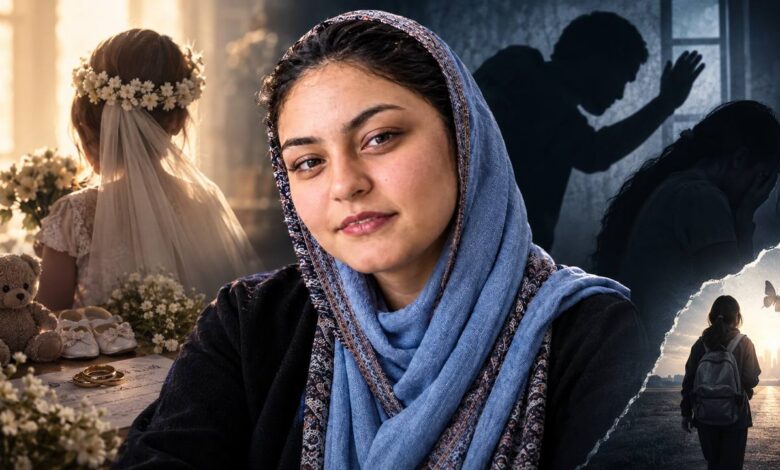
Yegane, a girl who was betrothed at age ten and married at fourteen, was killed by her husband at sixteen. The death of Yegane Hosein-Zayi is not merely a criminal case; it is a cry of protest against child marriage, domestic violence, and a structural system that continues to deny children the right to choose, to be safe, and to have a future.
“Yegane Hosein-Zayi,” a sixteen-year-old girl from Bakharz County in Razavi Khorasan Province, was killed by her husband on Friday, October 17 (September 9 in the Islamic calendar). This horrific crime once again exposes the deadly consequences of child marriage and the vulnerability of girls who, before reaching adolescence, are thrust into conjugal life and power dynamics they neither chose nor could necessarily escape. Crimes that sometimes remain hidden for years, with their reality never brought to light.
According to reports from the Hengaw Organization for Human Rights and accounts citing local sources, Yegane died as a result of blows from a club and a stick, as well as asphyxiation. She was transferred to the roadside emergency clinic showing no vital signs; her clothes were muddy and severe injury marks were visible on her body. Her husband was arrested and has confessed to the murder. The motive for this crime has not yet been officially disclosed.
But perhaps the most disturbing aspect of this case is not merely how Yegane died, but the life that was denied to her from childhood itself: she had been betrothed to her cousin at age ten and married at fourteen. Ten years old is an age for play, learning, friendship, and dreaming—not an age to enter into a commitment that can permanently alter a child’s fate and safety. Yet in a structure that enables child marriage, childhood can become not a period of growth and protection, but the beginning of years of deprivation and harm.
When a girl enters marriage as a child, the issue is not merely a contract or legal registration. The issue is power inequality, the restriction of choice, deprivation of opportunities for independent development, and the placement of a child in a situation where she may be unable to defend herself against violence or escape from a dangerous relationship. Child marriage is not inherently a guarantee of violence, but it can intensify a child’s vulnerability and make the consequences of violence more deadly.
Yegane’s murder poses a merciless question before society and those in power: Why should a girl who has not yet reached eighteen have been betrothed and married years before that? Who defended her right to a safe childhood? What mechanism should have prevented marriage at such a young age, and why was this child not afforded effective protection before becoming a victim of this crime?
Direct responsibility for Yegane’s murder lies with the individual who committed this crime; however, investigation of this case must not be limited to the arrest of the accused and criminal prosecution. A society in which child marriage remains possible must also be held accountable for the responsibility of families, legal institutions, and the government, which have a duty to protect children.
Article 1041 of Iran’s Civil Code permits the marriage of girls under thirteen with the permission of their guardian and the determination by the competent court regarding the protection of the child’s interest. Rather than establishing a clear and absolute prohibition on child marriage, this legal framework has left room for exceptions. The fundamental question is: How can one speak of “the child’s interest,” when the law permits the marriage of a ten-year-old girl—a child who has not yet developed the capacity for independent decision-making regarding many aspects of her own life?
A government that claims to protect the family and morality cannot overlook this contradiction. Protection of the family, without guaranteeing the safety and rights of each of its members, is an empty slogan. No tradition, consideration of interest, or legal authorization should serve as an excuse for ignoring a child’s right to safety, development, education, and a future.
The death of Yegane Hosein-Zayi must not be reduced to a brief news report about a “family dispute” or a “tragic accident.” Behind this name lie questions about child marriage, violence against women and girls, insufficient protection of children, and laws that must be reviewed to safeguard the most vulnerable members of society.
As long as child marriage is not stopped, as long as child protection does not become a real and effective mechanism, and as long as domestic violence is not taken seriously, other girls may find themselves in situations where escape and protection are difficult. Preventing such tragedies is not possible merely through expressions of sympathy after victims die; it requires an effective ban on child marriage, independent social and legal support, serious investigation of violence reports, and accountability from responsible institutions.
Yegane should have had the opportunity to live; the opportunity to grow, to choose, and to build a future for herself. She should not have become a victim of deadly violence at sixteen. A society that deprives its children of their childhood cannot rely solely on mourning after their death. Justice for Yegane means transparent and fair investigation of her murder case and prevention of this tragedy from repeating itself—that is, putting an end to child marriage and placing children’s safety and rights above any tradition, interest, or legal justification.