Calls for Justice for Iran’s Enforced Disappearances: From Stockholm to Tehran
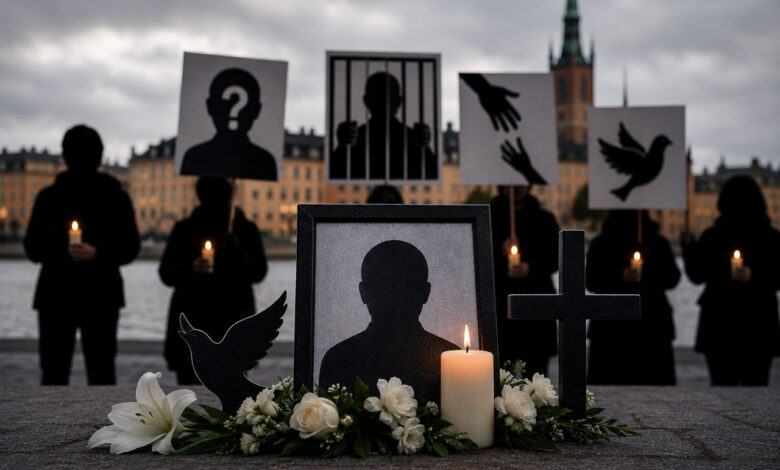
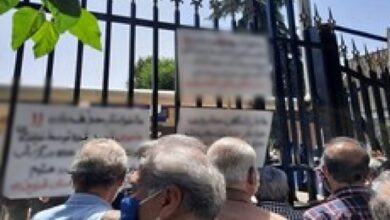
On the eve of the International Day of Victims of Enforced Disappearances, a report has been published about a gathering of Iranian Christians in Stockholm; an assembly said to have been held in protest against the enforced disappearances of opponents of the Islamic Republic and to keep alive the memory of victims such as “Saeed Zinali.”
A report has been published about a gathering of Iranian Christians in Stockholm, coinciding with the International Day of “Victims of Enforced Disappearances.” The assembly is said to have been organized with the aim of commemorating victims of enforced disappearances in Iran and protesting the policies of the Islamic Republic. However, independent source verification has not yet found a separate report of this gathering on August 30, 2026, and the available evidence indicates a very similar narrative was previously published in 2023.
According to this narrative, participants, referring to individuals whose fate has remained unknown to their families following arrest or abduction, emphasized the necessity of seeking justice and preventing these cases from being forgotten. In fact, a very similar narrative had been previously published on August 30, 2023, on the website “I Am Also a Christian.” That report also discussed a gathering of Iranian Christian citizens in Stockholm on the occasion of the International Day of Victims of Enforced Disappearances, and the gathering location was identified as “Mynttorget.” For this reason, without fresh evidence, one cannot republish all the details of the text published about the 2026 gathering, including the venue at Stockholm Central Railway Station, as verified fact; however, the occasion itself is completely documented.
The United Nations has designated August 30 as the “International Day of the Victims of Enforced Disappearances,” a day aimed at raising awareness about the fate of individuals who, in many countries, following arrest or abduction, have been deprived of legal protection and whose place of detention or fate is hidden from their families. UN documents emphasize that enforced disappearance is prohibited under international law and can constitute a crime against humanity under certain circumstances.
The UN Secretary-General also stated in a message about this phenomenon that enforced disappearance continues to be used worldwide as a method of suppression, instilling terror, and silencing opponents.
Under such circumstances, the issue of enforced disappearances is not limited to the fate of one individual; the family of the disappeared person also remains in a state of uncertainty for years, not knowing whether their loved one is alive, where they are being held, or what has become of them.
One of the most well-known cases of enforced disappearance in Iran is that of “Saeed Zinali.” Zinali, a Tehran University student, was arrested in July 1999 following student protests in June 1999. His family has received no reliable information about his fate since then.
According to a report published by the National Council of Iranian-Americans about his case, Saeed Zinali’s name has been included in the list of enforced disappearances by the UN Working Group. His family has made numerous attempts over the years to find any trace of him and obtain answers about his fate, but to no avail.
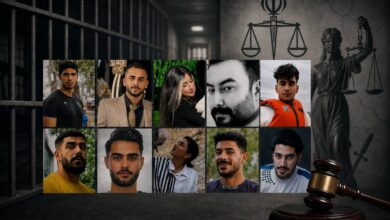
Zinali’s case is not merely a personal one; it is a symbol of hundreds and thousands of cases in which families have lived for years with an unanswered question: “Where is our loved one?”
In the 2023 report, the website “I Am Also a Christian” also included Saeed Zinali as one of the figures remembered at the gathering of Iranian Christian citizens in Stockholm.
From a human rights perspective, enforced disappearance is not merely the deprivation of an individual’s freedom; it is an act that simultaneously violates the rights of both the disappeared person and their family.
In its investigations regarding Iran, Amnesty International has considered the concealment of victims’ fates and the location of their burial sites, particularly in connection with the executions of the 1980s, as instances of enforced disappearance. The organization has also emphasized that the suffering and uncertainty imposed on families can itself constitute a form of cruel and inhuman treatment.
The Iran Human Rights Organization, in its investigations regarding enforced disappearances in Iran, has also noted that this phenomenon has a long history and, due to restrictions on media freedom and the lack of independent investigation capacity, precise statistics on the number of victims in Iran are not available.
In a report on following up cases of enforced disappearances, the organization emphasized that registering these cases with UN mechanisms is important, because even when the government refuses to be accountable, the registration of victims can keep their cases alive in international processes.
If the narrative concerning the 2026 gathering in Stockholm is ultimately confirmed by independent evidence, its significance will not be limited to holding a protest demonstration outside Iran. Revisiting the cases of enforced disappearances is, in fact, a reminder of the reality that governments can instill fear in families and society by concealing the fate of one person.
A person disappears, but the question remains. The family waits, the next generation repeats his name, and the case that the government wants to be closed and forgotten is placed before the public again. This is why seeking justice for the disappeared is not merely an effort to find one person; it is an effort to restore truth to society.
Regarding Iran, cases like Saeed Zinali demonstrate that the passage of time does not necessarily mean the end of a case. Twenty-seven years have passed, but the Zinali family’s question remains unresolved. Until these questions are answered, the names of Saeed Zinali and other Iranian enforced disappearances will remain part of the living memory of the search for justice.
If the recent Stockholm gathering is also confirmed with independent documents and images, it can be seen as a continuation of the same effort to keep this memory alive; an effort that seeks to remind the Islamic Republic that making a human disappear does not mean making truth disappear.