Fresh Pressure from London and Washington on Tehran; Iran’s Airspace Also Comes Under Sanctions
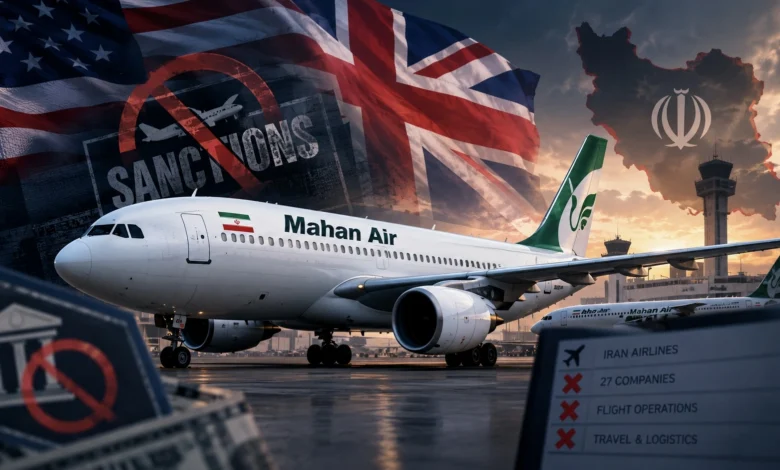
Britain and the United States, in a coordinated move, have increased economic and transportation pressure on the Islamic Republic. London, through new regulations, is restricting Tehran’s access to the British financial system, trade in certain goods, technologies, and the operation of Iranian aircraft on its territory, while Washington has sanctioned 27 Iranian airlines and a network of foreign intermediaries. These measures demonstrate that the scope of Western pressure on Iran’s government has extended beyond oil and financial affairs to reach the aviation industry and its supporting channels.
The British government has released new regulations to intensify sanctions against the Islamic Republic, regulations that simultaneously target Iran’s financial, commercial, energy, maritime, and aviation sectors.
According to the official announcement by the British government, the new restrictions make it more difficult for Iran’s government to access this country’s financial system, and the commercial prohibitions also extend to a broader range of goods, technologies, and services. These restrictions cover sectors such as energy, software, metals, gold, maritime shipping, insurance, and banking services.
One of the most important aspects of these regulations pertains to the aviation industry. Under the new laws, Iranian aircraft will no longer be permitted to land in Britain, except in cases where they fall under specific exemptions. The British government has also stated that it will have greater authority to target vessels that, in London’s view, play a role in the Islamic Republic’s nuclear program or destabilizing activities.
This measure has been taken under circumstances where the British government says its aim is to prevent the advancement of the Islamic Republic’s nuclear program and to limit the government’s ability to secure the financial resources and technology needed for this program.
London has also stated that the new restrictions are part of the return of a set of sectoral sanctions against Iran following the activation of a mechanism known as “snapback,” a process that Britain, France, and Germany pursued in connection with concerns about Iran’s nuclear program.
However, concurrent with Britain’s measures, Washington has also increased its pressure on Iran’s aviation industry in an unprecedented manner.
The U.S. Treasury Department announced on September 8 that it has targeted 36 individuals and entities related to Iran’s aviation sector for sanctions. Among them are 27 Iranian airlines sanctioned under executive order 13902.
The sanctions list is not limited to Iranian companies. The United States has also targeted companies and intermediaries in third countries that, according to Washington, have played a role in supplying aircraft, parts, and sensitive technologies to Iran.
The U.S. Treasury Department claims that the Islamic Republic has used a network of shell companies, foreign intermediaries, and indirect commodity transfer routes to obtain American-made aircraft and aviation-related equipment.
At the center of this action is the name “Mahan Air,” a company that has been under U.S. sanctions for years, and Washington accuses it of cooperating with the Islamic Revolutionary Guard Corps and transferring personnel, equipment, and weapons.
The U.S. Treasury also targeted a network of companies and sales representatives in several countries in July for supporting Mahan Air’s activities, claiming that this company plays a role in the transfer of military equipment and support for Revolutionary Guard operations.
In the new sanctions, Washington has also announced that it has targeted foreign networks used to supply American-made aircraft and sensitive aviation parts. According to the Treasury Department’s claims, Mahan Air received at least three Boeing 777 aircraft in the summer of 2026 through a network of companies and intermediaries in third countries.
The United States has also sanctioned several companies based in the United Arab Emirates, Turkey, Malaysia, and other countries for what it describes as assisting Mahan Air’s operations and supplying equipment to Iran.
Alongside the sanctions, the U.S. Office of Foreign Assets Control, known as OFAC, has also suspended certain previous licenses related to Iranian aviation. These include licenses for the re-export of certain civilian aircraft to Iran and related transactions. However, Washington has stated that it will continue to review requests related to aviation safety on a case-by-case basis.
Simultaneously, the Treasury Department’s Financial Crimes Enforcement Network, FinCEN, has requested that financial institutions identify procurement and supply networks related to Iran’s aviation industry and report suspicious activities in this area. This measure effectively extends the scope of pressure from sanctioned companies to banks and international financial institutions.
U.S. Treasury Secretary Scott Besen has warned in response to these measures that companies assisting sanctioned Iranian airlines may face the risk of losing access to the global financial system. The U.S. Treasury Department has introduced these measures as part of a program called “Operation Economic Outcast.”
Iran’s aviation industry has faced serious difficulties for years as a result of sanctions in terms of supplying aircraft, spare parts, and required technologies. However, from the perspective of the U.S. government, part of this industry is no longer merely a civilian transportation network, and some companies and associated channels are used for transferring personnel, military equipment, and cargo that Washington considers illegal or related to the Islamic Republic’s military activities.
For this reason, the new sanctions have not only targeted airlines themselves; rather, they have targeted a network that includes intermediary companies, transportation services, sales representatives, supplier companies, and financial and commercial channels related to them.
This approach shows that the U.S. strategy toward the Islamic Republic is moving toward closing the paths used to circumvent sanctions; that is, instead of merely sanctioning a single Iranian company, the network that enables that company’s continued operations is also targeted.
On the other hand, Britain’s measures demonstrate that European pressure has not remained limited to political statements. London’s new regulations have expanded financial and commercial restrictions and simultaneously impact the transportation and aviation sectors.
The escalation of sanctions carries a clear message for the Islamic Republic: the use of opaque networks, intermediary companies, and hidden channels to secure resources and technology will carry greater costs.
However, sweeping sanctions can have consequences beyond the governmental structure. Iran’s aviation industry is directly connected to the lives of millions of passengers, commerce, tourism, family relocation, and Iran’s connection with the world. Restrictions on access to aircraft and parts can also place greater pressure on Iran’s aging fleet.
For this reason, the boundary between pressure on the government and harm to society will be a determining factor in evaluating the new sanctions.
However, primary responsibility lies with the government, which over the past decades, through controversial nuclear policies, support for regional armed groups, and the creation of hidden networks to circumvent international restrictions, has exposed Iran to increasingly severe sanctions.
Now London and Washington say they intend to restrict this network further than before; from banks and insurance to ships, aircraft, parts, and intermediary companies.
In fact, the message of the new sanctions is not merely that several Iranian companies have been placed on a blacklist. The larger message is that the international channels used by the Islamic Republic to secure financial resources, technology, and equipment are becoming tighter.
However, the experience of recent years has also shown that sanctions alone do not necessarily lead to changes in government behavior. The Islamic Republic has repeatedly attempted to circumvent economic pressure by creating shell companies, rerouting commodity transfers, and using foreign intermediaries.
The new American and British sanctions are now precisely targeting these intermediary links. How much this policy can reduce Iran’s government’s ability to finance its controversial programs will become clear in the coming months; but what is clear now is that Western pressure on Tehran has entered a broader phase, and Iran’s aviation industry has also become one of the main theaters of this confrontation.