Iranian Women Are Running; Freedom No Longer Stands Behind Walls of Coercion
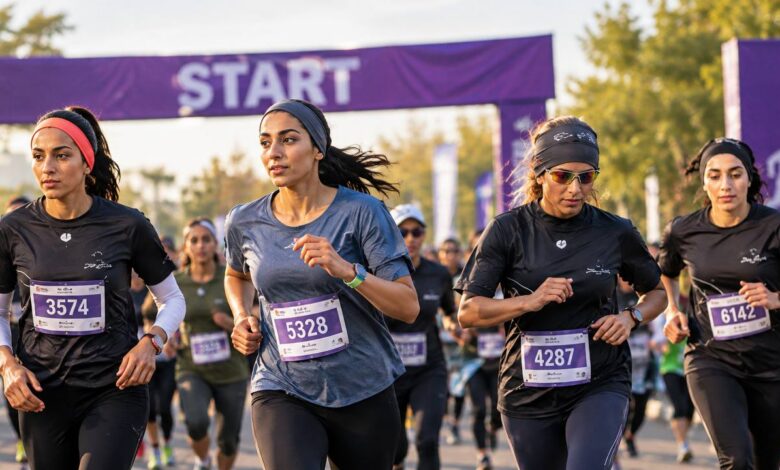
Friday morning, September 27th, Tehran’s 10-kilometer race took place in Valiasr Park, and the presence of women without mandatory hijab once again exposed the gap between the Islamic Republic’s imposed laws and the reality of people’s lives. Four years after the killing of Jina Amini, and at a time when the government continues to suppress opponents and critics, Iranian women demonstrate through their choice of clothing that social freedoms cannot be eliminated through law, threats, and prosecution.
Tehran’s 10-kilometer race took place Friday, September 27, 1405, in Valiasr Park. The official website of the event announced that the race was held in two categories for women and men, with hundreds of people registering to participate.
However, images and reports published from Tehran’s social sphere place this event beyond a mere sporting competition.
In recent years, the presence of women without mandatory hijab in streets, cafes, universities, parks, and public events has become a more widespread phenomenon; a phenomenon that the Islamic Republic government, despite threats, arrests, fines, closure of establishments, and prosecution, has been unable to completely stop. The Associated Press also reported, coinciding with the fourth anniversary of Jina Amini’s death, on the increase in the presence of women without headscarves in Tehran and the government’s practical retreat from strict enforcement of hijab laws in some situations.
Four years have passed since the death of Jina (Mahsa) Amini in the custody of the morality police; a 22-year-old girl whose death sparked the widespread protest movement “Woman, Life, Freedom” over the hijab issue.
Those protests faced severe suppression; hundreds were killed and thousands were arrested. Nevertheless, one of the most significant changes that occurred in Iranian society afterward was a change in women’s social behavior toward mandatory hijab. Many women are no longer willing to choose their clothing according to government orders.
This change is not only visible in Tehran’s streets. Women without headscarves can be seen in various cities across Iran; at a time when the government still considers hijab legally mandatory and conservative officials have repeatedly demanded the return of strict enforcement measures.
This change takes on greater meaning when we recall the government’s approach to women’s sporting events in past years.
In running competitions, restrictions related to gender segregation and hijab have repeatedly become a point of contention. The Human Rights Center in Iran had previously reported on Tehran’s first international marathon, noting that the routes for women and men were separated, and this decision was met with protests from some female runners.
Women are no longer just protesting about their clothing choices; they are living in public spaces, exercising, running, working, and in many cases refuse to seek government permission for their social presence.
The Islamic Republic has spent four decades attempting to make the hijab not merely a religious choice, but rather part of its desired social and political order. However, the experience of the past four years has shown that a deep gap has formed between the government’s formal law and the behavior of a large segment of society.
On one hand, government officials continue to demand mandatory hijab and conservative media present unveiled women as a “security threat”; on the other hand, even in Tehran and in public spaces, more women appear without headscarves. The Associated Press reported that some government officials, amid war, sanctions, and economic crisis, are concerned that stricter measures on hijab could trigger new protests.
This situation shows that the issue is no longer merely about the hijab; the issue is about the right to choose and the right to live without the government’s forced interference in the most intimate aspects of people’s lives.
This occurs at a time when Iranians face heavier crises; from economic pressure and reduced purchasing power to the consequences of war, sanctions, political suppression, and concerns about the future.
In such circumstances, a running race may at first glance seem like a simple, everyday occurrence; but the presence of women in public spaces through their choice of clothing shows that people’s social life has not come to a halt.
The government can arrest a protester, summon an activist, prosecute a critic, and punish a woman for her clothing; but controlling the behavior of millions of people in all moments of life is not easy, even for a security-focused government.
The image of a woman putting on running shoes early in the morning and leaving home to run may be completely ordinary in any other country, but in Iran, this very image can be a reminder of a larger social struggle; a struggle that entered a new phase after Jina Amini.
Iranian women have paid a heavy price over the past four years for their personal choices; from arrests and summons to deprivation of services and legal pressures. Yet many of them continue to resist the government’s imposition of a lifestyle.
For a society dealing with economic crisis, political suppression, and security pressures, this insistence on normal life carries important meaning. Women running in Tehran may be just a race, but when a woman can exercise in a public space without fear of forced hijab imposition, it shows a different image of a society that the government has not yet managed to fully control in all its choices.
Four years after Jina, Iranian women continue to run, and perhaps more importantly than reaching the finish line, it is that they are still unwilling to abandon their path of choice and freedom.