IRGC Spokesman Reports Possibility of U.S. Military Attack and Iran’s More Advanced Weapons
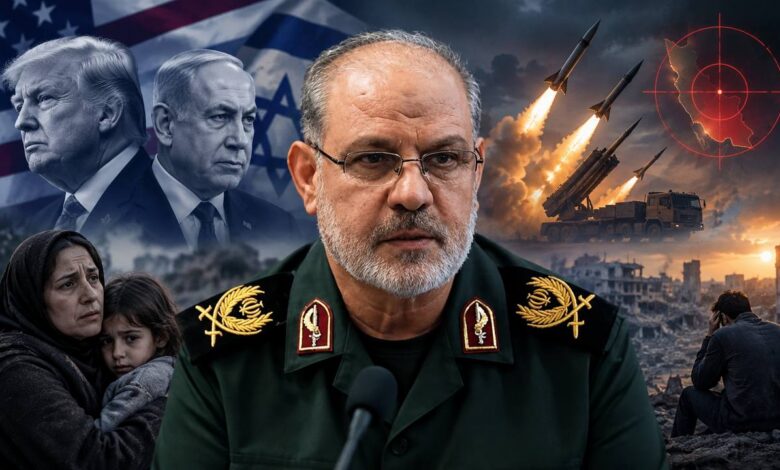
While Iran’s people continue to grapple with the consequences of war, economic pressure, and an uncertain future, the spokesman for the Islamic Revolutionary Guard Corps has once again spoken of the possibility of a U.S. military attack, claiming that the Islamic Republic has acquired more advanced weapons. Meanwhile, reports suggest conversations between Donald Trump and Benjamin Netanyahu about the possibility of resuming attacks. Amid Tehran’s military threats and the political calculations of Washington and Tel Aviv, it is the Iranian people who may once again find their security, lives, and livelihoods at risk.
Hossein Mohby, spokesman for the Islamic Revolutionary Guard Corps, on Wednesday, October 22 (October 14), in an interview with Islamic Republic of Iran Broadcasting, did not rule out the possibility of another U.S. attack on Iran. He said that starting a new war would be illogical for Washington, but claimed that the Trump administration might need a achievement before the U.S. midterm elections.
Mohby also claimed that the Islamic Republic used mostly older generation weapons in the 40-day war and has since acquired much more advanced weapons—a claim for which he provided no details about the type of weapons, the time of acquisition, or verifiable evidence.
These statements come as Donald Trump announced on October 8 that America would not attack Iran before the November 3 midterm elections. However, an October 13 Axios report citing American and Israeli sources indicates that Trump and Netanyahu have discussed the possibility of resuming military operations against Iran. According to the same report, Trump initially showed interest in this option but later became more cautious. Therefore, Trump’s public statements and reports of behind-the-scenes consultations present a picture of a changing and uncertain situation—neither a guarantee of peace nor confirmation of a final decision to attack.
The IRGC spokesman speaks of acquiring more advanced weapons but does not explain what these weapons are exactly, when they were obtained, or what independent evidence exists to evaluate this claim. At a time when the possibility of renewed conflict is being discussed, such statements without measurable information do more to add to confusion and concerns than to clarify the situation.
If the military capability of the Islamic Republic has indeed increased, important questions arise about the nature of this capability, the cost of its development, and its potential consequences. If, on the other hand, the purpose of these statements is deterrence and a show of strength, one must still ask whether repeating threats and military promises, without providing clear information, increases the security of the people or raises the risk of miscalculation and heightened tensions.
The Iranian people deserve access to accurate information about decisions that may turn their lives upside down, not to be informed only through military speeches and unproven claims about their future.
When politicians calculate about elections, people face the risk of war. According to the Axios report, the possibility of renewed military operations against Iran was discussed in talks between Trump and Netanyahu. The report also refers to Netanyahu’s concerns about Iran rebuilding its nuclear capability. Meanwhile, Trump has publicly stated that no attack will take place before the U.S. midterm elections.
This apparent contradiction between public positions and reported consultations shows that the statements of any political official should not be taken alone as a guarantee of the future. Military decisions may be influenced by security calculations, nuclear negotiations, and domestic considerations of countries, but their consequences are not limited to decision-making rooms.
For the Iranian people, war is not an abstract discussion about power and deterrence. Any potential attack could damage infrastructure, power grids, transportation, communications, medical centers, and economic activity. Even without a new attack, continued tensions could exacerbate economic uncertainty and make life harder for families already under pressure.
Mohsen Rezaei had earlier threatened that if there were another U.S. attack, the forces of the Islamic Republic would target cables, data centers, and artificial intelligence facilities in the Middle East. Such threats extend the scope of danger beyond military battlefields and increase concerns about infrastructure that millions of people depend on for daily services, communications, and economic activity.
Any attack on civilian infrastructure could have consequences far beyond military calculations. Iranian civilians and people in other countries in the region should not bear the cost of competitions and military decisions by losing security, essential services, and economic opportunities.
The Iranian government must clarify what the purpose of such threats is and what mechanisms have been put in place to prevent harm to civilians and vital infrastructure. Mutual threats, by themselves, are not a strategy for protecting the people—especially if they lead to an increased likelihood of wider conflict.
One of the fundamental questions that receives little attention amid military threats is the human and economic cost of war. Ordinary citizens are neither present in the secret negotiations of Washington and Tel Aviv nor do they play a direct role in Tehran’s military decisions; yet if the conflict expands, they may be among the first whose lives are harmed.
People struggling to afford food, medicine, rent, and daily necessities have the right to know what plan the government has to protect the lives of citizens, ensure the continuation of essential services, and prevent further economic collapse in the event of war. Is there a clear plan to protect civilians? Have the potential costs of a new conflict and ways to reduce them been explained to the people? And is diplomacy and ways of reducing tensions being pursued with the same seriousness as discussing military power?
These are not marginal questions; they are part of every government’s responsibility to its people, whose security and lives depend on its decisions.
The security of the people must take precedence over displays of power and political calculations. Neither claims of acquiring advanced weapons alone guarantee security, nor can a foreign president’s promise to refrain from attack alone make the future certain. What matters is reducing the risk of war, transparency about sensitive decisions, and accountability for their consequences.
The Islamic Republic, instead of merely making threats and displays of power, must explain the military costs, strategic objectives, and plans to protect citizens. At the same time, America and Israel must take seriously the human and regional consequences of any possible military action. Lasting security is not achieved through endless escalation of threats, but through decisions that prevent the expansion of war and keep the path of diplomacy open.
The Iranian people should not become powerless spectators to decisions that may endanger their homes, futures, and lives. The main question is not which side issues higher threats; the question is who takes responsibility for preventing war, protecting civilians, and being accountable for the costs of this crisis?