Prince Reza Pahlavi After Visiting Auschwitz: “Heirs of Cyrus Stand With the Jewish People”
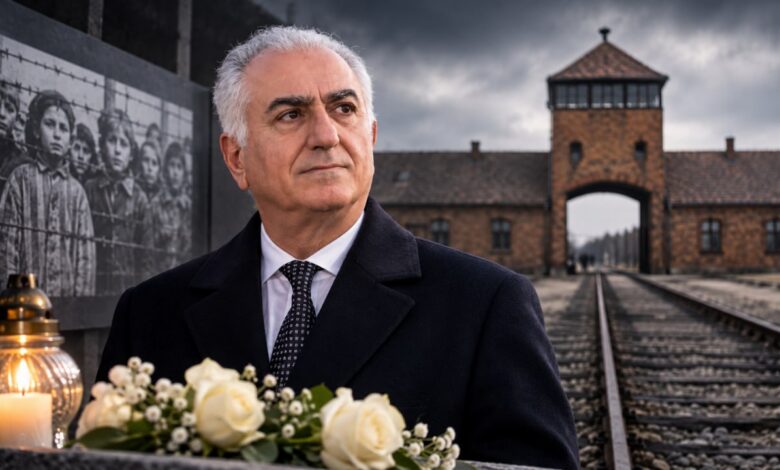
Prince Reza Pahlavi, following his visit to the Auschwitz-Birkenau concentration camp in Poland, described the Holocaust as an unparalleled crime in history in a message and stated that the heirs of Cyrus stand with the Jewish people. Referring to the Islamic Republic’s denial of the Holocaust and the suppression of citizens in Iran, he emphasized that the government in Tehran does not represent the Iranian nation, and the Iranian people are fighting for life and freedom.
Reza Pahlavi, on Wednesday, November 11 (November 20 in the Iranian calendar), after visiting the Auschwitz-Birkenau concentration camp in Poland, published a statement on his official social media accounts, describing the visit as a “horrifying and shocking” experience.
In this message, he wrote that he, along with his wife Yasmin Pahlavi, visited different sections of the camp, including the area where victims’ belongings were kept, gas chambers, and crematoriums. Prince Pahlavi, referring to the shoes and suitcases remaining from victims, wrote: “Every shoe and suitcase was a reminder of a human being who had a name, a family, and a life.”
He described the Holocaust as an industrial-scale crime that was designed and organized with the precision and efficiency of a bureaucratic apparatus, and considered Auschwitz and Birkenau as clear evidence of this crime.
A significant portion of Reza Pahlavi’s message was devoted to the connection between the history of the Holocaust and the current situation in Iran. He wrote that during his visit to the camp, he thought of the Iranian people; people who, according to him, face a government that denies the Holocaust and simultaneously attempts to erase the massacre of fellow citizens from the world’s memory through internet shutdowns, censorship, and secret executions.
Reza Pahlavi further emphasized: “But the Islamic Republic does not represent Iran. The heirs of Cyrus stand with the Jewish people, and while the regime pursues death and destruction, the Iranian nation fights for life and freedom.”
He also announced that he had placed a wreath bearing the symbol of the lion and sun at the Holocaust victims’ memorial site, stating that this wreath was presented on behalf of the Iranian nation.
At the end of his message, Prince Pahlavi emphasized that he will not allow the Islamic Republic government to turn the name and history of Iran into a tool of hatred, and expressed hope that a free Iran will once again be a symbol of peace, life, and human dignity.
This visit took place during Reza Pahlavi and his wife’s trip to Poland at the invitation of the Association of Jews in Europe. According to reports published about this trip, he received the “King Solomon” award from the association at a ceremony in Krakow on November 9, and on the same day, he visited the Auschwitz-Birkenau complex along with Yasmin Pahlavi and Rabbi Menachem Margolin, the president of the Association of Jews in Europe.
This trip and visit to the concentration camp was part of programs aimed at honoring victims of the Holocaust, countering denial of this crime, and emphasizing the necessity of combating antisemitism.
The Auschwitz-Birkenau concentration camp is one of the most important symbols of Nazi Germany’s crimes during World War II. According to statistics from the Auschwitz Museum and Memorial, approximately 1.1 million people were killed in this complex, with nearly one million of them being Jewish. Other victims also included Poles, Roma and Sinti Gypsies, Soviet prisoners of war, and other groups who were targeted for persecution and murder by the Nazi regime and its collaborators.
The visit to this historical site has once again drawn attention to the importance of recording and preserving historical truth, countering genocide denial, and safeguarding human dignity.
Reza Pahlavi’s message at Auschwitz, in addition to paying tribute to Holocaust victims, emphasized a political and historical distinction: the distinction between the Iranian people and a government that speaks in the name of Iran. Emphasizing that the identity and history of a nation should not be conflated with the policies of a government was a central part of his message. By recalling the name of Cyrus and the historical connection between Iranians and Jews, he presented an image of an Iranian who stands against hatred and antisemitism, and links his future to peace, freedom, and human dignity.