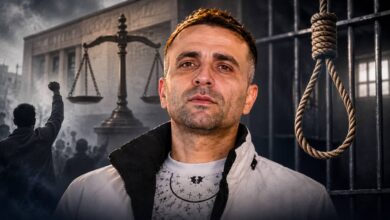
“Tayeb Rostami,” a Porter Shot Dead by Direct Gunfire for His Family’s Bread
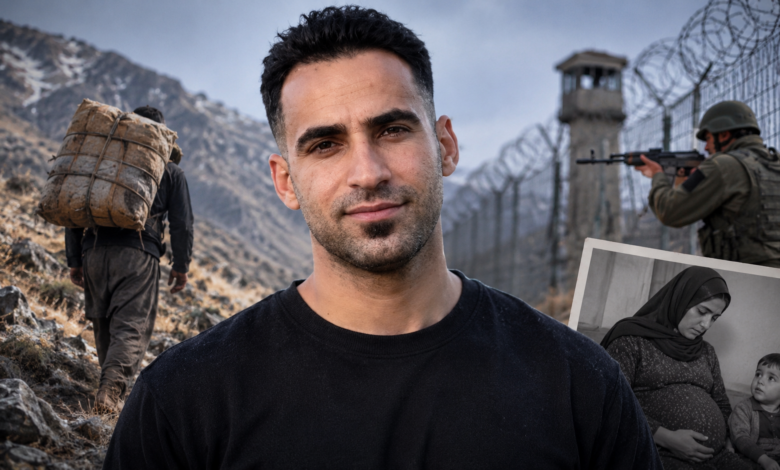
Tayeb Rostami, a 34-year-old porter from Baneh and father of one child, was killed on Saturday morning, November 14, by direct gunfire from border guards in the Surkiyou area. His wife was pregnant at the time. Reports indicate that officers fired at him from close range without prior warning—an incident that once again raises a harsh and fundamental question about the government’s policy toward porters: why do people driven by poverty and lack of employment opportunities to resort to smuggling for survival receive bullets in response?
According to published reports, Tayeb Rostami, 34 years old from Baneh, was targeted by Islamic Republic border guard forces in the “Surkiyou” border area on the morning of Saturday, November 14, and was killed. Informed sources stated that officers, without issuing prior warning and from close range, fired at him with a Kalashnikov rifle. Rostami was married, a father of one child, and his wife was pregnant at the time of his death. The Kurdistan Human Rights Network reported that a group of porters was targeted by gunfire in this area and Rostami’s body was transferred to the coroner’s office. The network stated that at the time of the report’s publication, his body had not yet been handed over to his family.
The death of Tayeb Rostami cannot be considered merely a border incident or a confrontation with someone accused of carrying contraband. Smuggling in many border areas of Kurdistan has emerged amid poverty, unemployment, economic deprivation, and the absence of stable employment opportunities—a situation that forces citizens to choose between accepting arduous and dangerous work or failing to meet their family’s most basic needs. These people do not venture into mountains and treacherous routes for recreation or large-scale profit; many of them carry heavy loads through dangerous passages to earn meager incomes, each time risking their lives to cold, falls, mines, and bullets.
The government’s responsibility in this context extends beyond the conduct of the officers pulling the trigger. Economic policymaking, unequal distribution of resources, chronic deprivation of border areas, and failure to create stable employment and livelihoods constitute part of the context that drives people toward such costly choices. A government that has armed forces and equipment for its borders is equally responsible for the rights of people in those same areas to work, security, and life. One cannot, on one hand, limit or make insufficient the lawful and sustainable means of earning income for sections of society, and on the other hand, punish with bullets those who have resorted to smuggling to survive.
Even if carrying goods without authorization is considered a violation or smuggling under Islamic Republic law, such an accusation does not justify the taking of life. Independent experts from the United Nations clearly stated in a statement released on September 23, 2026, that even suspicion of carrying goods in violation of customs regulations does not constitute a threat to the lives of officers and in no way justifies the use of lethal force. They called for an end to the use of deadly force against porters and fuel smugglers and for independent investigations into each death resulting from the actions of security forces. According to these experts, porters belong to the most economically deprived groups in Iran and should not pay the price of their poverty with their lives.
The statement noted that at least 12 porters have been killed by border guard or Revolutionary Guard gunfire from the beginning of 2026 until the statement’s publication. United Nations experts also reported on reports of seven porters killed in the two months prior to the statement’s release, shot at close range and without warning. They emphasized that the Iranian government does not even publish official statistics on porter and fuel smuggler deaths, and the documentation of these victims has effectively fallen to families and civil organizations.
On the other side of this issue, investigative reports on large-scale networks of oil sales and smuggling, and opaque financial flows linked to influential individuals and institutions, reveal a completely different dimension from livelihood-driven smuggling. For example, an Iran International investigation in August 2026 claimed that a network of oil sales intermediaries, including individuals connected to the families of some senior officials, failed to return approximately 11 billion dollars from oil sales revenue to the country. The U.S. Treasury Department also reported in 2026 on large-scale networks involved in secret sales of Iran’s oil and liquefied gas, use of shell companies, and transfer of hundreds of millions of dollars in proceeds from these transactions. These reports and allegations should be presented with reference to their sources and are not in themselves judicial convictions of all named individuals; however, they at least raise serious questions about oversight, accountability, and how large economic networks in Iran are dealt with.
The contrast that public opinion perceives in this regard is striking: a deprived porter carrying goods for meager wages may face bullets at the border; but in cases involving billions of dollars in unpaid oil revenue, influential intermediaries, and complex financial networks, the process of investigation, oversight, and accountability is far more complicated and opaque. The question is this: why is the government’s capacity and resolve in confronting defenseless citizens working for their families’ daily bread so quick to resort to lethal force, while in the face of large economic cases and networks connected to centers of power, transparency and accountability remain shrouded in obscurity?
The death of Tayeb Rostami is not merely the death of a porter; it has left a family with one child and a newborn on the way without a father and breadwinner. His pregnant wife must now confront the loss of her husband and an uncertain future, yet none of this suffering is justified by claims such as “combating smuggling.” If the government claims to enforce the law, it must first be bound by the right to life, proportionality in the use of force, and its responsibility to provide the means for a dignified existence. A border guard has the duty to protect the border, not to take the life of a human being who came to the border to provide bread for his family.