Identity of four executed in Ahvaz announced despite denials by authorities
Officials in Khuzestan are calling reports of the execution of 22 detainees from the Ahvaz armed attack "complete lies," but local activists in Ahvaz say that at least four of the executed have been identified so far.
On Monday, November 12, in an interview with the Islamic Republic News Agency (IRNA), Gholamreza Shariati, the governor of Khuzestan, called the news of the “mass execution of 22 people arrested in the Ahvaz terrorist attack” a “complete lie.” Regarding the process of investigating the cases of the detainees, the governor of Khuzestan only said that the charges against these people had been explained to them.
Jamal Alemi-Neisi, the governor of Ahvaz, also denied the veracity of the news of the executions in an interview with IRNA Plus, and Mohammad Javad Jamali Nobandegani, a representative of the Islamic Consultative Assembly and a member of the National Security and Foreign Policy Commission of the Islamic Consultative Assembly, while being unaware of the "execution of detainees," described the news as "more of a media hype."
The Ahvaz Human Rights Organization issued a statement on Sunday, November 11, announcing, "22 Arab citizens of Ahvaz who were arrested on October 18, 2018, by the Iranian Ministry of Intelligence on charges of being involved in the attack on the armed forces parade in Ahvaz, were collectively executed in Ahvaz Central Prison on Thursday, November 7, 2018, without prior notification to their families."
According to the organization, the identities of four of the executed have been confirmed so far: Mohammad Momeni Timas (nicknamed Abu Nasar), 58, a resident of the Shekareh area of Ahvaz and director of the "Shams al-Janoob" cultural institution; Nassar Momeni Timas, the eldest son of Mohammad Momeni Timas; Ahmad Heydari, 30, son of Abboud, a resident of Koy Kamplo, Ahvaz; and Hatem Savari, 24, a resident of Koy Alawi, Ahvaz.
The news of the execution of Mohammad Momeni Timas and his son Nassar was released by activists and media outlets associated with Ahwazi Arabs, while a source close to the Momeni family told Deutsche Welle Farsi that the accuracy of the news about the executions cannot yet be confirmed, and that all the Momeni family currently knows is limited to the news published on social networks and various media outlets. The source emphasized that intelligence agencies have prohibited the Momeni family from speaking to the media.
Ali Sari, a representative of Ahvaz, Bavi, Hamidieh, and Karun in the Islamic Consultative Assembly of Iran, refused to answer Deutsche Welle's questions about news related to the executions and postponed responding to the issue until another time.
The Ahvaz Human Rights Organization statement said: "The Ministry of Intelligence had previously released a video of the arrest of these 22 people and claimed that these people, who were "supporting or involved in the attack on the military parade," were arrested in a team house where "explosives, military equipment, and communication facilities" were discovered and confiscated."
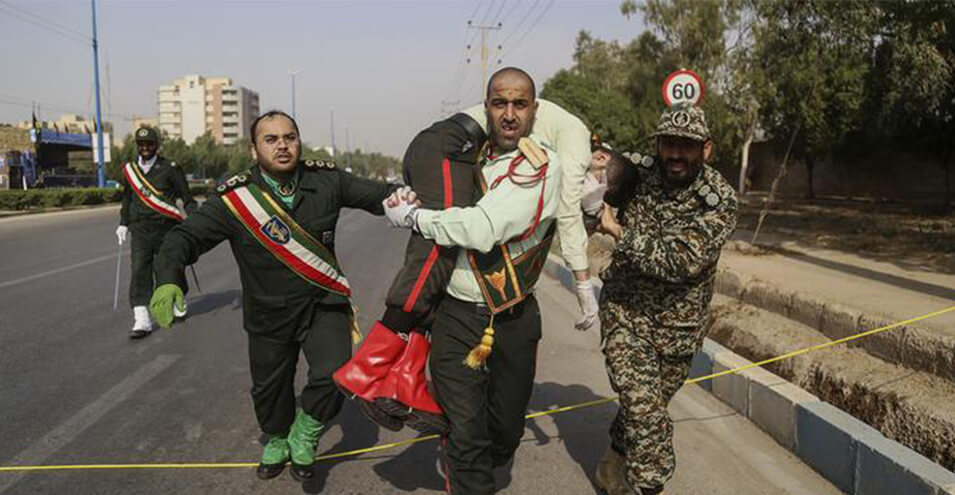
On Saturday, September 21, a group of four opened fire on the crowd during an armed forces parade in Ahvaz. In this armed attack, 24 people, including several civilians, were killed and about 60 others were injured.
Following the attack, for which ISIS claimed responsibility by releasing a video of the attackers, a wave of arrests took place in Ahvaz, and according to Ahvaz activists, around 800 men and women were arrested in Ahvaz, including political and cultural activists and ordinary citizens. These arrests prompted a response from Amnesty International.
Philip Luther, Amnesty International's Middle East and North Africa Research Director, said in this regard that "the scale of the arrests in recent weeks is deeply concerning and the timing suggests that the Iranian authorities have used the Ahvaz attacks as a pretext to crack down on members of Ahvaz's ethnic minority, including members of civil society and political activists, in order to suppress dissent in the region."
Source: DW