The rise of exorcism in Italy
Father Vincenzo points to the painting on the church wall and says, “Do you see that woman? Evil spirits have taken possession of her. The priests have taken hold of her hands and feet and opened her mouth. Little devils are coming out of her body. She is getting rid of them.”
Father Vincenzo is 79 years old. As he explains, he has been practicing exorcisms, which means expelling evil spirits from people's bodies in the Catholic tradition, for 27 years.
He says he got involved in this by chance. Another priest who was doing exorcisms asked him for help. He says, “I didn’t know anything, I hadn’t studied. He taught me what to do. I was completely ignorant.”
Many years have passed since that day. He is now one of the most famous exorcists in Rome. He is busy. It is not easy to find younger people to help him.
Father Vincenzo performs exorcisms three days a week in a windowless room behind his church, which is close to the Vatican. He sometimes sees up to 30 people in a single day.
He says, “I tell those who want to come to me to first go to a psychologist or psychiatrist and bring me a specialist diagnosis. I am personally in contact with the psychologists who refer their patients to me.”
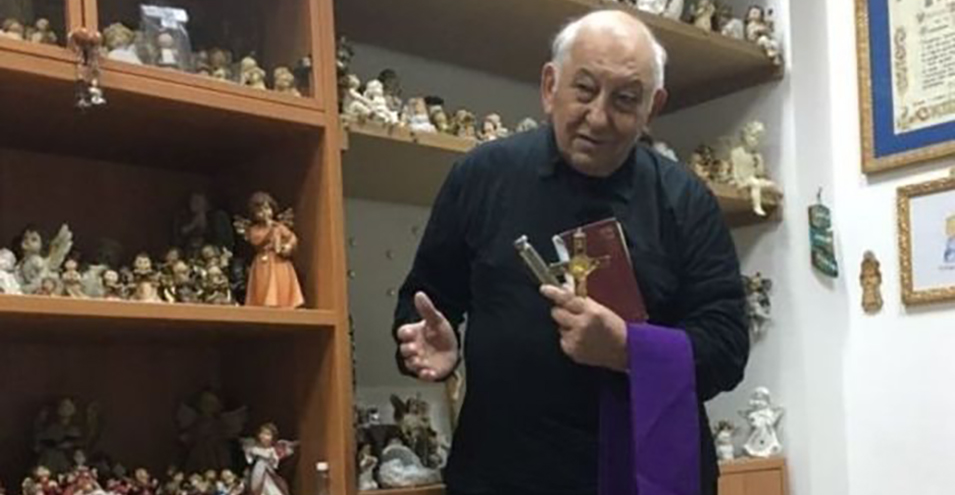
On one side of the room is a shelf full of small statues of various angels – maybe hundreds of them. In the drawer of the shelf he puts candy and offers it to people. On the wall is a framed certificate confirming that Vincenzo Taraborrelli knows how to exorcise.
The priest's desk is filled with papers, photos, and prayer books. There are two ordinary chairs behind and beside the desk, one for himself and one for the client.
He explains the steps to me: “First, I prepare the room. If someone who comes is unwell, I try to calm them down. We pray together. But it often happens that when they arrive here they are very unwell.”
The father looks down at the book he's holding—it's the Catholic exorcism prayer book. The back is taped shut to keep it from falling apart. Amidst the pile of papers on the table lies a crucifix, which he uses to drive away evil spirits.
It has a lot of memories. It tells the story of a man and a woman whose problems have lasted for 13 years.
“The man was a Satanist. He had fallen in love with a woman. She had said no. The man had said, ‘You will see what happens.’ Then he had cast a spell on her twice a week, to make her attracted to him. Finally, they came to me, in this very room. As soon as I prayed, the woman went into a trance. Then she began to curse and swear. I knew that the devil had taken possession of her. I continued to pray. The further we went, the worse she got, so that when I said to the devil, ‘In the name of Jesus, I command you to leave,’ the woman vomited up—needles and hairs and small stones and pieces of wood. It doesn’t seem real. No? But it is absolutely real.”
Exorcism – and essentially the incarnation of Satan in human flesh – is an accepted concept in the Catholic Church.
Sometimes it is used to explain the behavior of criminals, such as the attack on Father Jacques Amell, an 85-year-old French priest, in July. Two killers claiming to be affiliated with ISIS entered Father Jacques’s church in the French city of Rouen and stabbed him to death. The elderly priest shouted “Satan, get out!” as the killers attacked – suggesting he believed the work was the work of the devil.
But there are many who completely reject the idea of evil spirits and the incarnation of Satan in human flesh. They say it is a medieval superstition, a myth. And someone who claims to be possessed by evil spirits actually has a mental illness that can be easily explained by contemporary science.
But Father Vincenzo rejects such suspicions.
He says: “A person who does not believe does not accept Satan. But a person who does believe knows that Satan exists. It is mentioned in the Bible. Besides, look around you. The world has never been so bad. This violence that we see every day is not the work of man. It is terrible. This ISIS, for example.”
Dad's cell phone keeps ringing. It doesn't seem like he's going to—or can—quit his job.
But young priests are less likely to engage in exorcisms. Spending hours in a windowless room praying for possessed believers is not an attractive job.
“I told our bishop that no one is willing to help,” says Father Vincenzo. “Most of them are afraid. Even the priests are afraid. It’s not easy.”
Source: BBC