Paper shortage, a new monster facing the Iranian press
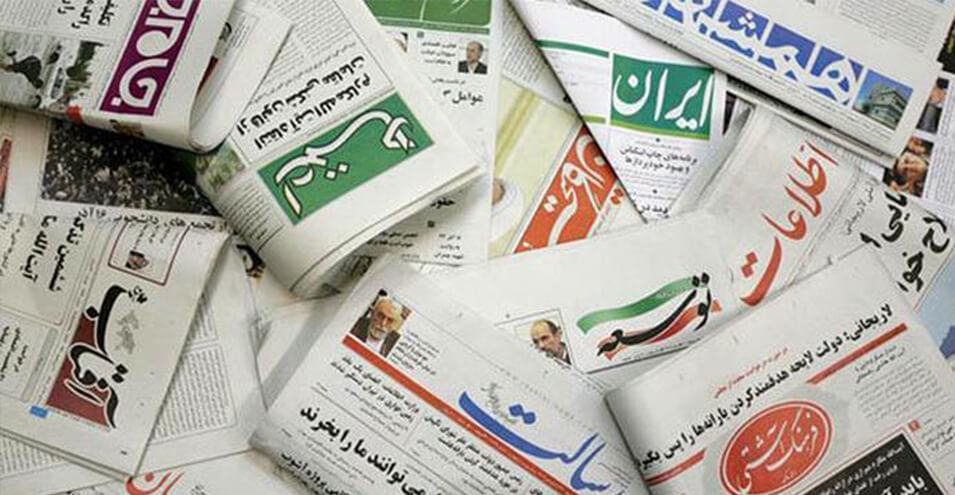
Iran's print media is facing an unprecedented shortage and high cost of paper. Some publications have been forced to reduce their pages and circulation. Experts warn that in the current situation, publications are threatened with closure and journalists are threatened with unemployment.
With the spread of economic unrest and the high cost of goods in Iran, which is mainly due to foreign sanctions, paper has also become a "luxury" commodity, posing a serious problem for the continuation of print media.
Although the government considers paper an essential commodity and has formed a special working group to organize its import, the problem persists: in recent weeks, many paper publications and news agencies have resorted to reducing pages and "reducing staff" to avoid closure.
Recently, Javad Daliri, the editor-in-chief of the state-run newspaper Iran, announced that the newspaper would be reduced by eight pages. According to the Labor News Agency (ILNA), Daliri had said in a Twitter message: "Due to the serious paper crisis, starting Sunday (May 12) and until further notice, we will reduce eight pages from the pages of the newspaper Iran, and this newspaper will be on the newsstands with 16 pages instead of 24."
Javad Daliri explained this decision: "We have to reduce paper consumption in order to last longer... The paper crisis is so serious that the circulation of many newspapers has decreased by a third in the past two months, and based on the information I have, some newspapers will have no more paper in a night or two."
Niloufar Ghadiri, a member of the editorial board of Hamshahri newspaper, also announced that the newspaper would be reduced by eight pages. ILNA quoted Ghadiri as saying: “The paper crisis has set fire to the press.”
Mohammad Reza Saadi, the editor-in-chief of Jahan Sanat newspaper, and Hossein Abdollahi, the editor-in-chief of Arman newspaper, told Hamshahri newspaper that if the paper shortage is not resolved as soon as possible, they do not see a clear prospect for continuing publication.
“200 years of journalism at risk of extinction”
Mahmoud Mokhtarian, a professor at Allameh Tabatabaei University and journalist, told ILNA news agency: "Since about 95 percent of our paper is imported, with the increase in the price of newspaper paper, the costs of producing printed media have also increased significantly. But in addition to the economic conditions and the increase in the price of paper, the main problem is that the media is state-owned, and there is no criticism or current life of the people in them."
Mahmoud Mokhtarian warns: "It would be a shame if 200 years of journalism in the country were to fall apart."
Mahmoud Sadri, director of Donyaye Eqtesad Publications and a journalist, also views the future of publications with the same pessimism: "This year, we have witnessed the cost of paper increasing, people's purchasing power decreasing, and the first effect of this is the elimination of cultural expenses, a decrease in newspaper purchases, and more layoffs. Therefore, I believe that there is no clear vision for the future of the press in Iran."
In this regard, the heavy and irreparable consequences of the decline of mass media on the cultural life of society are emphasized.
Causes of the crisis
The most important reason that experts cite for the mass media crisis goes beyond the problem of paper shortage and goes back to the general publishing crisis in Iran.
Cyberspace has expanded in Iran, and today, social networks and messaging applications such as Telegram, Twitter, and Instagram play a major role in providing information.
The pervasive phenomenon of the spread of cyberspace and its consequences is seen all over the world, but this process has taken a more acute form in Iran. Mahmoud Mokhtarian says: "The vulnerability of media in other countries to this issue has been at most 5 percent, not suddenly 80 percent damage like in Iran."
Therefore, the reasons for people's turning away from the big media and their excessive embrace of virtual media must also be addressed. The reality is that the "authorized" press and "official" news agencies are no longer a reliable and authoritative source for the people. In this regard, not only the mass media, but also book publishing has faced a "crisis of trust."
This veteran journalist points to direct and indirect pressure on the press in identifying the root of the problem: "Over the past 20 years, we have constantly humiliated our journalists and closed publications under various pretexts."
Mokhtarian criticizes that “the media has strayed from its main duties,” saying: “The main duty of the media is to criticize, highlight, create a platform, build trust, build culture, build civilization, and create waves. We must be able to create waves in our media that serve the national interests of the country. But how much does our media serve this criticism? Almost none.”
Mahmoud Sadri also states: "If governments allowed publications to operate freely in cyberspace, there would be no pressures such as filtering, and the door to speech would be somewhat more open and free. Instead of unknown and unofficial media taking over the field in this space, our country's official press could become active in cyberspace and speak their minds."
The way out of the crisis
As the paper shortage intensified, the Ministry of Islamic Guidance formed a paper working group a few months ago to address this crisis. However, despite promises, allocation of government funds for paper, and the arrival of several shipments, there has been no sign of any reduction in the crisis to date.
Identifying the real reasons for the paper shortage not only reveals the root causes of the problem, but also reveals the horrific dimensions of overt and covert corruption (bribery).
According to the Ministry of Culture and Islamic Guidance, 262,000 tons of paper imported with government currency this year, but only 23,000 tons were distributed with the approval of the Ministry of Culture and Islamic Guidance's cultural and press departments. This means that more than 93 percent of the imported paper with government currency has been wasted.
Some aspects of this corruption have been exposed:
Mohammad Soltanifar, the then deputy minister of religious guidance, said: "Two people received foreign currency to import paper that had no foreign existence at all."
He had stated that the two individuals (allegedly) received about 24 million euros in government currency for importing paper.
In January 2018, Hassan Rahimi, the chief of Tehran Police, announced the arrest of the "Sultan of Paper" along with a group of 16 people; the value of this case was announced at the time to be more than 1.7 trillion tomans.
The head of Tehran's police said: "These people imported over 30,000 tons of paper with government currency, but not a single gram of this paper was imported into the market or sold freely; with a number of government currencies, no paper was imported at all and was sold freely in the market."
In March 2018, Abbas Jafari Dolatabadi, the then-Tehran prosecutor, announced that the two main suspects in the paper importation case had fled Iran; he said that these individuals had received $190 million in foreign currency for the paper importation.
The Tehran prosecutor had stated: “In the paper case, eight companies have been prosecuted, and apart from the two main defendants who have escaped, 17 defendants are in custody.” According to him, “A total of these eight companies received $190 million in foreign exchange, which they either imported paper but sold on the open market by preparing fake invoices, or they did not import any paper at all and sold the foreign exchange.”
Rent-seeking and excessive spending on paper distribution is a major problem that has made the work of independent media particularly difficult. It is an old and well-known problem that the government uses unfair paper rationing to pressure critical publications.
To this day, no one has heard the media outlets complain about the lack of paper.
Source: DW