A Tale of Tragedy: Selling Body Parts to Survive
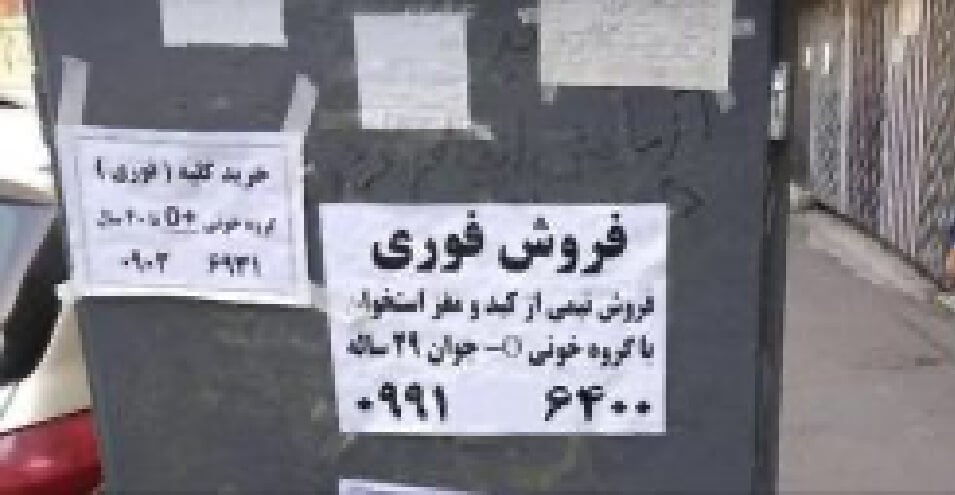
It is an undeniable reality that poverty, in addition to changing the economic conditions of society, also affects the social lives of citizens. The decline in purchasing power of citizens causes their previous social habits—such as allocating expenses for recreation, clothing, proper nutrition, health, and medical care—to change, resulting in a lifestyle in which the sole objective is to meet basic needs, including shelter and minimal food for survival.
As poverty expands and its pressure on citizens intensifies, at some point, merely reducing spending no longer meets family needs, and individuals are forced to change their source of income or add a new source to meet those basic needs. This is because, on one hand, with rising inflation rates, the purchasing power of previous income has decreased, and on the other hand, economic conditions are such that an increase in income from the previous source cannot be expected.
Under such economic conditions, changing the source of income through conventional and customary methods, such as seeking a higher-paying job, is certainly not possible; because the labor market, affected by dire economic conditions, does not have the capacity to attract workers with higher incomes. Therefore, the only way forward to maintain the existing “eat and survive” status is to increase income through unconventional, unhealthy, yet legal methods; methods that among socio-economic researchers are referred to as “fake jobs”; jobs that, although not prohibited under the laws of their respective societies, their creation and expansion have a direct relationship with the spread of poverty in society and proliferate at the same pace and rate.
The Direct Relationship Between Poverty and Sale of Body Parts in Iran
The role of poverty in the expansion of fake jobs, particularly the sale of body parts in Iran, is undeniable. A mere glance at economic statistics in the current year (1400 solar calendar) shows that the economic condition of Iranians remained on a downward trajectory, just as it had four years before, and the resulting poverty has worsened. In this regard, Mohammad Reza Pourabbasi, chairman of the economic commission of the Islamic Consultative Assembly, confirmed in November 1400 that the increase in the poverty rate compared to the previous year was a 10 percent increase. According to him, the poverty rate index in Iran rose from 22 percent in the previous year to nearly 30 percent in the current year.
This figure, of course, does not align with official statistics presented, and it appears the situation is worse than what this parliamentary representative states in Iran; because, based on a report published by the Ministry of Cooperatives, Labor, and Social Welfare in August of the current year, the 32 percent poverty rate refers to 1398 (solar calendar), when the inflation rate was approximately 35 percent. This means that in 1398, more than 26 million people in Iran lived below the poverty line in absolute poverty.
This figure certainly increased in 1399 with the rise of the inflation rate to 36.5 percent, and as a result, it appears that with 40 percent inflation in the current year and a 38 percent increase in the poverty line in just the past year, at least 36 million citizens in Iran are now living in absolute poverty. This condition, in which meeting completely basic needs such as access to shelter, clean drinking water, food, and medical care becomes a major and unattainable challenge for citizens, is a state with the highest capacity for creating and expanding fake jobs; because in it, the objective is solely to meet basic needs for survival, not for living.
Beyond the alignment of economic statistics with the expansion of body part sales cases, this issue has even been confirmed by official authorities. In this regard, Hossein-Ali Shahriiari, a member of the health and medical commission of the Islamic Consultative Assembly in March 1395, in a statement regarding citizens’ actions in selling their body parts, particularly kidneys, deemed it in line with “resistance economics” and said: “When we talk about resistance economics, the best action is kidney transplantation; because costs also decrease, since dialysis has very high costs and many machines must be purchased.” This former parliamentary representative also explicitly acknowledged poverty as one of the factors influencing citizens’ inclination to sell their body parts, stating: “What’s wrong if a person living in poverty transforms their life by receiving 20 to 30 million? Why shouldn’t they do it?”
Is Legally “Selling” Forbidden and “Donation” Free?
Some believe that the existing legal vacuum regarding the sale of body parts in Iran has not been inconsequential in the expansion of this phenomenon, and the issue of selling body parts is not merely an economic matter arising from poverty; meaning that despite the explicit criminalization of the buying and selling of body parts in many countries for the purpose of organ transplantation, this issue has not been addressed in Iran’s criminal laws whatsoever, and is only mentioned in circulars from the Ministry of Health addressed to organ transplant societies and medical centers.
In this regard, based on a circular issued by the health deputy of the Ministry of Health in October 1378 titled “Guidelines for Kidney Donation and Transplantation from Living Donors,” addressed to all kidney transplant centers, it merely stated that advertising and “kidney donation” announcements, as well as “commercial intermediation in the donation process,” are prohibited and violators will face legal action. However, in this context, aside from the fact that even the Ministry of Health’s circular refrained from using the word “sale” to express the prohibition, the main issue is that based on current criminal laws in Iran, there is fundamentally no punishment for advertising and announcing kidney donations, and it is unclear on what legal basis the Ministry of Health’s threat to take action is based.
On the other hand, this very lack of explicit reference to the issue of selling in this circular demonstrates that at least the authorities of the Ministry of Health at that time had no general problem with the issue of selling body parts by living individuals, and have not even made a direct attempt to prohibit it in their circular for the sake of appearing to take action.
For this reason, even based on current regulations and practical procedures of kidney patient support associations in the provinces, a mechanism has been created to receive a sum of money from the kidney recipient and transfer it to the donor. Davoud Norouzkhani, chairman of the Central Province Kidney Patient Support Association, in December of the current year, acknowledging the existence of a mechanism for receiving and paying a sum for kidney donation, referred to it as a “sacrifice gift” from the recipient to the donor and announced its ceiling at 80 million tomans. At the same time, he also confirmed the reality that between the recipient and the donor, financial agreements form outside the association’s mechanism, and this agreement increases to 300 million tomans in Tehran.
The attempt to earn more income through kidney sales has also caused many sellers from other provinces and cities to move to Tehran and sell their kidneys at a higher price in that city; of course, this is not easy for non-Tehran sellers and involves difficulties; because based on the kidney donation law, individuals can only donate in the same city where they reside. Therefore, these individuals are forced to present a fake house rental contract in Tehran to prove they are residents of the city; an action that is certainly not without cost, and as a result, allocating part of the sale proceeds for this cost increases the selling price.
While the claim about the role of legal vacuum is, from a legal perspective, somewhat acceptable, socio-economic realities show that the absence of preventive legislation is merely a secondary facilitator, and it is these economic conditions that play the primary role in the issue of selling body parts in Iran.
In this regard, Hossein Biglari, chairman of the Kermanshah Kidney Patient Support Association, in December of the current year, with implicit acknowledgment of the role of economic conditions, particularly the spread of poverty, in increasing the amount of the “sacrifice gift,” spoke of the influence of provincial kidney patient support associations in this price increase. According to him: “Unfortunately, the associations themselves have increased the price of kidneys; previously, the price of one kidney was 18 million tomans, but it has increased to 34 million tomans. In the past one or two years, the price suddenly became 80 million tomans. When the price of a kidney was 34 million tomans, the parties would agree among themselves on prices close to 50 million tomans and the transplant would be performed, but when the central kidney patient support association set the price at 80 million tomans, no one is willing to donate a kidney at lower prices.”
This official related to the donation of body parts also confirmed the role of economic factors in the donation of body parts in another statement. According to him, since transplanting organs from Iranians to foreign nationals is prohibited, some donors (read sellers) with the goal of receiving more money for transplant surgery have gone to Iraq and there calculate the amount with the recipient in dollars; a procedure that clearly demonstrates the establishment of body part sales by Iranian citizens as a way to earn income and escape absolute poverty.
The sale of body parts, of course, is not limited to kidneys, and some also sell part of their liver for transplantation to individuals with liver problems in order to earn income. Reports have also recently emerged about the sale of hair, which demonstrates the depth of the poverty tragedy. Based on these reports, some parents, due to severe financial poverty, sell their children’s hair to cover school and food expenses. Buyers, who are mostly hairdressers and artificial hair manufacturers, use the purchased hair for hair extension procedures; there have even been reports of exporting purchased hair to Turkey and from there to other countries, which, while demonstrating the depth of trade in this human product, sellers receive a very insignificant share of this trade, and their goal is solely to earn income to meet basic needs; exactly like sellers of kidneys and liver whose goal is only survival; because at such a level of widespread and increasing poverty, no one becomes wealthy with these earnings.
Source: Hrana