All Iranian provinces except Mazandaran and Gilan are ‘surrounded by dust storms’
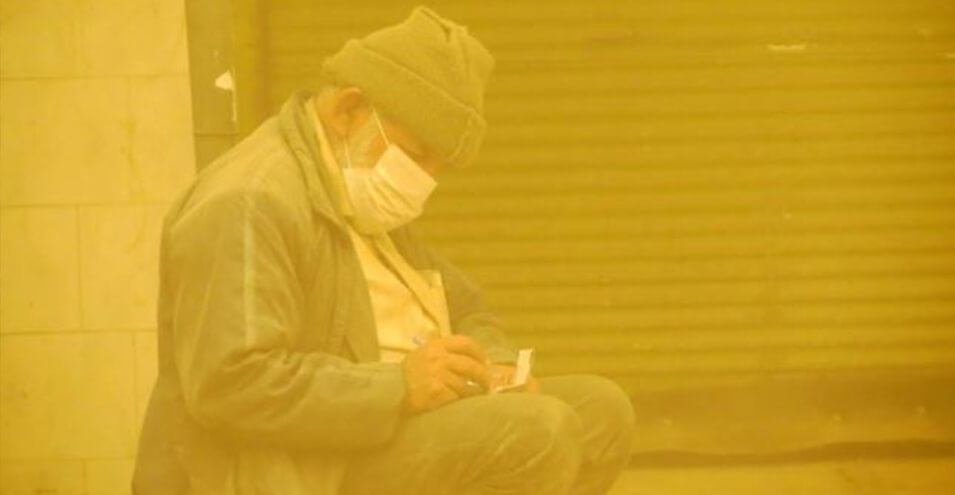
Iran’s state news agency IRNA says that due to reduced vegetation coverage, increased desertification, and other issues, currently all Iranian provinces except Mazandaran, Gilan, and parts of Golestan province are surrounded by dust storms.
IRNA reported on December 24 that eight million hectares out of 35 million hectares of desert land in Iran face the threat of dust storms and are turning into centers of wind erosion.
According to IRNA, “noticeable reduction in vegetation coverage in desert areas” is one of the main reasons for the increase in wind erosion centers.
Other challenges include “intensification of desertification,” “increased environmental problems,” persistent droughts, or reduced rainfall.
Soil usually consists of hard materials, mineral and organic compounds, living organisms, water, and air. Water erosion is a common phenomenon in soil erosion. Wind erosion is another important factor in soil erosion.
Dust storms are referred to as a collection of dry particles in the air. However, the National Headquarters for Combating Dust and Sand says the term “dust storm” is incorrect and the correct terminology is “soil dust” or “dust and sand.” Nevertheless, some other experts say these two phenomena are separate from each other.
Warnings about the situation of dust storms, soil erosion, and related problems in Iran are not new, and in recent years both government officials and experts have spoken about their occurrence and consequences.
Air pollution and dust storms have so far led to the closure of educational centers, disruption of citizens’ daily lives, migrations, increased visits to medical centers and various physical complications, as well as protests, marches, and various gatherings.
In April of this year, an official from the Ministry of Agriculture Jihad stated that if the current trend continues and there is “negligence,” the number of dust-producing desertification centers will reach 77 percent by 1400 [2021-2022], the expansion of which threatens more than half of Iran’s entire population.
In mid-December, Manouchehr Garaji, chairman of the Iran Soil Science Association, warned that Iran experiences two billion tons of soil erosion annually and “no one is responsible for protecting it.”
Mr. Garaji said that one billion tons of this soil settles in dams and another billion tons is converted into “deadly dust storms.”
A year ago, Ismail Najar, head of the National Crisis Management Organization, said: desertification in Iran is “extensively” increasing and the dust storm phenomenon has become a “super crisis.”
Nevertheless, recommendations and solutions have been proposed to address this phenomenon; for example, soil conservation programs that the United States implemented about eight decades ago can be mentioned. Experts have also provided recommendations regarding personal and individual protective measures.
Of course, dust storms in Iran do not have only domestic sources, and a significant amount also enters from other countries in the region, which experts say requires increased regional cooperation to address. However, it is unclear to what extent this issue is being taken seriously under current conditions and existing political tensions.
Source: Radio Farda