Assyrian Seal in Jerusalem, Confirmation of Official Relations between Assyria and Judah
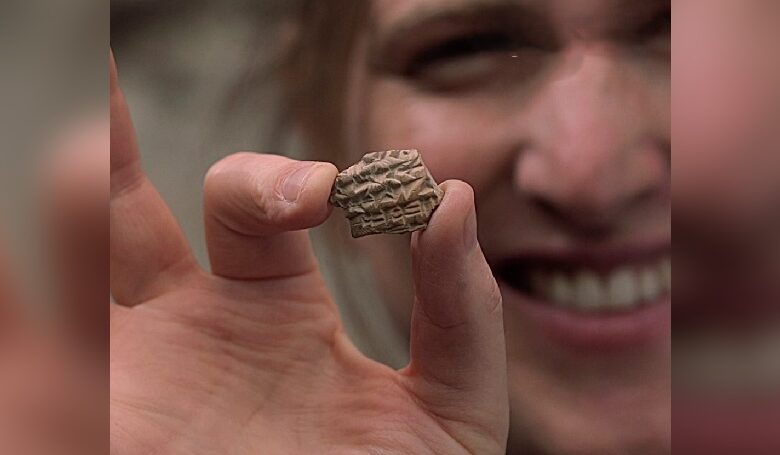
The discovery of a small 2.5 centimeter Assyrian seal near the “Kotel” (Western Wall) serves as evidence of official correspondence between Assyria and the Kingdom of Judah over two and a half thousand years ago.
During joint excavations by the Israel Antiquities Authority (IAA) and the City of David Foundation, a pottery fragment measuring only 2.5 centimeters and bearing an inscription in Assyrian cuneiform script was discovered. According to researchers, this finding represents the first direct written evidence of official correspondence between the Assyrian Empire and the Kingdom of Judah.
The nature and discovery of this fragment has been identified as part of a royal seal impression (seal impression) that was attached to an official document. The brief text raises a complaint regarding delayed payment of debt by the Kingdom of Judah.
The discovery point was located near the Western Wall and in an area where soil from excavations around the Western Temple had been transferred.
Scientific analysis and the origin of the artifact indicate that combined geological and soil chemistry studies have shown that the materials of this seal were sourced from the “Mesopotamia” region (probably from central areas of the Assyrian Empire such as Nineveh or Ashur). This confirms that the seal and its document came from the Assyrian court to Jerusalem.
The inscription mentions “the first day of the month of Av” (the first day of the month Av in the Mesopotamian calendar) and also refers to the position of “chariot officer,” a title that was known in the Assyrian court structure.
The shared calendar and historical context represent one of the important indicators that the word “Av” was used in the Mesopotamian calendar in Assyrian texts, which serves as evidence of the shared use of time reckoning between Assyrian lands and Judah during that period.
This period coincides with a time when Judah was under political and financial pressure from Assyria, and the issue of tribute payment and loyalty customs formed the boundary of Assyria’s relationship with Judah.
One of the highlights of this discovery is its correlation with biblical texts: “In the Second Book of Kings, Chapter 18, it is stated that Hezekiah, king of Judah, rebelled against Sennacherib, king of Assyria, during a certain period and refused to pay tribute. This small seal may be the document that reminded the Kingdom of Judah of the demand for tribute payment.”
Furthermore, Assyrian documents and texts, such as those attributed to Sennacherib, also reference the complex relations between Assyria and Judah at that time. This seal serves as tangible evidence showing that official correspondence existed between the superior empire of that time and the government of Judah, and tensions, the imposition of tribute, and the requirement of loyalty were an integral part of the relations between these two powers.
Dr. “Ayala Zilberstein,” head of the excavation, described this seal as “direct evidence of the depth of Assyrian presence and influence in the administration of the Kingdom of Judah.” “Amichai Eliyahu,” Israel’s Heritage Minister, also stated that this finding is “striking evidence of Jerusalem’s position as the capital of Judah and confirmation of historical narratives.”
Researchers participating from “Bar-Ilan University” and other centers have emphasized that this artifact is the first Assyrian seal from the First Temple period to be discovered in Jerusalem itself, opening new horizons for studying the political and economic interactions of that era.
A complete study of the seal’s text shows that some parts of the inscription have been lost or their reading is unclear. Continued work on precise transcription and comparison with Assyrian inscriptions may reveal more details about the subject of debt, the name of the king of Judah, or the conditions of debt payment.
Petrographic analysis and soil comparison also show that with the expansion of geological analysis and comparison of soil samples from various Assyrian centers (Nineveh, Ashur, Kalhu), a more precise origin of the seal can be determined.
Additionally, in comparison with Assyrian administrative documents, if this seal can be correlated with Assyrian administrative and diplomatic texts from a corresponding contemporary period, the network of correspondence and the administrative hierarchy of that era can be better reconstructed.
With further excavation around the discovery site and the area from which the seal was obtained, it suggests that it may be part of an administrative center or state treasury from the Judean period. It is believed that activities related to central government affairs were conducted in that area.