Ben Gurion warns Grossi over Iran’s potential nuclear weapons acquisition
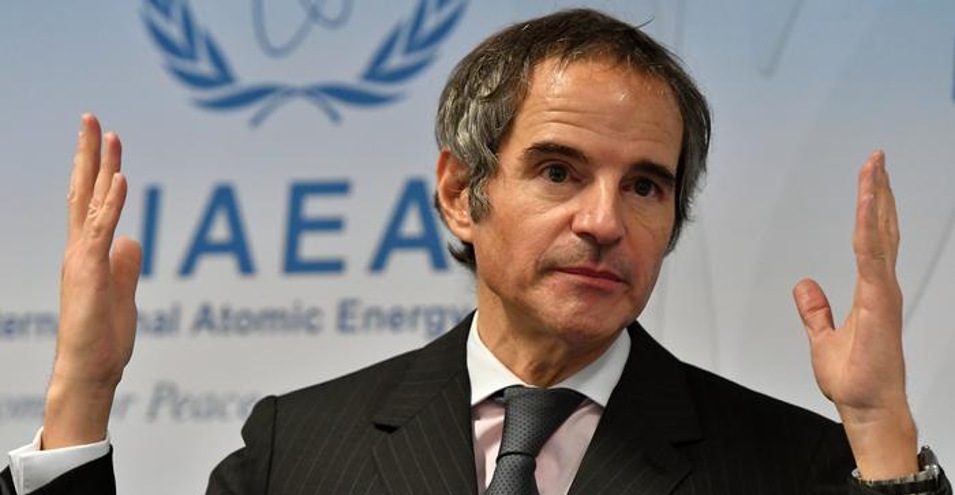
Naftali Ben Gurion, Prime Minister of Israel, told Rafael Grossi, Director General of the International Atomic Energy Agency, on Friday, June 3, that Israel “prefers a diplomatic path to counter the possibility of Iran acquiring nuclear weapons, but if the international community fails to achieve this goal in an appropriate timeframe, Israel will take action against Iran on its own.”
Ben Gurion added: Our right to “self-defense” and action to “stop Iran’s nuclear program” is preserved.
According to the Ynet news website, the Israeli Prime Minister emphasized “the depth of the danger from Iran’s continued progress toward acquiring nuclear weapons while deceiving the international community by providing false and misleading information.”
Grossi traveled to Israel on the evening of June 2, ahead of the International Atomic Energy Agency Board of Governors meeting, to meet and hold talks with Naftali Ben Gurion and other senior Israeli officials, and returned to Vienna on Friday afternoon, June 3.
Ahead of the Board of Governors meeting, Britain, France and Germany have prepared a new draft resolution asking Iran to cooperate with the Agency.
The White House announced on June 2 that the Biden administration will support the action of the three European countries in the Board of Governors.
Naftali Ben Gurion told Rafael Grossi that it is important for the IAEA Board of Governors, as “a professional, impartial and independent body,” to “send a clear message to Iran.”
However, according to Ynet and Walla News, Israel is struggling for the outcome of the Board of Governors’ regular meeting from June 6-10 to be the issuance of a resolution condemning Iran.
The last resolution by this nuclear watchdog regarding Iran was issued two years ago.
According to Walla News, ahead of the Board of Governors meeting, the Naftali Ben Gurion government launched a broad political and media campaign to show that Iran has been deceptive in its relations with the Agency for years.
Days before Grossi’s trip to Israel, Naftali Ben Gurion publicly released some documents from 2004 and 2005 from the history of Iran’s nuclear program that Israeli Mossad stole from Tehran in the winter of 2018, through Google Drive.
Ben Gurion, by publicly releasing papers from those documents, said Iran both lied to the International Atomic Energy Agency and spied on the Agency to prepare answers for the questions of this body. His reference was to documents from correspondence at the time between officials of Iran’s nuclear and military programs. Meanwhile, according to Israeli media reports, Grossi’s current trip to Jerusalem took place as Israel submitted a new proposal to the United States regarding Iran’s nuclear program, based on which, to maintain pressure on Iran, the “sunset clause” from the JCPOA, if revived, would be removed.
The Jerusalem Post wrote that Eyal Hulata, Israeli National Security Advisor, presented this new plan to the White House during this week’s meeting in Washington and is expected to present it to Britain, France and Germany as well.
Based on the Agency’s latest report, Iran’s enriched uranium stockpile has increased 18 times compared to the limit allowed under the JCPOA agreement and has reached over 3,809 kilograms. 43 kilograms of these materials are uranium enriched to 60 percent concentration.
Under the JCPOA, Iran was only allowed to maintain approximately 203 kilograms of enriched uranium.
Iran’s current level of enriched uranium means that the time gap between Tehran and having the materials necessary to mount a hypothetical nuclear bomb has been reduced to “zero.”
Grossi has also told Board of Governors members in recent days that Iran has not provided convincing answers to questions from IAEA inspectors about enriched uranium found at three locations in Iran. Israel played an important role in revealing the three aforementioned locations, including Turquzabad.
The Board of Governors is set to convene starting next Monday, as Iran’s negotiations with world powers, which also included indirect talks with the United States, have effectively been suspended for the past three months.
Iran has previously warned against “unconstructive steps” in the upcoming IAEA meeting.
Tehran, which continues to claim that it has no intention of acquiring nuclear weapons, holds Israel responsible for a series of sabotage explosions at the Natanz nuclear site and the killing of several Iranian nuclear program scientists.
Since two decades ago when Iran’s nuclear program became public, Israel has made countering it “a vital danger” at the top of its agenda.
The Israeli military has continued extensive military preparations in recent days for a possible attack on Iran’s nuclear facilities.
Israel, which has deliberately kept its nuclear bomb capabilities ambiguous to be “a deterrent factor,” has, according to multiple reports, long had on its agenda actions against other countries in the region that seek to acquire military nuclear capability.
Within the framework of this agenda, Israel destroyed, among others, Iraq’s Osirak nuclear reactor and the unfinished reactor at Deir ez-Zor in Syria.
Israel is not a member of the Board of Governors of the IAEA, but has been a member since the International Atomic Energy Agency was established in 1957. IAEA inspectors have monitored part of Israel’s nuclear program, known as “Shimon,” since 1966.
Western media reports claim that an important and possibly military portion of Israel’s nuclear program, because it is not a member of the Nuclear Non-Proliferation Treaty, is proceeding beyond the Agency’s oversight.
Rafael Grossi wrote on Friday in a tweet that in his meeting with Naftali Ben Gurion he emphasized the importance of the Non-Proliferation Treaty to international peace and security.
Source: Radio Farda