Cardinal Matthew’s Response to “Holy Mary” Station: A Christian Perspective on a Sign of Divine Love
Cardinal “Joseph Matthew” responded to the reopening of the “Holy Mary” metro station, describing it as a sign of divine love and a symbol of interfaith dialogue.
The naming of one of Tehran’s new metro stations “Holy Mary” has sparked a wave of positive and thought-provoking reactions in Iran’s Christian community and beyond.
Cardinal “Dominic Joseph Matthew,” Archbishop of Roman Catholics in Iran, in a note described this action as “an opportunity to understand divine love” and characterized it as a symbol of dialogue and coexistence between religions.
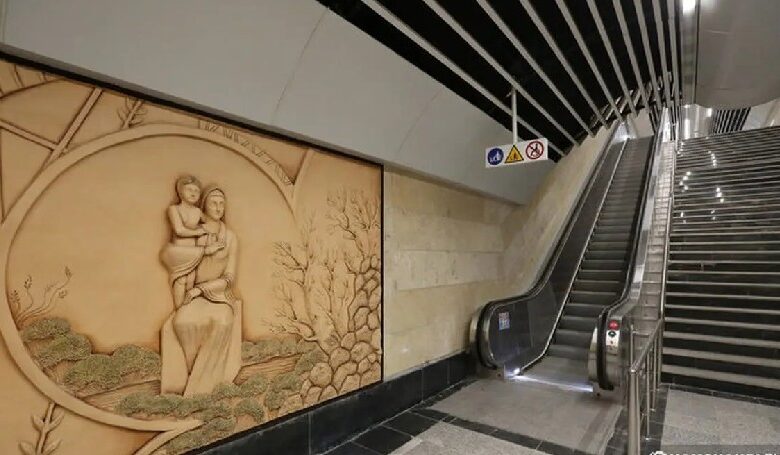
This station, located near the Church of Saint Sergius, has been designed with a blend of Christian symbols and Iranian-Islamic artistic elements, drawing considerable attention from Christians and religious analysts in Iran and worldwide.
In a note that Cardinal Matthew provided to Christian media outlets including “AsiaNews,” he wrote: “If there is a wish, it is that passengers can find, in silence and reflection, behind the lowered eyelids of Christ and the Holy Mary, a gaze full of love.” He added: “Through this gaze, God comes to visit His creatures.”
Cardinal Matthew, emphasizing the spiritual value of this naming, regarded it as a sign of the possibility of “mutual understanding and coexistence” among followers of religions, a topic that has always been one of his main concerns in his missions in Iran.
In Iran’s Christian community, this action has provoked mixed reactions. Many clergy and members of Armenian, Assyrian, and Catholic churches have referred to it as a sign of respect for Mary, a sacred woman in both Islam and Christianity.
One priest from an Assyrian church in Tehran said in an informal conversation: “Even if this decision is merely symbolic, it still reminds us that the Holy Mary is a bridge between us and Muslims. This itself carries a message of peace.”
On the other hand, some Christian activists believe that while this naming is beautiful, it should be accompanied by more concrete steps to strengthen religious and cultural freedoms for Christian minorities.
Reactions outside the country have also been largely marked by surprise and hope. On social media, many Christians from the Middle East, Europe, and North America welcomed the news and considered it an unprecedented move in an Islamic country.
The Christian publication AsiaNews wrote in an analysis: “In the heart of Iran’s capital, the name of the Holy Mary has been inscribed on the metro wall. A sign of hope for dialogue and love among religions.”
In contrast, some Western media outlets such as Christian Today and Newsweek reminded readers that “while this is a positive step, the actual conditions of Christian minorities in Iran should also be considered.”
The “Holy Mary” station, which was initially supposed to be named “Najat-Allahi,” has now, with a design featuring large prominent engravings of Jesus Christ and Mary, Qur’anic verses, Persian poetry, and statements by religious leaders, become a kind of visual dialogue between religions.
Tehran’s mayor described the purpose of this action as “displaying the coexistence of divine religions.” In line with this, the Armenian community also donated a stone sculpture of Mary with the Christ Child to this station.
For many Christians, Cardinal Matthew’s words remind us that outward signs gain meaning when accompanied by the spirit of love and respect. In a world where religious boundaries sometimes become walls of separation, even the name of a metro station can be an invitation to peace, dialogue, and the presence of God among people.