Complaint of Iran’s Top Prosecutor and Ahvaz Residents Against Communications Minister
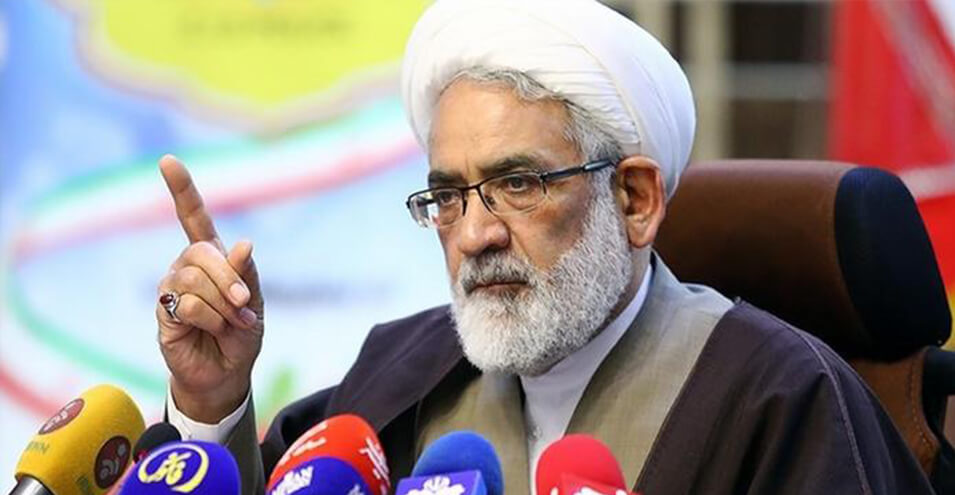
Iran’s top prosecutor, referring to the increase in cyber crimes and “shameful atmosphere in society,” held the communications minister responsible for ignoring the decisions of the Supreme Council of Cyberspace. Mohammad Jafar Montazeri and a number of Ahvaz residents filed a complaint against the communications minister.
Mohammad Jafar Montazeri, Iran’s top prosecutor, on Sunday, March 24 (February 24), while severely criticizing the interior minister, called him responsible for “shameful atmosphere in cyberspace.”
Montazeri referred to the sharp increase in cyberspace crimes and computer crimes and said that the communications minister is not providing the necessary cooperation in cleansing cyberspace.
Montazeri directly addressed the communications minister, saying: “You have not cooperated in cleansing cyberspace and will not, and you are trampling on the decisions of the Supreme Council of Cyberspace. We also say that when there is no will, they escape in some way.”
This judicial official, regarding the rapid expansion of computer crimes, said that society’s officials know “what shameful atmosphere has been created in society.” Montazeri warned society’s officials about the “frightening statistics of crime and sin growth” in society: “Today cyberspace has become a breeding ground for moral and financial crimes, people are suffering, who is responsible?”
According to Montazeri, cyberspace and computer crimes have increased 140 percent compared to last year, and computer fraud with 300 percent growth accounts for the highest computer crime in the country.
It is unclear from the top prosecutor’s remarks what measures should be taken to “cleanse cyberspace” and what internet domain his request for restrictions applies to, but it appears that Instagram filtering may be on the top prosecutor’s mind.
Internet and social networks in Iran face extensive filtering. International non-governmental organizations also call Iran’s government one of the “enemies of the internet.”
Following nationwide protests in December 2017, the filtering of social networks entered a new phase, which included the blocking of Telegram. Facebook and Twitter have also been filtered in Iran for some time. Instagram is currently the only popular unfiltered social network in Iran.
Hassan Rouhani, Iran’s president, has repeatedly spoken about the failure and non-implementation of the filtering policy in the country.
“Betrayal Behind Management Lines”
In his speech, the top prosecutor said: “One of our objections and complaints and grievances to cultural officials and to those who are leading the management of cyberspace today is why should our Islamic society be so abandoned that we witness so much crime and sin in society?”
Montazeri warned about “failure to cleanse cyberspace” and noted that “today the use of cyberspace is very influential in life, but this space must be cleansed of pollutants.” This judicial official emphasized that “part of the responsibility is in my hands but the tools are in someone else’s hands.” He asked “those who can cleanse this space of pollutants” to take decisive action and said, “If even 50 percent of cleansing occurs in cyberspace, conditions will improve.”
Iran’s top prosecutor also referred to the economic situation of the people and the state of corruption in the country in his speech. He said I want to say that corruption has become widespread, but in the Islamic system this amount of corruption is very high, and officials should provide grounds for eliminating corruption.
He said that some managers “have entrenched themselves behind their management in such a way that no one notices and they are pursuing betrayal.” He complained about the country’s economic situation and increased corruption in society and blamed it on responsible managers.
Montazeri added: “If all managers were justice-seekers, we would see the effects of justice in every corner of society.” He called for the decisive implementation of “leadership directives” and “decisions of the Supreme Council of Cyberspace.”
Complaint of Iran’s Top Prosecutor and Ahvaz Residents Against Communications Minister
On Sunday, March 24 (February 24), Javad Javidnia, deputy for cyberspace affairs at the office of Iran’s top prosecutor, announced a complaint filed by two thousand residents of Ahvaz and Iran’s top prosecutor against the communications minister. He said the communications minister’s case is being pursued at the Tehran Prosecutor’s Office and the prosecution is waiting for the legal process to proceed.
The deputy for cyberspace affairs at the prosecution told ISNA: “Multiple reminders were given to the communications minister regarding the necessity of implementing laws and decisions of the working group determining instances of criminal content and implementing judicial orders, and although implementing laws, judicial orders, and decisions of the Supreme Council of Cyberspace is obligatory and necessary for every official, unfortunately the communications minister complied with none of these reminders.”
Javidnia clarified that the complaint has been filed against the communications minister both by Iran’s top prosecutor and by two thousand residents of Ahvaz at the Tehran Prosecutor’s Office.
The deputy for cyberspace affairs at Iran’s top prosecutor’s office, regarding the reason for the Ahvaz residents’ complaint, said: “The people of Ahvaz complained against the communications minister for failing to create a safe and necessary environment for cyberspace in the country, and this complaint is also because a number of young people were attracted to takfiri groups and ultimately a terrorist attack on the military parade occurred in which their loved ones were martyred; of course, the people of Ahvaz filed complaints against both the communications minister and Instagram and Telegram managers.”
According to Javidnia, the titles of the complaint are “failure to implement laws and regulations and failure to implement judicial orders and providing grounds for computer espionage by enemies from large-scale information on people (big data).”
The deputy for cyberspace affairs at Iran’s top prosecutor’s office called the provision of such confidential data to foreigners, according to the country’s computer crimes law, “computer espionage,” which is considered a crime. He said: “Foreigners can, by analyzing data and espionage as well as information obtained from using this information to cause unrest, disrupt the order and security of the country, and these cases are an exact example of computer espionage.”
Source: DW