Continuation of Labor Strikes; Workers from Over 60 Companies in Eight Iranian Provinces Have Struck
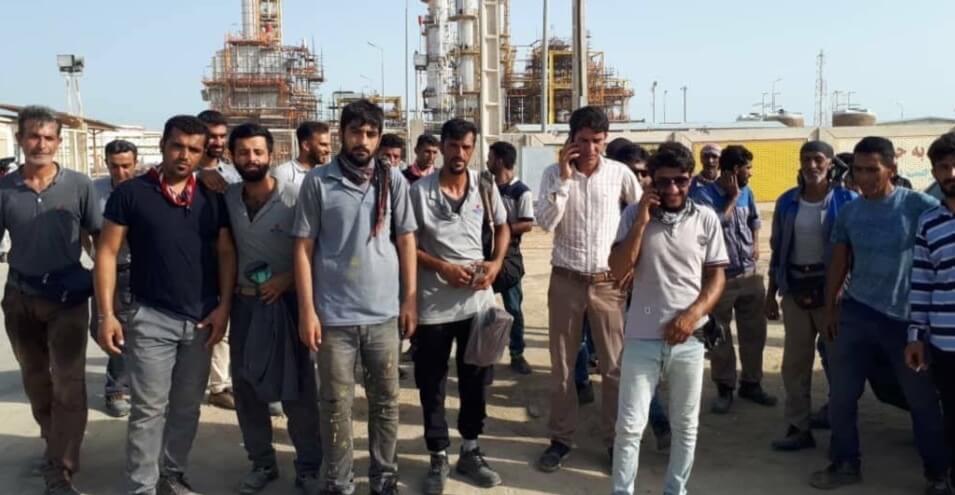
The Organizing Council of Protests by Oil Contract Workers announced that in addition to workers currently on strike, on June 30 (9th of Tir) “permanent staff” at the Ministry of Oil will also strike, and “if workers’ demands are not met by the end of August (end of Mordad), the scope of strikes will expand.”
The strike by contract workers, project workers, and daily wage workers in Iran’s oil, gas, and petrochemical industry continued and expanded on June 25 (6th of Tir).
Meanwhile, the Organizing Council of Protests by Oil Contract Workers announced that strikes will continue until workers’ demands are met.
Based on reports and videos shared on social media, contract and project workers from petrochemical companies in Bushehr and companies including Nima Radiation Welding, Azmoon Steel, Peshtazan Aria, and Pishgaman Fonoon Fars in Phase Two of Abadan Refinery have joined the strike in the oil, gas, and petrochemical industry. Additionally, a number of workers from Shiraz Refinery gathered and struck on Sunday in protest of their living conditions.
So far, workers from over 60 companies in at least eight provinces—Khuzestan, Bushehr, Hormozgan, Tehran, Isfahan, West Azerbaijan, Kerman, and Ilam—have participated in the recent strikes in the oil, gas, and petrochemical industry.
In this regard, the Organizing Council of Protests by Oil Contract Workers, in a statement on June 20 (5th of Tir), referring to the start of strikes on June 20 (29th of Khordad), announced that “several tens of thousands of our colleagues are on strike and our permanent colleagues will gather on June 30 (9th of Tir), and if our demands are not met by the end of August, we will prepare for broader continuation of our protests.”
According to reports, many striking workers have left their workplaces and returned to their cities. Nevertheless, this council has asked them to return to their dormitories to prevent contractor companies from hiring new workers.
Contract workers at refineries, petrochemical plants, and power plants have struck with the demands of “raising wages to 12 million tomans per month” and “changing the leave rotation to 20 working days and 10 days off.” Currently, they receive six days of leave for 24 days of work.
According to the Organizing Council of Protests by Oil Contract Workers, other demands have also been raised, including “wages being paid on time, limiting contractors’ involvement in the oil industry, elimination of worker layoffs and slavery-like laws in free trade zones.”
“Compliance with health, environmental, and workplace safety standards, improving health standards in dormitories and health services, ending securitization of work environments, recognition of the right to unionization, holding workers’ gatherings and protests” are among other demands announced by the Organizing Council of Protests by Oil Contract Workers.
Contract, project, and daily wage workers in the oil, gas, and petrochemical industry have held campaigns to improve their professional conditions during the summers of the past five years, but this is the second major strike by them in less than a year.
The strikes have continued despite the fact that 700 striking workers at Tehran Oil Refinery were fired on Tuesday of last week.
This has sparked much criticism on social media.
Meanwhile, the International Federation of Chemical, Energy, Mine and General Workers’ Unions, which represents over 50 million industrial workers in the automobile, steel, oil, petrochemical, and textile industries across countries worldwide, announced in a statement that it will stand alongside striking workers until their demands are met.
Besides, the Syndicate of United Bus Transport Company Workers of Tehran and Suburbs, the Syndicate of Haft Tappeh Sugar Cane Company Workers, the Free Union of Iranian Workers, the Council of Iranian Retirees, the Union Group of Retirees, Advanced Students of Isfahan University, and a number of teachers have expressed support for this strike.
Alongside the decline in purchasing power in recent years, numerous reports of workers’ and wage earners’ gatherings and strikes regarding difficult living conditions have been published.
Source: Radio Farda