Deaths from Coronavirus in Iran; Officials’ Cover-up Has Increased Public Distrust
Following the formal announcement of at least 5 coronavirus cases in Iran and the deaths of two of these patients in the city of Qom, public concerns have grown amid distrust of Iranian authorities.
Islamic Republic officials, who previously had not provided transparent statistics on suspected coronavirus cases in Iran and had emphasized that there were no coronavirus cases in the country, announced on Wednesday, March 20 the infection and death of two coronavirus patients only within hours of their occurrence.
However, statements published in Iranian media by the brother of one of the coronavirus victims in Qom have once again heightened concerns about official cover-ups.
Mohammad Mollaei, a member of the central council of the Islamic Association of Physicians of Iran, whose brother is one of the two who died from coronavirus, said in an interview: “During the week my brother was in the hospital, he was not given a coronavirus infection test, and only on the last day, upon my insistence and pleading, they took one and sent the coronavirus test to Tehran, and today the test results came back positive.”
According to him, “dozens of people with these symptoms have died in Qom hospitals and the cause has been reported as pneumonia and lung infection, and it is not really clear whether it was pneumonia, influenza, or coronavirus?”
Rokna news website, one of the sites that published this interview, denied the report hours later, stating that someone close to the family said Dr. Mohammad Mollaei “has not had any conversation.”
Widespread denials instead of clarification in media coverage have caused fear to spread further among the public. For example, following the publication of images showing special units’ presence in Qom, officials first denied the presence of these units and then said their presence was for holding elections and had nothing to do with coronavirus.
On the other hand, a video was circulated on social networks showing a patient being transferred from an ambulance into Farmaniyeh Hospital in Tehran. This video was also denied by Iran’s Emergency Medical Services, and the Emergency Services Public Relations Officer announced that the person had come to a hospital and due to the suspected nature of the illness, he was transferred to Shahid Yaftabad Hospital, which is a coronavirus quarantine center.
These statements come while the images show the patient is not being transferred from a hospital; rather, he is being brought into Farmaniyeh Hospital.
Another controversial denial by officials concerns the cancellation of flights between Iran and China.
According to information from Imam Khomeini International Airport, the last flight from China to Iran landed in Tehran at 4 a.m. on March 20. However, at the same time, the Civil Aviation Organization emphasized that no flights from China to Iran and Iran to China are taking place.
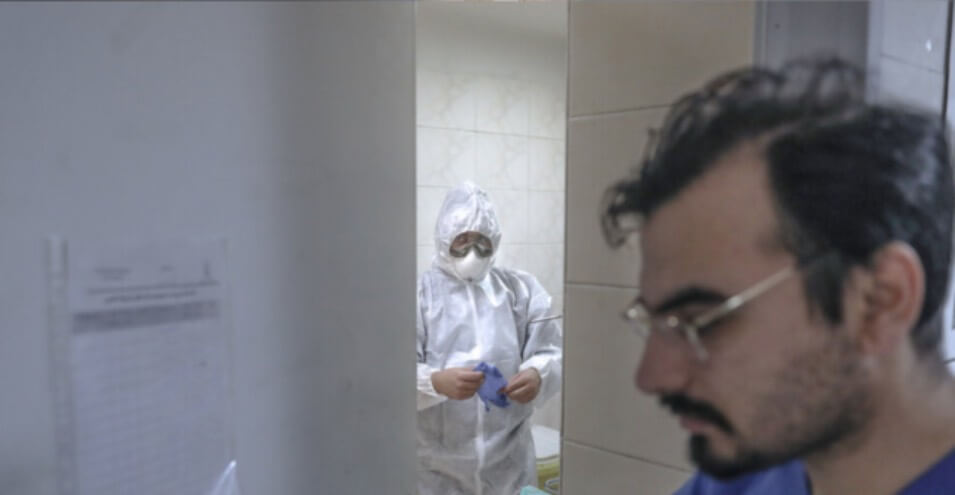
The Civil Aviation Organization changed its statement hours later and published images on its Telegram channel of people wearing special clothing and face masks, writing that these flights were at the request of the Islamic Republic government to send “humanitarian aid.”
On the other hand, while reports indicate rising numbers of coronavirus patients, there has been no restriction or limitation on attendance at Qom’s religious sites. The Health Ministry said in this regard that a proposal to temporarily restrict access to Qom’s pilgrimage sites was made, but the Qom provincial governor should have announced it.
Alongside these statements, varying statistics have been released about the number of coronavirus cases in Iran. According to unofficial reports, Babol, Rasht, Arak, and Tehran are among the cities where suspected coronavirus cases exist.
Also, the transfer of a patient suspected of having coronavirus from Shush metro station in Tehran to a hospital caused this metro station to close for several hours.
The issue of mask prices following this disease outbreak has also faced contradictions. Hossein Safavi, head of Medical Equipment and Supplies Affairs, announced that there is no shortage of masks and the price of mask supply to all manufacturing units has been announced, with necessary oversight being conducted at all stages from production to distribution.
However, social media users report that mask prices have increased following the announcement of two coronavirus deaths in Iran.
Concerns about coronavirus spread in Iran have grown as parliamentary elections are scheduled for Friday, March 21, regarding which the Health Ministry announced “there are no special considerations in this regard.”
Given these circumstances and the authorities’ history of concealing matters from the public, many social media users have expressed concerns about hiding accurate news from the people.
Previously, the concealment of death tolls and detainees in November protests and cover-ups in the truth about the downing of a passenger plane with 176 passengers had caused public trust in Iranian officials’ statements and actions to sharply decline.
Now it appears that distrust of the government and leaders of the Islamic Republic has spread alongside the coronavirus in Iran.
Source: Voice of America