Destruction of Karaj B1 Bridge: When the Target is Not Just the Military and Iran’s Destruction is on the Agenda
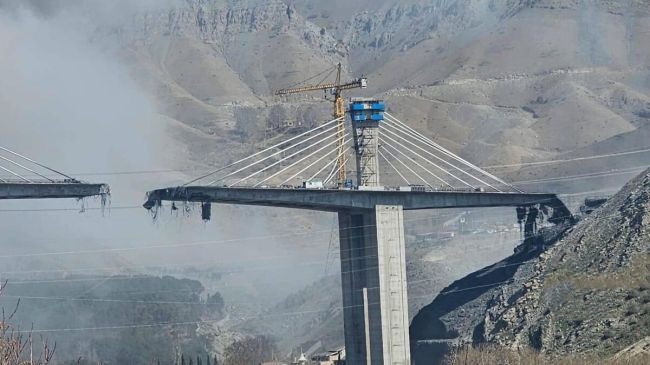
The destruction of Karaj B1 Bridge demonstrates that the target is not merely military objectives, but rather the destruction of Iran’s infrastructure and inflicting comprehensive damage to the country is on the agenda.
The attack on the B1 Bridge in Karaj was not merely a limited military operation, but rather a clear sign of a shift in the nature of targets in a conflict increasingly tied to civilian infrastructure. This bridge, constructed in the Azamiyeh area, was considered one of the largest civil engineering projects in recent years in the Middle East and was supposed to reduce traffic congestion in this region by connecting important routes such as the Chalus Road to the Tehran-North Freeway.
A project of this scale (spanning over one kilometer in length and considerable in height) had not reached operation after years of work and expenditure of several trillion tomans, when during aerial attacks, it was targeted twice and sections of it collapsed. This is while, according to city officials, this project was fundamentally for civilian use and was never recognized as a site for military deployment or gathering of forces.
What is even more shocking is the timing of this attack. On the thirteenth day of Esfand, when many citizens were present in the green spaces surrounding the bridge to spend their holidays, the attack took place. Reports indicate that 8 people were killed and dozens were wounded; people who were neither military personnel nor had any role in the conflict.
Hours after this attack, Donald Trump posted images of this action on his social media network, writing: “The biggest bridge in Iran has collapsed and will never be used again. More things are on the way!” He also warned: “It is time for Iran to make a deal before it is too late and nothing is left of what could become a great country.”
This tone, beyond a military threat, contains a clear message about targeting the entirety of a country’s infrastructure. Later, Trump again emphasized: “Over the next two to three weeks, we will deliver heavy blows to them. We will take them back to the Stone Age, where they belong.”
When such statements are placed alongside the choice of a target like a civilian bridge, they raise the serious question of whether the goal is merely to weaken military capability or to destroy the vital foundations of a country.
On the other hand, the reaction of Iranian officials also emphasized the civilian nature of this target. Abbas Araghchi, in response to this attack, stated: “Targeting civilian infrastructure, including unfinished bridges, will never force Iranians into submission. Every bridge and every building will be rebuilt, this time more robust; but what will never be repaired is the damage inflicted on America’s position, credibility and trust.”
However, beyond official positions, ground reality shows something different. An attack on a bridge that was neither operational nor had military use, and at a time when ordinary people were present around it, can hardly be justified within the framework of “military targets.”
From analysts’ perspective, this action should be examined within the framework of a “maximum pressure” strategy but in its militarized form; a strategy that targets not only military centers, but vital infrastructure, from bridges and roads to power networks, in order to disrupt the daily lives of people and increase internal pressure.
Reports also emerged of power cuts in surrounding areas and disruption to residents’ lives following this attack; another sign that the consequences of this action extended beyond a single point target. The destruction of such infrastructure, especially in fragile economic conditions, could set back development progress for years.
This attack has also sparked widespread reactions in social spheres. Some considered it an action against ordinary people and warned of its long-term consequences. Another group, within the framework of opposition to the Islamic Republic, has a different perspective; but even among these views, concerns about the future of a country with damaged infrastructure are evident.
Ultimately, what the attack on Karaj B1 Bridge reveals is the crossing of an important line: when civilian targets are directly attacked, one can no longer speak of purely military warfare. Here, the issue goes beyond confrontation with a government; signs of a strategy are evident that could lead to the overall weakening of a country and harm to the lives of millions of citizens.