Discovery of “Good Shepherd” Mural Painting Near Iznik: A Rare Window into the Faith of Third-Century Christians
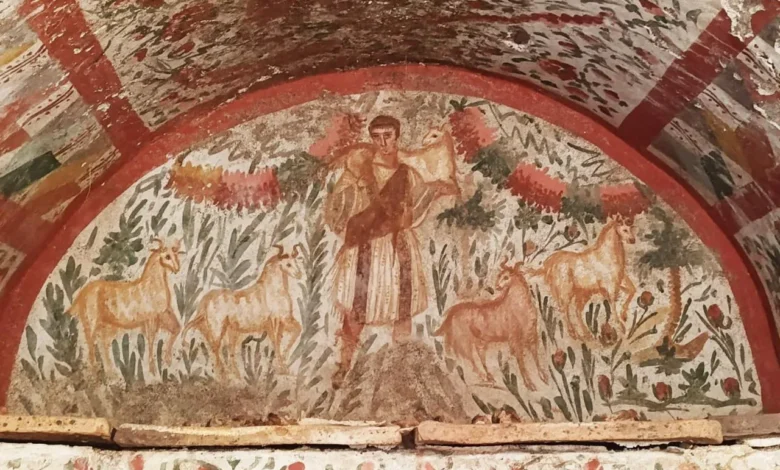
The discovery of a “Good Shepherd” mural painting in an underground burial chamber near Iznik, Turkey, has revealed one of the most well-preserved and rare images of Jesus Christ from the early Christian period.
Archaeologists in western Turkey, near the historic city of Iznik, have succeeded in uncovering a remarkable mural from the Roman era depicting the “Good Shepherd”—an image that portrays Jesus Christ as a compassionate and protective shepherd.
According to researchers, this work, which dates back to the third century AD, is considered the best-preserved known example of this Christian motif in the Anatolia region, once again highlighting Anatolia’s significant place in the history of Christian faith.
This mural was discovered within an underground burial chamber in the village of “Hisardera” near Iznik, an area that has long been an important center for the formation and spread of early Christianity. In this artwork, Jesus Christ is depicted with a youthful face, without a beard, wearing clothing similar to Roman togas, carrying a lamb on his shoulders—a symbolic image portraying him as the “Good Shepherd.”
Researchers believe that this burial chamber belongs to a period when Christians were still facing pressure, threats, and widespread persecution within the Roman Empire. In such circumstances, the use of indirect symbols rather than explicit signs of faith was a way to express Christian belief and hope for salvation. Before the cross became the universal symbol of Christianity, the image of the “Good Shepherd” was one of the most important symbols of early Christians, reflecting concepts such as love, divine protection, guidance, and salvation.
This image is reminiscent of Jesus Christ’s words in the Gospel of John: “I am the good shepherd. The good shepherd lays down his life for the sheep.” Therefore, the Good Shepherd motif is not merely an artistic image, but rather a profound expression of the faith and hope of the first Christians.
According to archaeologists, known examples of the Good Shepherd image in Anatolia are very rare, and the example discovered in Hisardera is described as unique in terms of its state of preservation and clarity of designs. Gülşen Koytbay, head of the archaeological team, states: “This work is likely the only example of its kind in the region.”
The walls and ceiling of the small, narrow burial chamber are also decorated with depictions of birds, plants, and scenes of aristocratic life. Alongside the Good Shepherd image, representations of wealthy men and women with their servants are visible, reflecting the social structure of that period.
Eren Ertem, archaeologist at the Iznik Museum, states: “These paintings depict the transition from the late polytheistic period to early Christianity, and in them, the departure of the deceased to the afterlife is portrayed in a positive and dignified manner.”
During archaeological excavations, skeletons of five individuals were also discovered in this burial chamber, with three of them identified: “two young adults and one six-month-old infant—a discovery that has raised new questions about family bonds, religious beliefs, and burial practices of early Christians in this region.”
The importance of this discovery is doubled by the historical significance of the city of Iznik. This city is the ancient Nicaea, the place where the Council of Nicaea was held in 325 AD, and where one of the most fundamental documents of Christian faith, the Nicene Creed, was adopted. Iznik continues to symbolize the formation of Christian theology and the unity of the Church in the early centuries.
In this regard, in recent months, this city has once again attracted worldwide attention, as Pope Leo XIV visited Iznik during his first foreign visit. Additionally, last month, Turkish President Recep Tayyip Erdoğan, on the occasion of the 1,700th anniversary of the Council of Nicaea, presented Pope with a ceramic tile panel inspired by this archaeological discovery during their meeting.
Anatolia played a decisive role in the history of Christianity. Saint Paul was born in the city of Tarsus, Saint John spent the final years of his life in Ephesus, and according to some Church traditions, the Virgin Mary also spent her last days in the vicinity of this region. The discovery of the Good Shepherd painting in Hisardera once again demonstrates that this land was not only a witness to historical events, but also carried the faith, hope, and testimony of the first Christians.
The discovery of the “Good Shepherd” mural painting near Iznik is, beyond an archaeological find, a visual testimony to the living faith of third-century Christians—a faith that, even in the midst of fear and persecution, still trusted in Christ as the protective shepherd and savior. This rare artwork is a bridge between history, art, and faith, and a reminder of the truth that the light of Christ was never extinguished even during the darkest periods of history.