Germany’s Effort to Play Mediating Role in Resolving Middle East Crisis
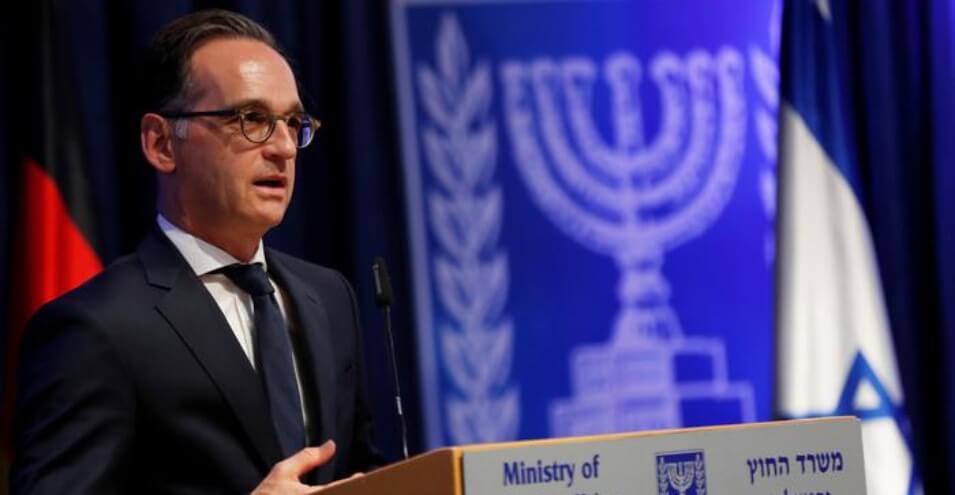
Germany’s Foreign Minister emphasized his criticism of Israel’s plans for annexing West Bank territories during a meeting with Israeli officials. According to him, Germany is willing to take on a more prominent role as a mediator in resolving the Middle East crisis.
Heiko Maas, Germany’s Foreign Minister, traveled to Amman on Wednesday, June 21 (June 10) following the conclusion of his visit to Israel to meet and discuss with his Jordanian counterpart. Maas and Ayman al-Safadi also held joint video conference consultations with Mohammad Shtayyeh, Prime Minister of the Palestinian Authority.
During his visit to Jordan, Maas pledged that Germany would support the country in fighting the coronavirus pandemic by sending 23,000 coronavirus test kits and 32 testing devices. However, the main topic of the talks between the parties was the Middle East crisis.
Germany’s Foreign Minister stressed that the country is willing to play a more prominent role in resolving the Middle East crisis during Germany’s EU Council presidency, which begins on July 1.
According to him, Germany will undoubtedly play the role of mediator, especially within the framework of European Union activities as well as in the UN Security Council. From July, Germany will also hold the rotating presidency of the Security Council.
Maas added that his vision is for Germany to be able to play the role of an “honest broker or mediator” in these institutions, including in bringing Israel and Palestinians to the negotiating table.
Mohammad Shtayyeh, Prime Minister of the Palestinian Authority, expressed dissatisfaction that Germany’s Foreign Minister, contrary to usual practice, did not travel to Palestinian-populated areas this time, saying: “This is not a good sign.” The German government cited the coronavirus pandemic as the reason Maas did not visit Palestinian-populated areas.
However, according to Shtayyeh, coronavirus is an excuse and the Israeli government did not issue permission for a meeting in Ramallah. He had also spoken of Israel’s attempt to dictate its policies to Maas.
During his visit, Heiko Maas asked Palestinian leadership to present “specific proposals” so that conditions for talks with Israel could be established based on them.
He clarified on this matter: “The UN plan and program in this regard is on the table. But in my opinion, it would be helpful if the Palestinian side also presented specific proposals on how the door to talks could be opened again.”
On Tuesday, June 9, Palestinians presented their four-and-a-half-page plan to express their position regarding the Trump plan for the Middle East. The Palestinian plan proposed “the establishment of an independent and non-military Palestinian state.”
The establishment of an independent Palestinian state was also included in the Trump plan, but without considering East Jerusalem as the capital and the Jordan Valley in the West Bank, which has great economic and strategic importance, will also be part of Israel in this plan.
Before traveling to Jordan, Heiko Maas met and held discussions with Israeli officials. He criticized Israel’s plans for annexing Palestinian territories and considered it contrary to international law. He also spoke of the need to resume negotiations between the two sides, which had been stalled six years ago.
The new Israeli government, which was sworn in three weeks ago, intends to annex up to 30 percent of the occupied Palestinian territories in the West Bank based on the Trump plan for the Middle East to Israeli soil.
Initial steps in this regard could begin on July 1, precisely the date when Germany takes on the rotating presidency in the EU Council and the UN Security Council.
Maas’s mission in Israel was undoubtedly difficult. Germany, due to its dark past and the organized slaughter of millions of Jews, has special relations with Israel and considers the preservation of the country’s security as part of its overall policies.
On the other hand, the German government has consistently and explicitly criticized Israel’s settlement policies in Palestinian territories and considers the annexation of part of their occupied territories in the West Bank to Israeli soil as a clear violation of international law.
EU member states are engaged in discussions and consultations on whether to impose sanctions on Israel in the event of annexation of occupied territories.
According to Heiko Maas, Germany’s Foreign Minister, as long as final decisions have not been made, it is not right to resort to threatening policies.
Maas, in his meeting and discussion with his Israeli counterpart, raised Germany’s “serious and sincere concerns” about this program and emphasized: “Germany and the European Union believe that the annexation of Palestinian territories is not in accordance with international law.”
In the Six-Day War of 1967, Israel occupied the West Bank of the Jordan River and East Jerusalem (Bait al-Maqdis) and has since been building settlements to accommodate its citizens in the occupied territories. Palestinians seek to reclaim their lands and consider East Jerusalem the capital of their future state. Israel, unlike the European Union, does not consider settlement building as a violation of any law.
Source: DW