Global Voice of Freedom: Support from Iranians Abroad for People Inside Iran
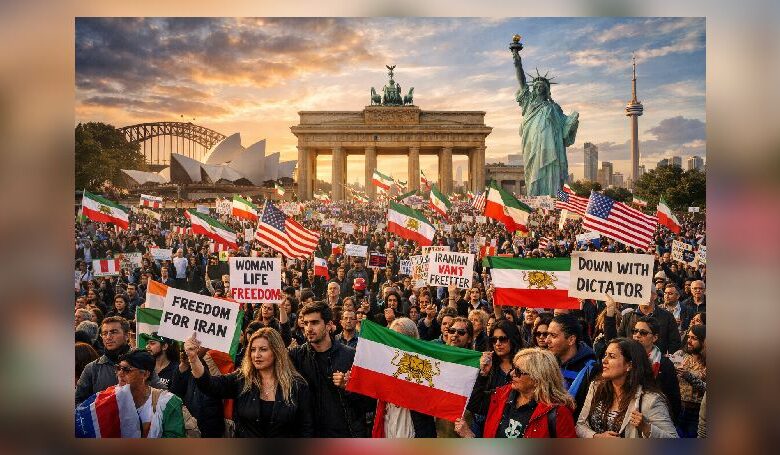
Iranians residing across the globe have taken to the streets to support the people of Iran and joined protests, a solidarity that transcends borders.
As nationwide protests in Iran enter their third week and security forces attempt to suppress them through severe crackdowns and internet shutdowns, Iranians living abroad have once again demonstrated their support for the people inside Iran through widespread and passionate gatherings across different continents. This transnational solidarity shows that the “Woman, Life, Freedom” movement has now become a global voice for freedom and justice.
In major European cities such as Berlin, Brussels, The Hague, and Amsterdam and other cities in the Netherlands, thousands of Iranians and human rights supporters gathered in the streets to display their support for protests inside Iran while chanting slogans such as “Woman, Life, Freedom” and “Death to the Dictator.” Protesters in Berlin, carrying placards with symbols of resistance and the Iranian flag, demanded an end to suppression and international accountability for Iran’s internal crisis.
In London as well, hundreds gathered in front of Iran’s embassy; protesters not only chanted against the suppression of protests in Iran, but also lowered the official flag and raised the pre-1357 (1979) revolution flag featuring the Lion and Sun, conveying a message of resistance and hope for the future to the world. It is worth noting that British police did not prevent the lowering of the Islamic Republic’s flag from the Iranian embassy entrance. Protests in Britain continue in other major cities such as Birmingham, Newcastle, Manchester, and elsewhere.
In the United States and Canada as well, Iranians and their allies held major gatherings in cities such as New York, Washington, Los Angeles, Toronto, and Montreal. Participants, carrying placards about human rights, called for cutting foreign support to suppressors and applying political pressure on the Islamic Republic.
In Australia too, Iranians residing in Melbourne, Sydney, and other cities took to the streets, their voices united with protesters inside Iran, crying out for freedom and an end to oppression. These gatherings took place as news of internet shutdowns and families being cut off from their loved ones has created widespread concerns among the Iranian diaspora.
Iranians outside the country have not been active only in physical gatherings; rather, through united slogans and global messages, they are attempting to amplify the voice of internal protests and draw the attention of international media and human rights organizations. Many participants carried placards with messages such as “Free Iran, Freedom for All,” “Our voice is the voice of the Iranian people,” “This is not the last battle, the Pahlavi will return, When? Reza Pahlavi,” “Long live the Shah,” “Your soul is at peace, Reza Shah,” and “Death to the Dictator,” reflecting emotional and political solidarity with protesters inside the country.
Recent developments also show that the Iranian diaspora has not only held protests in previously known cities, but has also organized demonstrations in lesser-known cities such as Hamburg, Budapest, Auckland, Tokyo, and other global centers, which demonstrates the breadth of international support.
Human rights experts and political analysts believe that this global support for Iran’s protests goes beyond simple gatherings; it is a clear political message to Iran’s government and the international community that the Iranian people’s desire for freedom, justice, and deep structural change has supporters and voices not only within the country but throughout the world.
In sum, the presence of Iranians in the streets of America, Europe, Canada, Australia, Britain, and other parts of the world demonstrates that the movement of Iran’s people is no longer confined to geographical boundaries and has transformed into a global wave of freedom-seeking that has captured the attention of politicians, media, and international organizations.