Hamid Noori Denies Existence of Khavaran Cemetery at 1988 Executions Trial
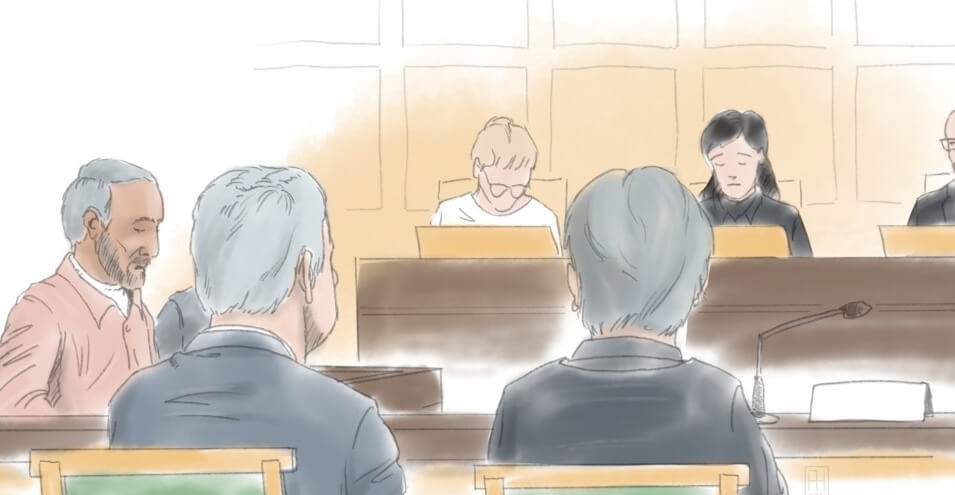
Hamid Noori, accused of participating in executions during the summer of 1988, denied the existence of mass graves in Khavaran during the fifth session of his defense in courtroom 37 of Stockholm District Court in Sweden, claiming that Khavaran has no external existence.
He described Khavaran as “false” and “fabricated,” claiming that communists invented this story.
Noori claimed that while he was in Iran, he had never heard anything about this matter and only learned about Khavaran after his arrest.
During the morning court session on Wednesday, December 1st, he simultaneously confirmed that the bodies of executed prisoners were not handed over to their families, claiming that the execution unit did not return the bodies of executed prisoners whose families did not comply with regulations and buried them themselves.
Khavaran Cemetery in east Tehran is a tangible symbol of body confiscation and grave desecration; mass graves and a cemetery known as a symbol of those executed in the 1980s, where some Bahá’ís have also been buried.
Islamic Republic security officials have continued to prevent the families of victims from visiting the cemetery and have imposed numerous restrictions in this regard.
Based on the accounts of families and survivors of 1980s executions, the bodies of executed prisoners and political opponents were buried in mass graves in Khavaran, which was given the name “Lanatabad” by the government.
Hamid Noori is accused of participating in mass executions of political prisoners at Rajai Shahr Prison (Gohardasht), charges he denies, claiming he was at Evin Prison from 1982 to 1993.
He arrived at Stockholm airport on November 9, 2019 on a direct flight from Iran and was immediately arrested.
During Wednesday’s session, according to previous court announcement, Manouchehr Eshaqi was scheduled to testify as a witness and complainant, but based on the judge’s decision, the session was dedicated to Hamid Noori’s defense statements. The prosecutor had stated in the previous session that he had many questions for Hamid Noori.
Thursday’s session on December 12 will also be dedicated to Hamid Noori’s defense and questions from lawyers representing the complainants and witnesses, according to the judge’s announcement.
During Wednesday’s court session, Hamid Noori denied the execution of communists and claimed that in Iran no one interferes with anyone’s personal beliefs. He referenced the Quranic verse “There is no compulsion in religion” and denied that prisoners were executed because of their beliefs.
He also accused Ayatollah Hossein-Ali Montazeri, the then deputy of Ayatollah Khomeini, of “lying” and called the audio file of his meeting with members of the Death Committee “fabricated.” He claimed that Montazeri’s speech was like shaking pebbles in a box and that this file is “fabricated.”
Ayatollah Montazeri’s Telegram channel published an audio file on August 10, 2016 from a meeting on August 15, 1988 between the late marja with four judicial officials at the time, in which Ayatollah Montazeri told them: “The greatest crime in the Islamic Republic, from the beginning of the revolution until now, has been committed by you. In the future, you will be remembered as criminals in history.”
Hamid Noori said that Montazeri fell off the revolution’s train and has no credibility for the Iranian people. He also rejected Montazeri’s interviews about the executions, saying that “the words of a counter-revolutionary and opponent of the Imam have no value.”
He called the Death Committee a self-created committee of Montazeri and claimed he lived with Ayatollah Montazeri for 20 years. He claimed that Ayatollah Montazeri’s voice was such that “people mocked him and gave him a bad name.”
In response to the prosecutor’s question, he said that in 1981 he formed a “Command Headquarters for Front Support and Marivan War” with several other soldiers and he was the head of this headquarters, and in this regard had also met with Ayatollah Montazeri.
Hamid Noori, who according to the complainants’ account was the former deputy judge of Gohardasht Prison during the executions, for the umpteenth time denied the summer 1988 executions and called the court’s witnesses and complainants liars.
This comes as one of the executioners, Ibrahim Raisi, who was a member of the Death Committee, said after the 2021 presidential election that the 1988 executions should be subject to “appreciation and encouragement.”
Mostafa Pourmohammadi, another member of this committee, had said in September 2016 that regarding the executions of the 1980s, he acted according to Islamic law and throughout these years did not lose a single night’s sleep.
Later in the court session, Hamid Noori said about the Friday prayer sermons of August 5, 1988, which were raised by complainants and witnesses in court, that Mousavi Ardabili, the preacher of this Friday prayer, did not say that all Mujahideen should be executed.
In response to the prosecutor’s question, he rejected the statements of some complainants in previous court sessions that they saw him after the executions in the streets and said: They said they saw me and I was scared. Is someone who goes to Evin Prison from the age of 21 a coward? Can someone who goes to Kurdistan to fight at 19 be a cowardly person?
Majid Jamshediyat, as a witness and complainant in previous court sessions, had said that when he accidentally saw Hamid Noori on Abbas Abad Street in Tehran in 1995 or 1996, Noori frantically told him that he no longer works in the prison: “In prison they felt very powerful, but outside the prison, they felt terrified and perhaps even ashamed. He immediately approached me and said he no longer works in the prison and works in mining.”
Mohammad Zand, as a complainant and witness, had also said that after being released from prison, he was a taxi driver and saw Hamid Noori in Azadi Square in Tehran: “I was a taxi driver. Hamid Abbasi (Noori) said Karaj. I stopped. He came to the front of the car and when he saw me, he regretted it and said I don’t want to. Because he recognized me. I also recognized him.”
Hamid Noori questioned an audio tape attributed to Naserian (Mohammad Moghisseh) that was recently submitted to the court by the Mujahideen-e Khalq as evidence.
Thousands of political prisoners in the 1980s, particularly in the summer of 1988, were executed in Evin and Gohardasht prisons in Tehran and prisons in Mashhad, Shiraz, Ahvaz, and some other Iranian cities on the direct order of Ayatollah Khomeini, the then leader of the Islamic Republic, and by the decision of committees that became known as Death Committees.
Many of these executed prisoners were supporters of the Mujahideen-e Khalq Organization and many others were supporters of left-wing groups who had been imprisoned in the early 1980s.
Due to Iranian government cover-up, there is no accurate count of these executions, but according to Amnesty International’s report, at least 4,482 men and women disappeared within two months.
In a previous court session, Hamid Noori also denied “Ayatollah Khomeini’s fatwa” regarding political prisoners in 1988 and had claimed that this phrase was “forged.”
Ayatollah Khomeini, in a formal letter in 1988, explicitly states: “Those who persist in their position of hypocrisy in prisons across the country and continue to do so are wagers of war and sentenced to execution, and the determination of the matter is in Tehran by the majority vote of Hujjat al-Islam Niri… (religious ruler) and Mr. Eshraq (Tehran prosecutor) and a representative of the Ministry of Intelligence.” The former leader of the Islamic Republic in this decree also referred to prisons in provincial centers and wrote that in these centers “the majority vote of the judges, the revolutionary prosecutor or judge, and the Ministry of Intelligence representative is binding. Mercy to simple-minded wagers of war is misplaced. Those gentlemen who are responsible for determining the matter should not be tempted by doubt and uncertainty and should try to be severe against the disbelievers. Doubt in Islamic revolutionary legal matters is disregarding the pure and sacred blood of martyrs.”
The trial of Hamid Noori, which will continue at Stockholm District Court in Sweden until April 2022, has also prompted reactions from Islamic Republic officials.
With the beginning of Hamid Noori’s defense sessions, two people from the Iranian embassy in Sweden are also present in the court sessions, although they are not seated in the main courtroom but in another room following Noori’s defense.
Saeid Khatibzadeh, spokesman for the Islamic Republic’s Ministry of Foreign Affairs, on the first day of Noori’s trial called it “a design” by the Mujahideen-e Khalq Organization and claimed that the Swedish court “relied on a series of false stories and documentation and witness fabrication, all carried out by a small group.”
Source: Radio Farda