“In Iran’s Road Accidents, the Driver is Not the Only One to Blame”
The chairman of the board of directors of the Professional Association of Long-Distance Bus Drivers in Iran says that in road accidents, the driver is not solely responsible. Driver fatigue caused by multiple trips, road conditions, and the age of buses are also accident-causing factors.
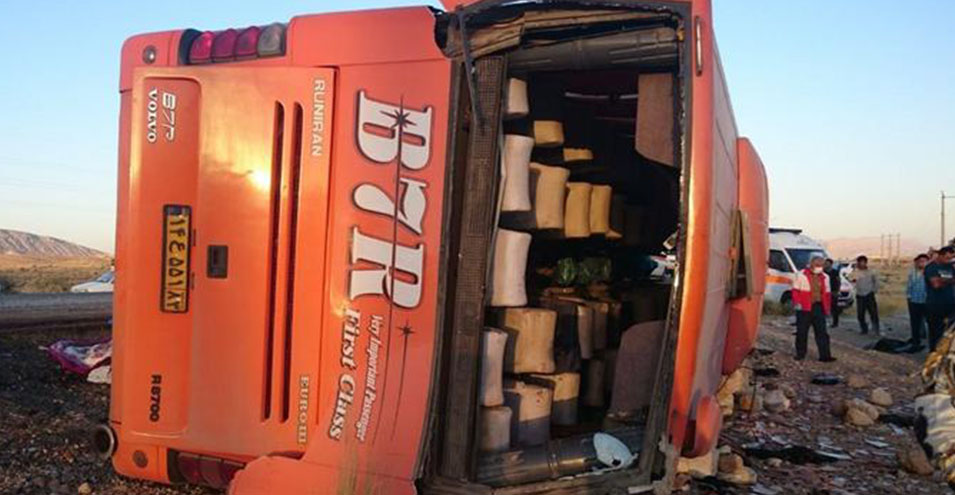
In the unfortunate incident of a bus carrying elite students overturning in Hormozgan Province (September 1st) which claimed the lives of at least 12 people, including 9 students, the bus driver was declared responsible.
Authorities investigating the accident stated that “driver negligence” was the cause. It was said that “the driver was drowsy while driving and lost control of the bus after hitting a bridge barrier and a front tire burst. The bus rolled onto its right side after traveling approximately 100 meters.”
However, union officials and activists from the Professional Association of Passenger Transport Vehicle Drivers say that in road accidents of this kind, drivers are not the only ones to blame.
According to Iran’s Labor News Agency (ILNA), professional activists in the passenger transport industry believe that excessive driver fatigue caused by multiple trips, poor quality of urban and intercity roads, and the failure to modernize the bus and minibus fleet are the main reasons for the increase in accidents.
Gholamreza Khademizadeh, chairman of the board of directors of the Professional Association of Long-Distance Bus Drivers, considers “driver drowsiness” more influential than any other factor in causing accidents. A factor that itself results from another issue: the lack of necessary conditions and facilities for drivers to rest.
This union official told ILNA that the highway police currently report that 60-70 percent of accidents are caused by driver drowsiness, while the law has made the government responsible for building dormitories for drivers. However, nowhere, not even in the 4 passenger terminals in the capital, are there dormitories for drivers.
According to the chairman of the Professional Association of Passenger Transport Drivers, under these circumstances drivers have no choice but to rest in a sleeping bunk inside the bus, which certainly will not provide restful sleep due to the noise of the terminal environment, and this will certainly affect the quality of their work while driving. Therefore, under these circumstances, expecting a driver not to become drowsy is unreasonable.
Beyond dormitory facilities, other amenities such as showers, air conditioning, and heating equipment should exist in drivers’ workplaces. According to Khademizadeh, none of these essential infrastructures exist in passenger terminals. While in European countries there are standard dormitories for drivers equipped with sound insulation and complete ventilation systems.
Technical Offices Have Been Converted into Food Shops
In the opinion of the chairman of the board of directors of the Professional Association of Long-Distance Bus Drivers, another reason for excessive driver fatigue relates to the absence of technical offices inside the country’s passenger terminals. He says: “Technical offices were established long ago to prevent wasting drivers’ time and energy at terminals. This way, drivers would leave their shift scheduling forms at the terminal early in the morning when they arrived, so that the office manager could assign driving shifts to drivers based on the service companies’ requests.”
According to Khademizadeh, these offices have now been repurposed, and a driver must waste considerable time and energy to find a service, for example being able to find a service for the Tehran-Ahvaz route at 4 PM in the middle of the day, which alone is enough that the driver cannot rest sufficiently.
Most bus companies have converted their offices into food shops from which they generate millions in revenue, so drivers are forced to wander around the terminal. According to Khademizadeh, these conditions exist in both private and state-owned companies.
As Khademizadeh says, a cabinet resolution has obligated the Terminal Organization and all city municipalities in the country to equip passenger terminals with dormitories meeting the required technical parameters, but no action has been taken in this regard, to the point that it can be said no dormitory even meeting 30 percent of standards exists in the entire country for drivers.
Another reason for disrupted sleep and rest schedules for passenger drivers is roadside checkpoints. Khademizadeh says in this regard: A driver resting in the bus’s sleeping bunk is awakened by a highway police officer at the first patrol post they reach to check travel documents, an event that is repeated several times throughout the day. This very factor leads to irregular sleep for the driver, which combined with fatigue from daily driving on roads, becomes problematic.
The Role of Monitoring Cameras in Driver Cabins
The chairman of the Professional Association of Long-Distance Bus Drivers continued his conversation with ILNA by also criticizing the role of driver monitoring cameras in buses. He said, “The intelligent fleet traffic monitoring system” was installed by highway police on buses to reduce road casualties. This device includes an online streaming camera for monitoring driver behavior.
Khademizadeh says a driver is forced to drink tea and coffee to avoid drowsiness and even talk to the assistant driver. With this device, the driver is fined if they consume a beverage while at the wheel or talk to the assistant driver. Even if they want to switch seats with the assistant driver during drowsiness, the camera records this movement and the driver is fined for handing the vehicle to someone else and their license may even be confiscated.
He emphasizes that installing these monitoring cameras is an illegal and unethical measure that is not seen anywhere in the world.
This union official adds that despite all these conditions, after reaching their destination, the driver must think about the technical problems of the bus: they must change the oil or fix a flat tire and refuel so the vehicle is ready for the next day, which altogether takes two hours of the driver’s time. And only then do we reach the point that the driver has no suitable place to rest in any of the major cities.
The high age and wear of buses is another factor affecting road accidents. The chairman of the Professional Association of Long-Distance Bus Drivers says that although the average lifespan of fleets is between 8 to 10 years, these vehicles, which are from well-known international brands, are assembled domestically, which has caused their quality to be at the lowest level in the world compared to the original vehicles, and this places enormous costs on the owner and driver.
Extended Working Hours and Road Problems
Fatigue from extended working hours is also among the accident-causing factors on Iranian roads. Khademizadeh says in this regard that a service driver works more than eight hours a day. Although the route journey may not take more than eight hours, they must spend more than eight hours for coordination and moving the bus outside the city, which leads to extreme fatigue.
The chairman of the Professional Association of Passenger Transport Drivers adds that companies may not provide an assistant driver to save costs, and this issue becomes extremely tiring for the driver after two daily trips. This is while drivers employed in office and factory services do not have smart transit cards and road transport permits.
This union official continues by pointing to Iranian road problems as another accident-causing factor and says that single-lane highways continue to claim victims. For example, there was a time when the Kerman-Rafsanjan road had dozens of deaths and injuries daily due to being single-lane, and now that it has been made two-lane, the accident rate has dropped significantly. Therefore, one of the reasons for the rising death-causing accidents is single-lane highways.
The chairman of the Professional Association of Passenger Transport Drivers of the country added that overall, standard guard rails (roadside and median barriers) do not exist on roads, and traffic signs are small, all of which are problematic for buses, which are difficult to control on some routes.
Source: DW