Iranian Activists in Europe Call on Macron to Support ‘Nationwide Uprising’ of Iranian People
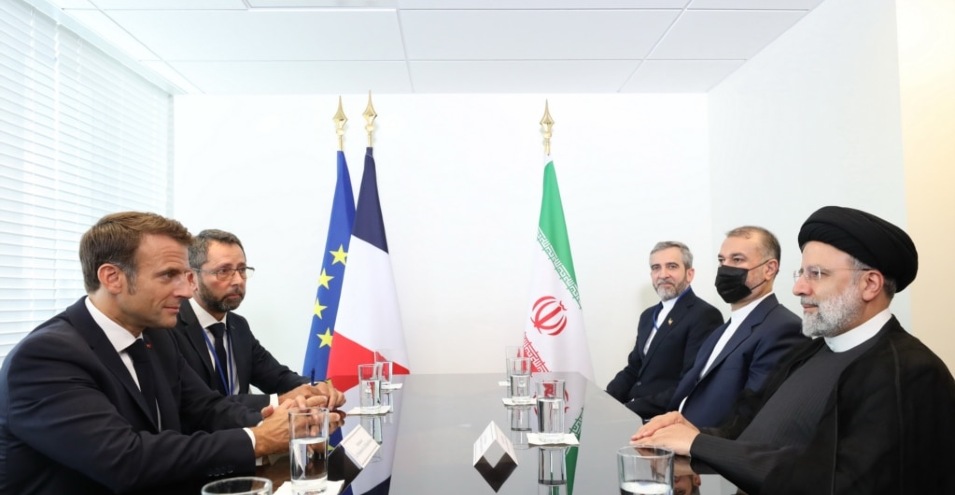
Ten days after Emmanuel Macron’s meeting with Ibrahim Raisi on the sidelines of the 77th UN General Assembly, a number of Iranians living in Europe have written to the French president asking whether he does not think that this meeting “has displeased many Iranians.”
The signatories of the letter, referring to “the nationwide uprising of the Iranian people that continues following the death of Mahsa (Jina) Amini,” have described Ibrahim Raisi as “one of those accused of the massacre of thousands of innocent Iranian prisoners in the summer of 1367 in Iranian prisons.”
The letter to Mr. Macron was signed by a number of journalists, academics, and political activists in Europe, including some in France.
Emmanuel Macron met with Ibrahim Raisi on September 20 in New York, and according to his own account, the main subject of this meeting was around efforts to revive the JCPOA.
The meeting took place six days after Mahsa Amini’s violent arrest in Tehran by the “Moral Security Police” and four days after her death was officially announced in a Tehran hospital.
Since then, the French president has neither reacted to this incident nor commented on it on social networks.
The protest demonstrations following Mahsa Amini’s death initially sparked in the cities of Sanandaj and Saqez in Kurdistan, which was Mahsa’s hometown province, and in subsequent days spread to over a hundred cities in Iran.
However, Mr. Macron, at the end of his meeting with Ibrahim Raisi and while extensive news of Iranian protests had not yet been widely reflected globally, told BBC Persian that he had raised the issue of “violence” in Iranian society and “the necessity of respecting women’s rights” with the Iranian president.
According to Ibrahim Raisi’s aides, in response to these remarks by Emmanuel Macron, he recalled the violent behavior of French police in the lengthy “Yellow Vest” protest movement.
During the Islamic Republic’s president’s stay in New York, apart from the president of France and the president of Switzerland, whose country is the protector of American interests against Iran, few officials from Western countries met with him.
Iranian media had written that the French president was carrying a message regarding efforts to revive the JCPOA, and the Swiss president had a separate message, in response to which Ibrahim Raisi had said that there is no point in meeting with those who break their word.
From the content of this response, it apparently emerges that the presidents of France and Switzerland had attempted to facilitate the possibility of direct meetings between Iranian and American officials, at least at the diplomatic level, on the sidelines of the UN General Assembly.
The Iranian signatories of the letter to Emmanuel Macron have asked him to support the protest movement of the Iranian people “in these sensitive circumstances” and “by using the position he holds in Europe and the world, not to leave the Iranian people alone in their struggle against the Islamic Republic of Iran.”
Leaders of European and American countries, who have strongly condemned the recent violence in Iran, still insist that this is separate from efforts to conclude the JCPOA negotiations.
Ibrahim Raisi, in a television program on the evening of the sixth of Mehr on the news network, stated that he told Emmanuel Macron that the age of French buildings exceeds the age of America and not to allow France to be portrayed under the influence of others.
The French Foreign Ministry on the fifth of Mehr in a statement “strongly condemned violence, arbitrary arrests, pressure and arrest of journalists, violation of women’s rights and freedom of expression and severe internet restrictions in Iran.”
Recent two weeks of protests in Iran have had extensive coverage in French media and have even been referred to as signs of a new “revolution.”
In recent days, French police, with the aim of preventing Iranian protesters in France from approaching the Islamic Republic’s embassy in Paris, have dealt harshly with some protesters, which along with the behavior of British police against protesters in London, has become the subject of numerous reports in Iranian government media, accusing these two countries of “speaking out of both sides of their mouths.”