Iran’s Defense Minister: Ukrainian Plane’s Black Box Has Been Damaged
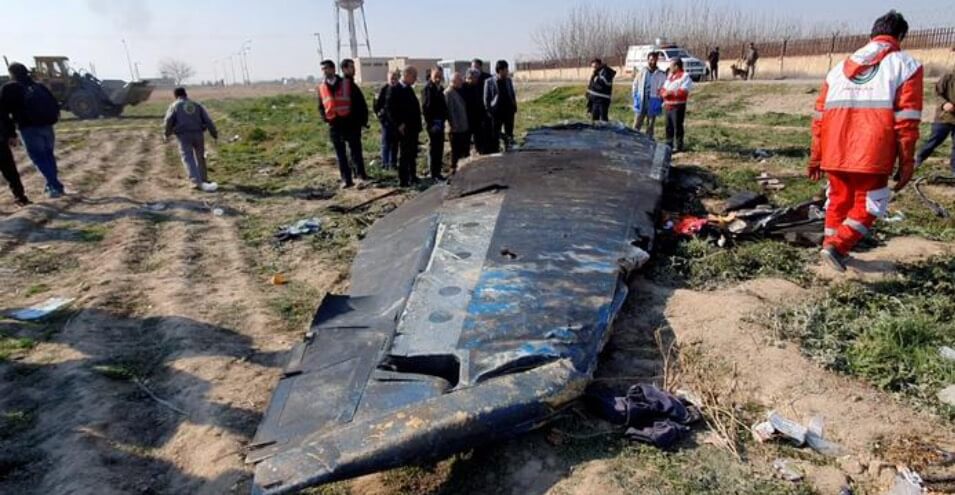
The fate of the black box from the Ukrainian plane shot down by a Revolutionary Guard missile remains unclear, and contradictions among Iranian officials continue. One official says they won’t hand over the black box, another says they might, and the defense minister says the black box has been damaged and will be reconstructed.
Days after five countries involved in the downing of the Ukrainian passenger airline issued a categorical request for the prompt handover of the black box, senior officials of the Islamic Republic continue to contradict each other.
Foreign Minister Mohammad Javad Zarif, who recently stated that Iran would not hand over the Ukrainian plane’s black box to foreign governments, claimed at the margins of Wednesday’s government session on the 30th of Bahman that his remarks were “cut short” and that he meant: “We have the right to read the black box ourselves. We have the right to be present in any investigation of the black box.”
Many officials of the Islamic Republic, including Zarif, have previously acknowledged that Iran lacks the technical capability and knowledge necessary to read the black box of the downed plane.
Senior officials from five countries—Ukraine, Canada, Britain, Sweden, and Afghanistan, whose citizens died in the downing of the Ukrainian plane—demanded on the 26th of Bahman in a joint statement that the Islamic Republic honor its commitments under international agreements and promptly hand over the black box from Flight 752, Tehran-Kyiv, to centers capable of reading it.
Readiness Declared for Black Box Handover
Farsi News Agency reported two days after the release of this statement, quoting Mohammad Eslami, Minister of Roads and Urban Development, that if the Islamic Republic is unable to read the black box data from the downed plane, it is willing to send it to a third country in coordination with Kyiv.
The Ukrainian passenger plane was hit by two air defense missiles from the Revolutionary Guards early on the 18th of Dey, minutes after taking off from Tehran airport, killing all 176 passengers on board.
Islamic Republic officials refrained from revealing the true cause of the plane’s downing for three days, despite having precise knowledge of the incident, and instead engaged in contradictions and cover-ups that continue to this day.
Defense Minister and “Significant Damage” to Black Box
Amir Hatemi, Defense Minister under Hassan Rouhani, on the 30th of Bahman presented a new narrative about the incident among journalists, saying: “This black box has sustained significant damage and we have requested the defense industry sector to help with the reconstruction of the black box. It has been decided that the black box will first be reconstructed and then read.”
Apparently, the Islamic Republic is concerned that reading the black box will reveal new information that will further expose officials’ contradictions about the plane’s downing.
Recently, Ukrainian media released an audio file of a conversation between a pilot of one of Aseman Airlines’ flights and Tehran airport’s control tower at the time of the incident, which confirmed that contrary to the claims of all Iranian military and government officials, the missile strike on the Ukrainian plane was identified within the first minutes.
Amirali Hajizadeh, commander of the Revolutionary Guards’ aerospace force, took responsibility for the incident three days after the plane’s downing in a television interview and said that the operator of the Revolutionary Guards’ air defense system “mistakenly identified the Ukrainian passenger plane as a cruise missile” and fired at it.
Ukraine has recently emphasized that holding a single soldier of the armed forces responsible for the plane’s crash is unacceptable, and other individuals within the structure that enabled such an error should also be held accountable.
Days ago, several Canadian lawyers on behalf of survivors of some of the victims filed a complaint against some senior officials of the Islamic Republic, including Ali Khamenei as supreme leader of the armed forces and a number of senior Revolutionary Guards commanders, in court. In this case, Iran has been asked to pay 1.5 billion Canadian dollars (equivalent to 1.1 billion U.S. dollars) in compensation.
Iran’s Concern About Case Being Referred to International Courts
Leila Joneidi, legal deputy to the president, on the 30th of Bahman informed of Iran’s efforts to prevent the case from being referred to international courts and expressed hope that with the joint investigation committee reaching results acceptable to Iran and countries involved in the incident, this issue would be resolved.
According to Joneidi, the International Civil Aviation Organization (ICAO) normally follows the technical report of the joint committee, and Tehran hopes that through cooperation with this committee “shortcomings will be addressed.”
Rouhani’s deputy told the Borna News Agency that the government will make necessary efforts, including “compensating the victims, treating all victims and those affected by this incident equally,” to prevent the case from being taken to international courts.
Given Canada and Ukraine’s requests and emphasis on the need to identify and pursue justice regarding the commanders and officials responsible for the missile attack on the Ukrainian plane, and the complaint filed against Khamenei and Revolutionary Guards leaders, it is unlikely that this case will be closed soon and easily with just the payment of compensation.
Amir Hatemi, regarding the timing of reading the Ukrainian plane’s black box, said: This black box has sustained significant damage and we have requested the defense industry sector to help with the reconstruction of the black box. It has been decided that the black box will first be reconstructed and then read.
Source: DW