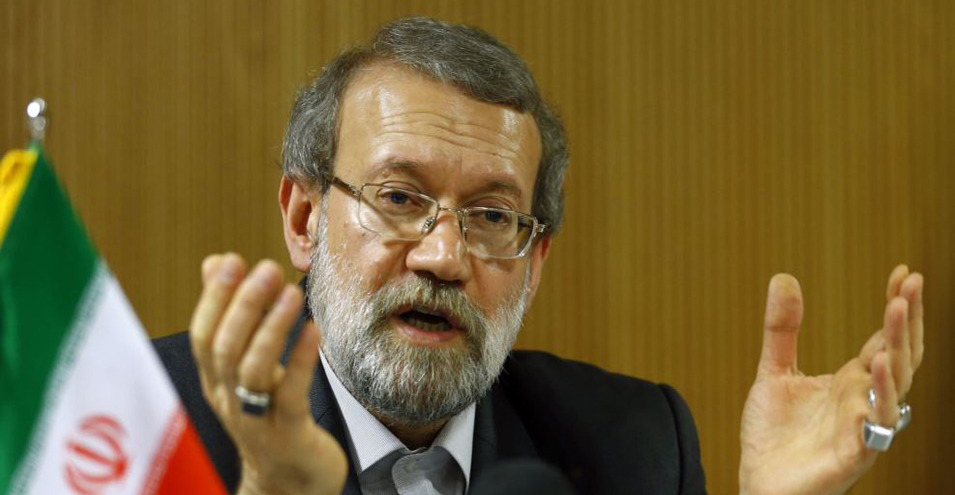
The Speaker of Iran’s Parliament in an unprecedented speech outlined the severe dimensions of Iran’s backwardness in economic and managerial spheres by citing statistical data. At the same time, he states that at the helm of affairs is the leadership and the guardianship of the jurist, in which popular sovereignty in that institution is serious.
Ali Larijani on Thursday in a speech at the twelfth national congress of the Islamic Association of Engineers and the commemoration of Government Week presented alarming statistics about Iran’s economic and managerial situation.
According to Larijani, per capita gross national product is one of the components of a country’s economic situation, but in this regard Iran stands at rank 94 among 185 countries, and in terms of economic freedom, Iran is at the bottom of the table, ranking 171st among 178 countries. In describing these figures, he said that “this means that competition in our country is very low.”
Larijani also cited Iran’s unemployment ranking 82nd among 104 countries and said that few countries in the world have double-digit unemployment rates, with Iran being one of them. Larijani, pointing out that Iran ranks 164th among 178 countries in attracting foreign investment, added: “We have a problem in terms of attracting investment, and in these conditions Iran’s ranking among 187 countries in terms of support for investment is 167. This shows that our people prefer to invest their money where it yields quick results, and this is due to the difficult and corruption-prone bureaucratic conditions of the country, which is why people prefer to place their money in a safe place like a bank and take the 18 percent interest, but not invest in production.”
Villages that have emptied, brains leaving the country
According to the Parliament speaker, Iran also ranks 130th out of 140 countries in respecting intellectual property rights, which “has created concern among entrepreneurs.” And while Iran’s leader and some senior officials consistently point to costly uranium enrichment or some measures in the field of nanotechnology or stem cells as signs of Iran’s “spectacular” progress, Ali Larijani, citing statistics, says that Iran “ranks 111th out of 140 countries in terms of access to the latest technology. A matter that may be due to the superficial approach of managers and the lack of vision for using new technologies.”
Larijani then, noting that only 50 percent of Iran’s development programs are implemented, ranked this country 134th among 140 countries in attracting talent, which is prominently symbolized by the widespread exodus of brains from Iran.
Iran 1404, perhaps another time
The Islamic Republic has repeatedly reiterated the slogan of caring for villages and remote areas and shown itself to be a supporter of it. But Ali Larijani says that after 37 years, today “villages are being emptied because there is no favorable economic cycle in villages for progress and they are forced to migrate. The result is that 70 percent of Iran’s people have become urbanized, and Iran in this regard ranks 12th among 216 countries.”
Larijani’s unprecedented remarks about Iran’s economic backwardness come as the Islamic Republic, in accordance with the plan known as “Iran’s Vision 2024 Document” which is considered an upstream document for Iran’s development, should by this year be “in the first position economically, scientifically and technologically in the region of Southwest Asia (including Central Asia, the Caucasus, the Middle East and neighboring countries) with emphasis on the software movement and science production, rapid and sustained economic growth, relative improvement in per capita income level and achieving full employment.” It is unclear how, with the statistics cited by Larijani which show fundamental backwardness in some indicators compared to the time of the revolution, Iran is supposed to reach the “Vision 2024 Document.”
Points not mentioned
Many critics of Iran’s regional policies and lack of international cooperation, as well as a security and military approach to stability and authority, consider them among the factors of the backwardness mentioned by Ali Larijani, but the Parliament speaker did not mention these in his speech. At the same time, while praising Iran’s political system for the central role of the “Guardian Jurist” in Iran and calling this system democratic, he complained that some of the mentioned problems stem from weak organization, lack of party activities and shortcomings in political management in Iran. This is while critics consider this very central role of the Guardian Jurist incompatible with the presence of powerful parties and a barrier to the implementation of party programs and the development of strong party managers.
Years ago, even Hashemi Rafsanjani implicitly considered this matter a contradiction that should “be worked on”: “We have a specific issue that we need to work on, and that issue is the guardianship of the jurist. Because parties that come and powerful non-executive people who enter the party want to make decisions and create policies, which these policies become programs, and if they win, their programs in the course of running the country become law, and if they know that these do not have the right to determine policy and must operate within a certain boundary, they do not engage in partisanship.”
Source: DW