Iran’s Economy Minister: 55% of Export Currency Has Not Returned to the Country
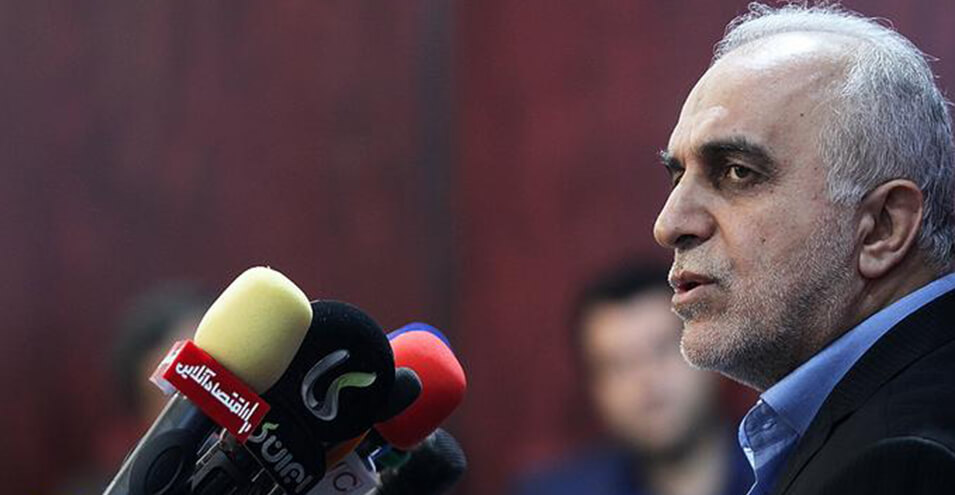
Iran’s Minister of Economic Affairs and Finance announced that 55 percent of foreign currency from non-oil exports has not returned to the country. Farhad Dezpesand also estimated the amount of tax evasion recorded in Iran at “between 30 to 40 thousand billion tomans.”
Farhad Dezpesand, Iran’s Minister of Economic Affairs and Finance, stating that over the past year and a half “we have had approximately 61 billion dollars in non-oil exports,” said that only “27 billion dollars” of this amount has returned to the country, with more than half still not returned.
The Iranian economy minister, speaking Monday evening on the sidelines of the “Government and Private Sector Dialogue Council,” emphasized: “Based on our estimates over the past 18 months, we have had approximately 61 billion dollars in non-oil exports, of which 45 percent of the export currency has returned to the country.”
According to ISNA, Dezpesand added: “For us there is no doubt that Iran’s rooted exporters have made all efforts to return this currency to the country, but certainly follow-ups must also be made to return the remaining amount, and we are confident that if the remaining 55 percent of currency returns, many of the country’s needs will be met.”
The return of foreign currency from non-oil exports to Iran’s economic cycle has been one of the controversial topics and among the disagreements between the government and exporters in recent months. Hassan Mirshojaeian, an advisor to Iran’s economy minister, had said last month that some exporters’ claims regarding the return of export currency were not true, and 30 billion dollars out of a total of 40 billion dollars in export currency has not entered the country either as goods or in any other form. He had described this as an example of “capital flight.”
According to reports from Iranian media, with a dramatic increase in currency prices over the past two years, in most cases the currency from non-oil exports has not returned to the country, and this has further exacerbated the government’s problems in meeting foreign currency needs. Part of the non-return of export currency to the country is attributed to the significant difference between official and free market exchange rates, which reduces exporters’ willingness to bring their export dollars into the country.
Some experts attribute the government and central bank’s failure to return export currency to the country partly to the lack of transparency in the economic environment and rent-seeking by “semi-governmental companies.”
30 to 40 Thousand Billion Tomans in Tax Evasion
Iran’s Minister of Economic Affairs and Finance, in another part of his remarks, also described the amount of recorded tax evasion in the country as “a figure between 30 to 40 thousand billion tomans” and announced that the central bank and tax organization would review the issue of “exporters’ tax exemptions” in the coming weeks.
Farhad Dezpesand said: “Before the sanctions era, exporters had 30 days to receive tax exemptions specified in the law by returning their export currency. In recent months, given the problems caused by sanctions, this time was extended to four months, but given the private sector’s request to help exporters in the tax sector, we are conducting the necessary reviews so that exporters, if they provide the required documents, can also receive tax facilities after four months.”
Amidreza Parsa, head of Iran’s Tax Administration, recently estimated the volume of tax evasion in Iran’s economy at 40 thousand billion tomans. Informal activities outside the scope of supervision, also referred to as the “underground economy” or “shadow economy,” are mentioned as one of the important factors in tax evasion. Experts believe that at least 30 percent of Iran’s economic volume is comprised of the “shadow economy.”
Although Iran’s parliament, in its 2019 budget law, required institutions such as the Astan Quds Razavi, economic enterprises of Iran’s armed forces, and the executive order headquarters, which are subordinate institutions of the Supreme Leader’s office, to pay taxes, at the same time, in cases where there is “explicit permission from the Supreme Jurist,” it made exceptions for them and exempted them from tax payment in such cases.
Source: DW