Iran’s Economy Minister: No 4,200 Tomans Exchange Rate for Goods Other Than Medicine and Bread
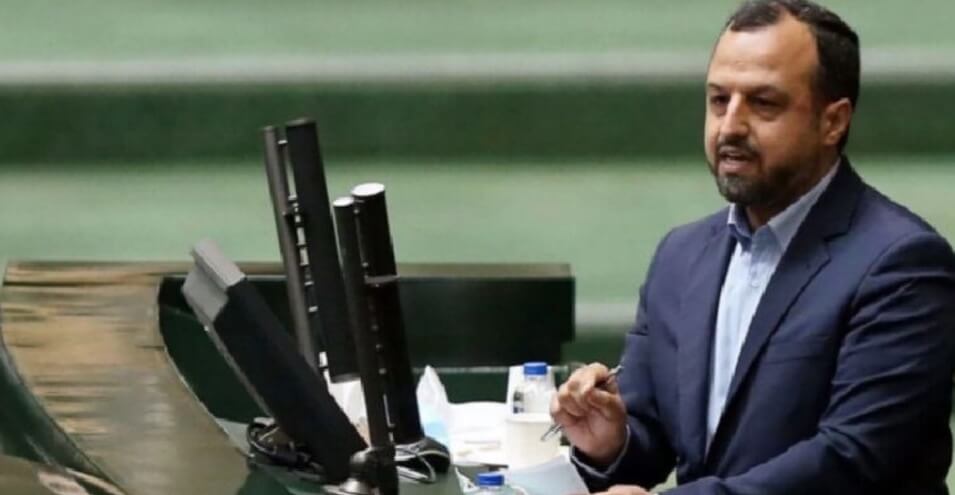
Iran’s Minister of Economy and Finance says that in the 1401 budget, “there will be no 4,200 tomans exchange rate for goods other than medicine and bread”.
Ehsan Khandouzi, speaking on Sunday, December 28 in a television program, added that “with the cooperation of the government and parliament,” in the coming months, “in the 1401 budget, we will not see a 4,200 tomans exchange rate for importing livestock inputs and items of this kind.”
Last week, it was announced that despite warnings about increased economic pressures on people in case of abolishing the “preferential” exchange rate, President Ibrahim Raisi’s government sent the 1401 budget bill with the removal of the 4,200 tomans exchange rate to parliament.
Currently, six essential commodities including wheat, barley, corn, soybeans, crude oil, and oilseeds, along with some medicines and medical equipment, receive a 4,200 tomans exchange rate.
The economy minister’s remarks on Sunday about removing the preferential exchange rate for livestock inputs come at a time when the head of Iran’s Light Livestock Union said in early October that with a reference to a fifty percent reduction in meat consumption in Iran, per capita meat consumption in Iran has dropped from 12 kilograms per year to six kilograms.
The mandatory selection of the 4,200 tomans rate per US dollar in spring 2018 was one of the most controversial decisions of President Hassan Rouhani’s twelfth government. A decision that was made in response to the sharp surge in free-market exchange rates following former US President Donald Trump’s unilateral withdrawal from the nuclear deal.
The goal of this plan was stated as supporting vulnerable groups to control prices of essential goods, livestock inputs, medicine and medical equipment so they reach the final consumer at prices compatible with the purchasing power of the middle and lower classes.
The 4,200 tomans exchange rate was allocated for importing these goods to curb commodity prices, but the twelfth government gradually removed many goods from the list of those receiving this exchange rate, which caused those commodities to become more expensive.
Ibrahim Raisi, who sent the preferential exchange rate removal bill to parliament in mid-November, in defense of the government’s action, called state-controlled exchange rate a breeding ground for “corruption” and “rent-seeking” and said “its benefits have gone into the pockets of a few speculators and have not appeared on people’s tables.”
However, critics of Mr. Raisi’s approach, including Hossein Raghfar, an economist and university professor, believe that this measure will lead to increased inflation and double pressure on people.
Iran’s Minister of Economy and Finance said on Sunday in another part of his remarks that he considers the existence of this preferential exchange rate for the vast majority of essential goods “an ineffective approach.”
Critics have repeatedly warned about the removal of the preferential exchange rate, and Majid Reza Hariri, head of the Iran-China Joint Chamber of Commerce, also warned in mid-November about “super inflation” and severe price increases, stating that Iran’s economy is at “the most dangerous point in the history of inflation over the past four decades.”
Simultaneously with the increase in inflation and commodity prices in recent years, the Ministry of Cooperatives announced last month that out of every three Iranians, one person lives in “absolute poverty.”
According to the report of Iran’s Statistical Center, the annual inflation rate in November was 44.4 percent, and based on official statistics from the Ministry of Labor, the average price of more than 83 percent of food items in Iran has exceeded the crisis threshold.
Source: Radio Farda