Iran’s Plan to Build ‘200,000 Homes’ in Syria
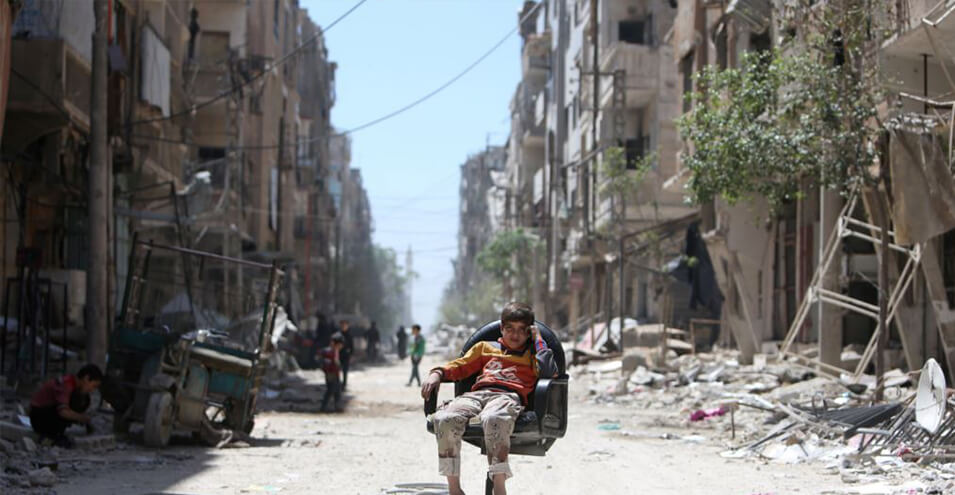
The vice president of the Tehran builders association says that Tehran and Damascus have signed a memorandum of understanding under which Iran will build 200,000 homes in Syria.
According to ISNA news agency, Iraj Rahbar said on Sunday, March 26, that during the fourteenth economic meeting between Iran and Syria, a memorandum was signed between the two countries for the construction of 200,000 residential units.
According to Mr. Rahbar, these homes are to be built as residential complexes in Damascus.
He provided no details about the memorandum or how the construction of these homes will be financed.
Syria’s eight-year civil war has caused extensive damage to the country’s infrastructure and residential centers and killed hundreds of thousands. Iran and Russia were among the main supporters of Bashar Assad during the government’s war against opposition forces in Damascus.
The fourteenth economic meeting between Iran and Syria was held on February 27 in Damascus with the participation of Iran’s first vice president and Syria’s prime minister.
During this meeting, Emad Khamis, Syria’s prime minister, announced that Iranian companies would participate in the construction of “hundreds of thousands of residential units, development of ports, agriculture and mobile phones” in Syria.
During the meeting, Ishaq Jahangiri, Iran’s first vice president, also announced an “important” banking agreement with the country.
Meanwhile, the vice president of the Tehran builders association said that due to American sanctions, even Syrian banks do not issue guarantees for Iranian economic activists.
He added: “We have suggested to the government to activate branches of Iranian banks in this country to operationalize city construction in Syria so that contractors can easily conduct financial transactions.”
SWIFT is the most important international money transfer network, which in November, coinciding with the beginning of American sanctions against Iran, cut services to the Central Bank and a number of Islamic Republic banks.
Iran and Syria have signed multiple agreements in the fields of investment in oil, electricity, energy and other industrial sectors.
Meanwhile, coinciding with the fourteenth economic meeting of the two countries, construction of the Latakia power plant began.
The memorandum for the construction of this 540-megawatt power plant valued at 411 million euros was signed on September 1 of this year in the presence of the Iranian energy minister and Syrian electricity minister. The “Iran Power Plant Projects Management” (MAPNA) group will establish this power plant.
In recent years, Iran has provided substantial financial assistance to Syria, including the establishment of two credit lines of 1 billion dollars and 3.6 billion dollars for exporting goods to the country.
Iran’s special action group in the U.S. State Department announced in September of this year that the Islamic Republic has spent 16 billion dollars since 2012 to support Bashar Assad and its supported groups in Yemen and Iraq.
Bloomberg news agency also reported in 2015 based on estimates and research that Tehran spends six billion dollars annually supporting Assad’s government, and in some cases this assistance has amounted to 15 billion dollars.
Previously, Yahya Rahim Safavi, special assistant to the leader of the Islamic Republic on military affairs, said in a speech that Iran should recover the costs it has incurred in Syria through “oil, gas and phosphate mines” of the country.
Many Arab countries that had tense relations with Syria over the past eight years have recently reopened their embassies in Damascus one after another and emphasize that they are seeking to seize economic opportunities from Syria’s reconstruction period; a matter that has concerned Iran greatly.
A number of Iranian officials in the recent period have expressed dissatisfaction, implicitly or explicitly, that Syria has entrusted profitable projects to other countries including Russia and that Iran’s private sector will reap the least benefit from Syria’s reconstruction.
Source: Radio Farda