Khamenei Intervenes in Case of Detained Environmental Activists
The case of environmental activists has been referred to the Supreme National Security Council upon orders from the Leader of the Islamic Republic. It is reported that Khamenei has requested “attention to the opinion of the Ministry of Intelligence” in this case, and the charge of “corruption on earth” has also been removed from the case.
Following reports that the charge of “corruption on earth” has been dropped from some environmental activists by a lawyer, a parliamentary representative announced yesterday that the Leader of the Islamic Republic has ordered the case of these detained activists to be referred to the Supreme National Security Council.
Mohammad Reza Tabesh, on Monday, October 14, in a note to Etemaad newspaper, announced the “removal of espionage charges” from environmental activists and wrote: “In the case of environmental activists, from the very beginning, there has been disagreement between the Ministry of Intelligence as the body responsible for identifying espionage crimes in the country and the information organization of the Islamic Revolutionary Guards Corps.”
“Removal of Espionage Charges”
The parliamentary representative added: “Some of these responsible bodies, including a special four-member committee formed by order of the president in this regard, as well as some environmental officials and specialists in multiple reports prepared in connection with these individuals’ areas of work, have emphasized the removal of this charge. In other words, all these reports support the removal of espionage charges from these individuals.”
Tabesh ultimately reminded that “simultaneously, another important event that occurred during the investigation of this case and following the preparation of those reports was the referral of the case by the office of the Supreme Leader to the secretariat of the Supreme National Security Council and subsequently a meeting we had with the secretary of the Supreme National Security Council; a meeting that actually rekindled the flame of hope in our hearts and made us, the public opinion, environmental activists and other observers inside and outside the country hopeful that this case would ultimately come to a good and satisfactory conclusion.”
One day before this parliamentary representative, Mohammad Hossein Aghasi, a lawyer, said: “Four environmental activists who were detained had the charge of ‘corruption on earth,’ which has been removed from them. Of course, other charges still remain.”
This lawyer, who previously represented Sam Rajabi, one of the detained environmental activists, noted that “the legal representation of these defendants is handled by court-appointed lawyers or lawyers covered by the note to Article 48.”
Attention to “Ministry of Intelligence’s Expert Opinion”
Simultaneously with the announcement of Khamenei’s order to refer the case to the Supreme National Security Council, “a source familiar with the case of environmental activists” confirmed this news in an interview with the Iran Human Rights Campaign and said that the Leader of the Islamic Republic in his order requested attention to the “expert opinion of the Ministry of Intelligence in this case.” This source, while confirming the news of “removal of the corruption on earth charge” for several environmental activists, attributed the removal of this charge to the consideration of the Ministry of Intelligence’s opinion in the case.
According to this “informed source,” the charge of “corruption on earth,” which was added to the case of some of these activists at the request of the former Tehran prosecutor, was removed from the case after Khamenei’s order regarding “attention to the expert opinion of the Ministry of Intelligence,” and “now both the prosecutor has changed and attention has been paid to the expert opinion of the Ministry of Intelligence and this charge has been removed.”
This “informed source” added: “Following extensive follow-ups by the lawyers and families of imprisoned environmental activists, the Leader ordered attention to the expert opinion of the Ministry of Intelligence in this case, and for this reason the trial of these activists was suspended for a period and has now resumed.”
The source told the Iran Human Rights Campaign that he has no information about possible charges against these environmental activists, but “all of them have the charge of assembly and conspiracy with intent to disturb security. Contact with the hostile US government and investigative examination with intent to spy have also been raised, and the case judge has an opinion favoring acquittal on the espionage charge.”
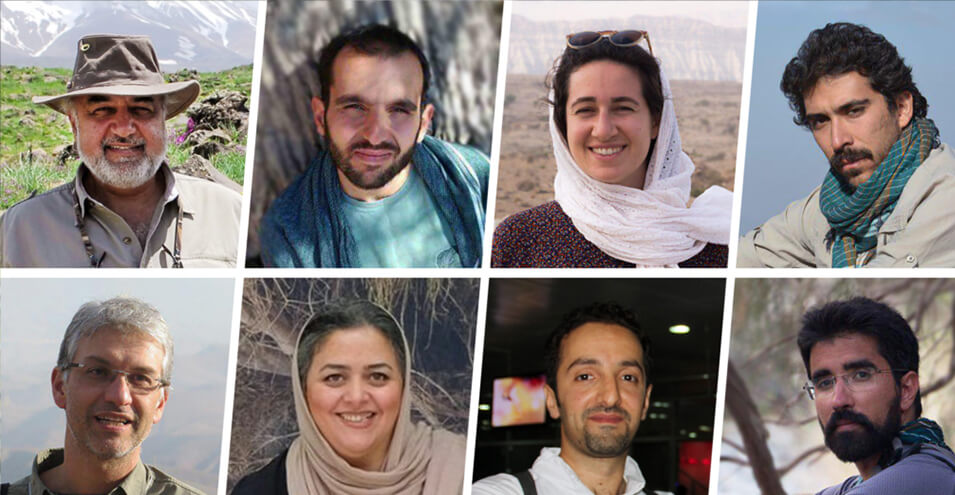
Sepideh Kashani, Niloufar Bayani, Amir Hossein Khaki, Hooman Jokar, Morad Tahbaz, Abdolreza Koohpayeh, Sam Rajabi, and Taher Ghadirian are eight environmental activists who were arrested by the Revolutionary Guards Intelligence Protection on the fourth and fifth days of Bahman 1396 (January 2018). Some of them were charged with espionage and four were charged with the serious charge of “corruption on earth.” Two court hearings were held for Niloufar Bayani and Morad Tahbaz in Bahman 1397 (January 2019). However, Niloufar Bayani was not transferred to her second court hearing, and only her lawyer was present. Contrary to previous promises, the court hearings were suspended and the courts of the other detainees were not held.
Holding Trials “Within the Next Two Weeks”
Mohammad Hossein Aghasi, a lawyer, told the Iran Human Rights Campaign that Morad Tahbaz’s court hearing was held last Saturday and “his final defense has been taken from him” and “the trial hearing of other activists will be held within the next two weeks.”
The Iranian judiciary has so far ignored the views and findings of the Supreme National Security Council, the Ministry of Intelligence, and Iran’s Environmental Protection Organization in this case. Mahmoud Sadeghi, Tehran’s representative in the Islamic Consultative Assembly, wrote in a tweet on February 3, 2019: “According to information received, the Supreme National Security Council, after expert review of the case of the environmental activists charged, did not consider the activities of the defendants as espionage.”
Isa Kalantari, head of Iran’s Environmental Protection Organization, also announced that based on the determination of the four-member government committee, “the detained activists should be released because there is no evidence to prove the charges against these individuals, and the Ministry of Intelligence has concluded that there is no evidence that these individuals are spies.”
Previously, in addition to the Minister of Intelligence, one member of the investigation committee of the presidency in this case, and the head of Iran’s Environmental Protection Organization, while emphasizing the “innocence” of these individuals, identified the intelligence organization of the Revolutionary Guards as responsible for the detention of environmental activists.
The former Tehran prosecutor said in June 2018 that not only the head of the environmental protection organization, but even the four-member committee of the presidency has no right to express opinions and interfere in this case. Abbas Jafari Dolatabad was dismissed from the position of prosecutor of Tehran in April 2019 and appointed as senior advisor to the judicial court of appointed judges.
In Bahman 1397 (December 2018-January 2019), news was published about mistreatment of detained environmental activists, including solitary confinement and psychological torture, threats of injecting hallucinogenic drugs, and threats of arrest and murder of themselves or family members. It was also reported that some of the detained activists were beaten to obtain forced confessions against themselves.
Approximately two weeks after the arrest of environmental activists in Bahman 1396 (January 2018), Kavous Seyed Amami, one of the detainees, died under suspicious circumstances in prison. Prison authorities announced the cause of death of this environmental activist as “suicide.” However, Seyed Amami’s family has not accepted such a claim.
Source: DW