Lavrov Meets with Raisi; Multiple Issues on the Negotiation Table
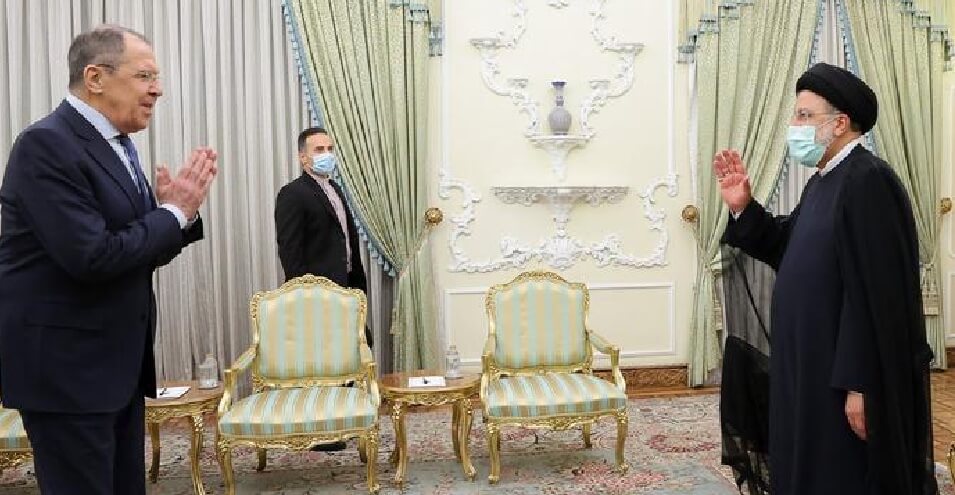
Russia’s Foreign Minister is holding talks with Iranian officials. This is his first trip to Tehran since the formation of Raisi’s government and the start of Russia’s war against Ukraine. Cooperation between the two sanctioned countries, negotiations to revive the JCPOA, and the situation in Syria are on the negotiation agenda.
Russia’s Foreign Minister held talks with Ibrahim Raisi on Wednesday evening (June 1st) during his visit to Iran. According to Iranian media reports, Raisi described the ongoing negotiations at various levels between Iran and Russia as “a sign of the serious will of both countries to shape a new era of beneficial strategic cooperation for both nations, including in the economic sphere.”
The Iranian President, while supporting the speediest possible end to the war between Russia and Ukraine, again identified “American and NATO provocations as factors in the formation of these conflicts” and called on Moscow and Tehran to “be active in relation to efforts being made to expand NATO’s influence in each region of the world, including in West Asia, the Caucasus, and Central Asia.”
Lavrov’s current trip to Iran is his first visit since the thirteenth government took office in Iran in June of last year, and also his first visit after Russia’s attack on Ukraine.
Hossein Amirabdollahian, Iran’s Foreign Minister, has visited Moscow twice since the thirteenth government began its work, in October and February of last year, and has also held several meetings with Lavrov on the sidelines of other multilateral meetings. Ibrahim Raisi, Iran’s President, also visited Moscow in December of last year (2021) and held talks with Vladimir Putin, Russia’s President.
Similarities and Commonalities That Have Increased
Lavrov had previously participated in early June in a meeting of Foreign Ministers of the Gulf Cooperation Council in Riyadh, where speeches and the final statement had a tone and content against “tension-raising activities of the Islamic Republic in the region and Tehran’s support for proxy quasi-military groups,” accompanied by Russian silence.
Heavy international sanctions against Russia, which have created a similar situation for Iran, are seen as creating new grounds for cooperation and convergence between Moscow and Tehran. This is while numerous reports in recent weeks have emerged about Russian similar goods capturing Iranian oil, steel, and petrochemical markets in Asia. These goods, which Russia is not permitted to export to Europe and America under Western sanctions, have been offered at cheaper prices in the Asian region, which constitutes a major portion of Iran’s market.
Nevertheless, officials of the Islamic Republic have expressed hope that Tehran and Moscow can have close cooperation in the three areas of energy, trade, and transit under the new conditions where both countries face similar situations due to sanctions.
Increased Trade Between the Two Countries
The Fars News Agency, citing Kazem Jalali, Iran’s Ambassador to Moscow, reported that “Iran-Russia relations have entered a new phase and the volume of Iran-Russia trade in 2021 reached $4.5 billion, while this figure was only $1.6 billion in 2019.”
The details of Russia and Iran’s military and security cooperation in Syria and their joint support for Bashar Assad’s regime is also another topic for Lavrov’s talks in Tehran.
Both Russia’s greater focus on the Ukraine war, which has apparently led to a reduction in its presence in Russia, as well as the nature and extent of Moscow’s response to the intensification of Israeli attacks on the positions and bases of the Islamic Republic’s and Hezbollah’s presence in Syria are also areas of discussion for both sides.
Although the Ukraine war has fueled certain tensions in Russia-Israel relations, it does not appear that the Kremlin is seeking a shift towards explicit support for the Islamic Republic or practical action against Israeli actions on Syrian soil.
Russia is one of the parties in the P5+1 group in JCPOA revival negotiations. Although Moscow voted with China against the recent resolution passed by the Board of Governors of the International Atomic Energy Agency against the Islamic Republic, both Tehran’s likely orientation towards further expanding its nuclear program and moving closer to nuclear weapons production, as well as the uncontrollable escalation of tensions between Iran and Western countries and Israel, are sources of concern and worry for Moscow.
For this reason, the Tehran negotiations probably cannot be focused without emphasizing the exchange of views on how the next path for JCPOA revival should proceed.
This is while there remain ambiguities about the extent of Moscow’s willingness and cooperation to bring the Vienna negotiations to a conclusion. In March of this year, following heavy Western sanctions against Russia due to its attack on Ukraine, reports were released that Moscow had made its agreement to a positive process of negotiations and their conclusion conditional on keeping relations between Russia and Iran free from any effects of Western sanctions. Later, Iran’s Foreign Minister, during a visit to Russia, said that no such condition had been raised, and Western countries also deemed Russian-Iranian nuclear cooperation permissible on the basis of the JCPOA text in case of its revival.
It is said that the Afghanistan file and the type of approach towards the Taliban government in that country will also be raised in Lavrov’s talks with Iranian officials. Although neither Moscow nor Tehran have formally recognized the Taliban government, they maintain close contacts with it.
Source: DW