Meeting between Iran’s Minister of Cultural Heritage and Pope Leo XIV
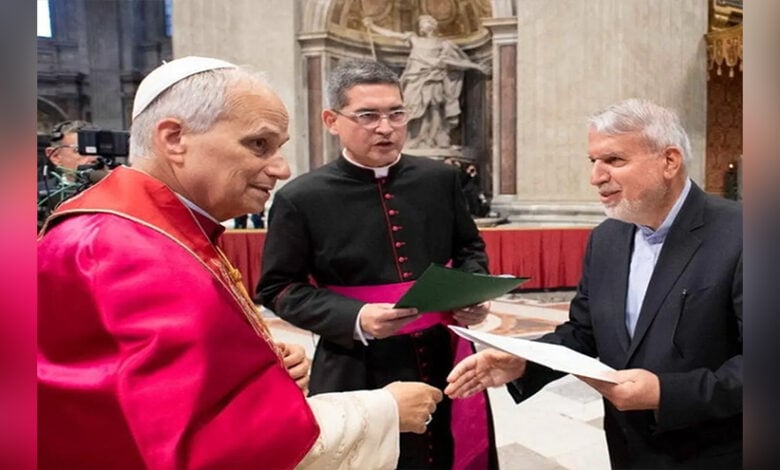
“Seyedresa Salehi-Amiri,” Iran’s Minister of Cultural Heritage, met with Pope Leo XIV during a visit to Vatican.
Seyedresa Salehi-Amiri, Minister of Cultural Heritage, Tourism and Handicrafts, traveled to Vatican as a special representative of Masoud Pezeshkian, President of Iran, to participate in the inauguration ceremony of Pope Leo XIV and to deliver the President’s message.
The Minister of Cultural Heritage held discussions with Pope Leo, the new leader of Catholics worldwide, and Archbishop Richard Gallacher, Vatican’s Minister of Foreign Affairs, during this meeting. The purpose of this meeting was to emphasize shared capacity-building for deepening pilgrimage diplomacy, promoting inter-religious dialogue, and reconstructing the moral order of the contemporary world through spiritual concepts.
Seyedresa Salehi spoke about this meeting saying: “We believe that divine religions are rooted in one absolute truth. A truth that calls humanity to dignity, love and peace. Our cultural heritage is a language for global communication, and this language is what today’s world needs for building a more humane future.”
He further emphasized that Iran supports a message that transcends politics and is based on culture and civilization, adding: “We have come to Vatican to make the world hear the voice of cultural Iran, believing Iran, peace-seeking Iran. This meeting was a symbolic moment but will have a lasting impact. Iran is ready to play an active role in redesigning global pilgrimage pathways and exchanging caravans of peace.”
Pope Leo, in turn, during his meeting with Iran’s Minister of Cultural Heritage, while praising the historical depth and culture of Iran, said: “Faith, when it speaks in the language of respect and dialogue, can rebuild a world. We welcome all efforts to bring hearts and nations closer together.”
Salehi also emphasized in his meeting with Archbishop Richard Gallacher, Vatican’s Minister of Foreign Affairs, the Pope’s designation of 2025 as “International Year of Pilgrimage Tourism” and that this designation should be a prelude to reviving the role of religions in creating meaning in today’s turbulent world, and added: “The year 2025 should become a turning point in connecting cultural diplomacy with spiritual diplomacy; because pilgrimage is not merely a ritual act, but a shared narrative of peoples about truth, compassion and peace.
Iran, blessed with sacred pilgrimage sites and relying on a civilizational heritage in the field of spiritual hospitality, is ready to play an active role in redesigning global pilgrimage pathways, exchanging caravans of peace, and developing elite capacities in the field of inter-religious dialogue. What the world needs today is a return to a shared religious understanding of human dignity and the value of dialogue.”
Archbishop Richard also welcomed the positions of the Islamic Republic during this meeting, stating: “Your approach in linking the concept of pilgrimage with world peace is very precise, intelligent, and in line with the spirit of divine teachings. The Catholic Church supports every effort to promote coexistence, spiritual exchange, and create shared pilgrimage pathways.”