Ministry of Education, “The Poorest Ministry”
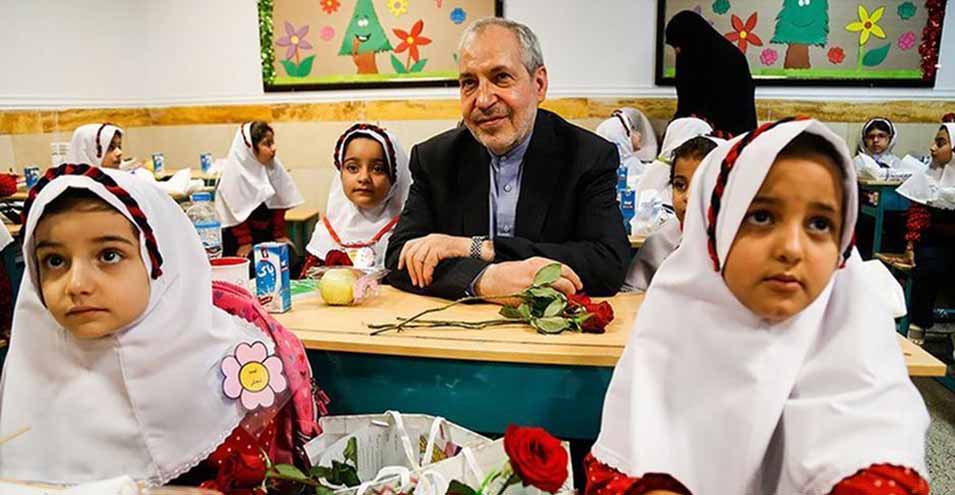
The Minister of Education says that no minister since the revolution has been able to solve the livelihood problems of teachers. According to teachers, the Ministry of Education, with a host of unresolved problems, is the poorest ministry.
The start of the new academic year on the first of Mehr this year has also provided an opportunity for aspects of the problems of educators and the Education Ministry to be reflected in society and media. Teachers have called for improvements in their living conditions and the elimination of wage discrimination between themselves and other government employees.
Ali Asghar Fani, Minister of Education, promises that this year one of the priorities of the Ministry of Education will be the livelihood of teachers.
Officials have spoken about injustices and wage inequalities between teachers and other ministry employees. Ahmad Hemati, representative of the people of Semnan, Mehdishahr and Sorkheh in parliament, says, “One of the groups whose rights have truly been lost are educators, and we hope to move in a direction that reduces these injustices.”
Seyed Mehdi Moghadasi, representative of the people of Arak, Kamijan and Khondab in parliament, also says that insufficient attention has been paid to the education budget and “teacher salaries must be reconsidered so they do not face problems due to inflation like other segments of society.”
Mismatch between teacher salaries and inflation rate
On the eve of the 1395-1396 academic year, the Minister of Education acknowledged that no minister since the revolution has been able to solve the livelihood problems of teachers.
One of the unsolved problems facing Iranian teachers is the mismatch between their salary levels and the inflation rate. According to Article 125 of the Civil Service Management Law, the government must increase the salaries of its employees annually equivalent to the official inflation rate.
Therefore, as the inflation rate increases by that same amount, teacher salaries should also increase accordingly, but according to teachers, this has never been fully implemented, even during the Rouhani administration. As a result, their livelihood problems have continually increased with rising inflation rates. The Teachers’ Professional Association has repeatedly protested the failure to implement this law, but so far their complaints have yielded no results.
Teachers protest that the government does not treat them the same as other ministry employees and that bonuses and benefits for teachers are less than those of employees in other government ministries. In response to employees of this ministry, Fani, the Minister of Education, says “since the beginning of the eleventh government’s tenure, the average teacher salary has grown by 85 percent.” However, some teachers, in interviews with Deutsche Welle, did not confirm the minister’s statements. They said that especially the benefits that educators receive have been less than employees of other government institutions.
Shahid Alavi, former member of the Teachers’ Professional Association, says: “Teaching is not a high-paying profession and a teacher is forced to choose a second job. Teachers’ problems are the inadequacy of salaries and benefits with the work they do and the mismatch between salaries and their level of education. This very issue affects education and causes a teacher to lack sufficient energy and motivation for teaching. On the other hand, the relationship between teacher and student also becomes problematic.”
This former teacher adds: “Official statistics in Iran show that the effective working hours of employees daily is less than one hour. In comparison, teachers work at least 3 hours of effective work daily. However, a teacher with a teacher’s salary cannot afford expenses such as house rent and other necessities of life.”
Shahid Alavi, in his interview with Deutsche Welle, also emphasizes: “Education is a populous organization with high costs and should not be viewed as a consumption institution. This consumption perspective is a wrong perspective. They think that any money spent there is wasted.”
This expert further emphasizes: “The system’s view of education is a traditional one, meaning the same view held toward seminaries is applied to this institution, whereas education is a modern institution and cannot be solved with this traditional approach.”
In this expert’s view, solving the livelihood problems of teachers is part of the overall set of educational problems in the country. According to Alavi, the Rouhani government has not been able to do anything in this regard over the past three years, because solving the education problem “requires changes in the country’s laws and a change in the overall approach of the political system to education.”
Retired teachers have been forgotten
Mrs. Elaheh Bahrami, a retired teacher of literature and social sciences from Tehran, tells Deutsche Welle that retired teachers are among the poorest segments of society and their issues and livelihood problems have been forgotten. She adds in this regard: “Retired employee pensions are lower than the salaries of employees in almost all ministries, and based on whatever law they want to reconcile, I don’t know why it’s not possible.”
This retired education employee continues: “One of the problems of retired teachers is medical issues. Because due to old age their expenses increase and a large portion of their salaries is spent on buying medicine. Unfortunately, insurance and supplementary insurance do not cover expensive doctor visits including dentistry and eyeglasses. Even the cost and payment of prescriptions per year has a ceiling for us. Retirement salary is not enough, especially if retired teachers are renters, and this salary in no way matches inflation.”
“There is not a day that retired teachers are not protesting”
According to this former teacher, to solve their livelihood problems, retired teachers have not remained idle. She explains in this regard: “There is not a day that retirees are not in the streets protesting in front of parliament and ministries. Unfortunately, our situation during the Rouhani period did not change. Now, just like before, only 12 percent is added to retiree salaries each year. Whereas we expected 20 percent to be added to salaries this year, but it seems they forgave us all again and we received 12 percent once more. Another one of our problems is the lack of transparency in salary slips. I have no idea what is being deducted from our salaries or what is being reduced. The office is also not accountable.”
Mrs. Bahrami, who has been retired since 1379, says: “Everyone agrees that with current inflation, our livelihood is close to poverty. Education is the poorest ministry and its budget is less than all other ministries. We have protested so much that we no longer have the energy and nerves to continue this work. Stresses at our age are not pleasant and we get sick and the amount of money we receive for retirement should be spent on a doctor.”
The Minister of Education, however, in response to retirees’ requests, said “the decision-maker on retired teachers’ salaries is not me.” However, he promises that the livelihood situation of educators will improve.
Mrs. Elaheh Bahrami, a retired teacher of literature and social sciences, however, is not optimistic about Mr. Fani’s statements, the Minister of Education, regarding “making teacher livelihood a priority and promising to improve the livelihood situation of educators,” saying that officials have made many promises but fail to deliver.
Source: DW