New Images Released of Iran’s Readiness to Launch Satellite into Space
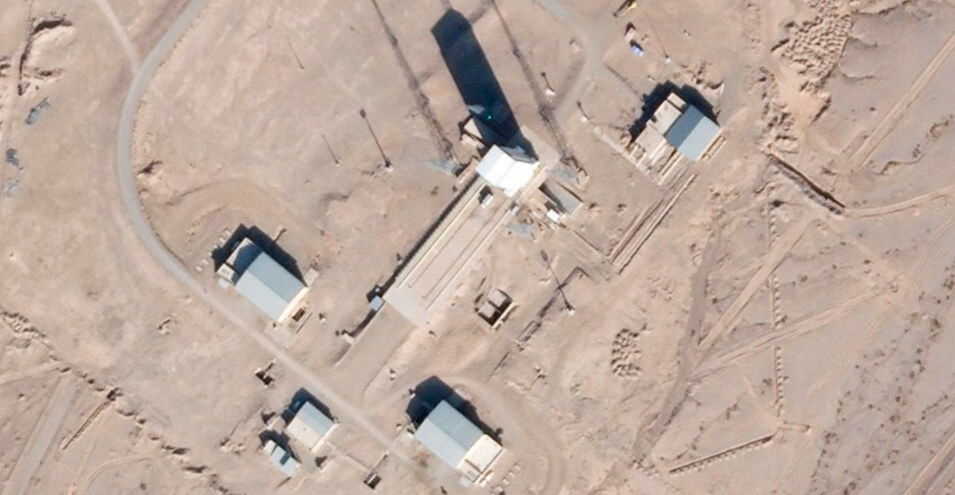
Coinciding with the eighth round of talks to revive the JCPOA in Vienna, the Associated Press reported that satellite images indicate Iran is preparing to conduct a space launch from the “Imam Khomeini” base in Semnan Province.
The report, based on satellite images captured by the “Planet Labs” company, shows satellite imagery of a hydraulic crane and a support truck beside a large capsule at the launch site, which is typically used to house rockets.
Critics of the Islamic Republic view satellite launches as provocative measures, since satellite-carrying rockets utilize technology similar to that required for intercontinental ballistic missiles. Consequently, the release of this news amid the stalled JCPOA revival talks in Vienna, which are progressing slowly with a negative outlook, could heighten existing sensitivities.
On December 4 of this year, Iran’s state news agency IRNA reported that Iran has four satellites—”Zafar 2,” “Nahid 1 and 2,” and “Pars 1″—in final stages of preparation and launch, but did not release details about the timing of their launches and testing.
In recent years, Iran has had several failed satellite launch attempts, including a reported failure in June of this year when Iran was unable to launch a satellite-carrying rocket from the Imam Khomeini space base in Semnan. At that time, CNN reported that this was “the fourth consecutive failure of the Simorgh rocket launch, and it appears Iran is facing problems with this particular system.” Last winter, the launch of the “Zafar 1” satellite also failed.
The United States and Israel, along with some Western countries, are concerned about Iran’s development of ballistic missile programs to carry nuclear warheads under the guise of a peaceful space launch program.
In recent months, officials in Ibrahim Raisi’s government have spoken about the need for faster development of space programs. For example, Isa Zarepour, the Minister of Communications and Information Technology, said on December 8 of this year that there are shortcuts in the space sector to reach major goals, and we must find ways to achieve them.
Meanwhile, the Islamic Revolutionary Guard Corps is also pursuing its own parallel program in this field and launched a satellite last year.
In early May of last year, the Islamic Revolutionary Guard Corps announced that the “Qased” satellite-carrying missile had delivered the military satellite “Noor” from “Central Desert of Iran” to an “orbit 425 kilometers above Earth.”
The U.S. government considers Iran’s military satellite launch as a violation of UN Security Council Resolution 2231 and says Iran’s actions are a cover for its missile tests.
However, the Iranian government rejects these accusations, stating that these programs are defensive in nature.
Source: Radio Farda