Nine Christians Released from Evin Prison on Bail
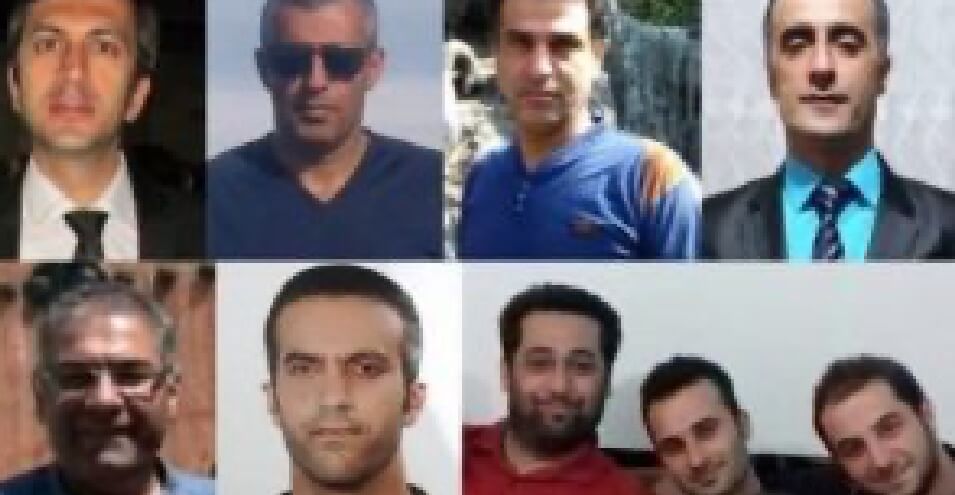
Behnam Ekhlaghi, Babak Hosseinzadeh, Abdolreza Alighighnejad, Shahrouz Islamdoost, Mehdi Khattibi, Khalil Dehghanpour, Hossein Kadivar, Kamal Noemanyan, and Mohammad Vafadar, nine Christians, have been temporarily released from Evin Prison on bail. In November of this year, the request for retrial of these citizens at the Supreme Court was accepted, and their case was referred to the equivalent branch for reconsideration. In an unprecedented ruling by the Supreme Court, it was stated that promoting Christianity and establishing a home church is not a crime and conspiracy to undermine national security.
According to Hrana news agency citing Article 18, Behnam Ekhlaghi, Babak Hosseinzadeh, Abdolreza Alighighnejad, Shahrouz Islamdoost, Mehdi Khattibi, Khalil Dehghanpour, Hossein Kadivar, Kamal Noemanyan, and Mohammad Vafadar, nine Christians, have been temporarily released from Evin Prison on bail.
In November of this year, the request for retrial of these citizens at the Supreme Court was accepted, and their case was referred to the equivalent branch for reconsideration. In an unprecedented ruling by the Supreme Court, it was stated that promoting Christianity and establishing a home church is not a crime and conspiracy to undermine national security. The release of these citizens occurred while the Supreme Court ruling was issued on November 12 and for unknown reasons their release had been delayed until now.
Behnam Ekhlaghi, Babak Hosseinzadeh, Abdolreza Alighighnejad, Shahrouz Islamdoost, Mehdi Khattibi, Khalil Dehghanpour, Hossein Kadivar, Kamal Noemanyan, and Mohammad Vafadar are all members of a home church called “Church of Iran” in the city of Rasht, who in September 2019 were accused of “acting against national security by establishing a home church and promoting evangelical and Zionist Christianity” and were each sentenced to five years in prison.
In the ruling of the panel reviewing the case in Branch 28 of the Supreme Court, chaired by Seyed Ali Izpanah Shahri, the retrial request of these nine Christians was accepted and it was specified that merely private promotion of Christianity and promotion of an apparently Zionist evangelical sect, both of which essentially mean promoting Christianity through holding family gatherings (home church), does not constitute conspiracy to undermine Iran’s national security whether domestic or foreign, and through forming associations and branches does not fall under Articles 498 and 499 of the Islamic Penal Code 1996 and other criminal laws, and promoting Christianity and establishing a home church have not been criminalized in the laws.”
While accepting the retrial, the Supreme Court referred their case to the equivalent branch for reconsideration.
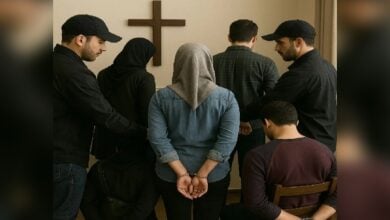
Hossein Kadivar and Khalil Dehghanpour were arrested on February 28, 2018 at a home church gathering in Rasht, and Babak Hosseinzadeh, Behnam Ekhlaghi, and Mehdi Khattibi were also arrested on March 25 of the same year. Mr. Ekhlaghi’s residence was searched after his arrest by security forces, who confiscated some of his personal items and took them away. According to an informed source, security forces during the search of Mr. Ekhlaghi’s home damaged or destroyed symbols related to Christianity.
On March 11, Abdolreza (Mattias) Alighighnejad was arrested at his private residence, and continuing this process, on Friday, March 16, three other Christians named Mohammad Vafadar, Mohammad (Shahrouz) Islamdoost, and Kamal Noemanyan were arrested during a home church meeting. It should be noted that the arrest of all these citizens was carried out by officers of the Islamic Revolutionary Guards Corps Intelligence Organization.
Babak Hosseinzadeh and Behnam Ekhlaghi were transferred to prison 12 days after being detained at one of the security institutions and were held for 11 days without respecting the separation of crimes principle in this prison. Finally, on March 18, 2018, with a bail of 150 million tomans, they were temporarily released until the end of legal proceedings. Also, Khalil Dehghanpour, Hossein Kadivar, Kamal Noemanyan, and Mohammad Vafadar were released on bail in March of the same year.
On July 24, 2019, the first hearing of the court to hear the charges against these citizens was held in Branch 28 of the Tehran Revolutionary Court chaired by Judge Mohammad Moqiseh. During this session, the bail amount for Abdolreza Alighighnejad, Shahrouz Islamdoost, Behnam Ekhlaghi, Babak Hosseinzadeh, and Mehdi Khattibi was increased to 1.5 billion tomans, and following their inability to pay the bail, they were arrested and transferred to Ward 4 of Evin Prison. Four others were released on bail.
Finally, each of these citizens was convicted of “acting against national security by establishing a home church and promoting evangelical and Zionist Christianity” to 5 years of imprisonment. This sentence was ultimately confirmed in June 2020 by Branch 36 of the Tehran Provincial Court of Appeals chaired by Judge Seyed Ahmad Zargar and notified to them.
An informed source regarding the conduct of court hearings told Hrana: “The court sessions were brief and these citizens were not given the opportunity to defend themselves during the court sessions. They only sent their written defense statements from prison to the court by mail. The behavior of Judge Moqiseh toward Christian defendants was very harsh and insulting, and repeatedly told them ‘You are improper people, you are apostates and deserve to be executed. Don’t say anything at all.'”
It is worth noting that Kamal Noemanyan was also summoned to court in 2011 along with three other Christians. In May 2016, Mohammad Vafadar was arrested along with Pastor Yusuf Nadarkhani and two others. Abdolreza Alighighnejad, known as Mattias, also has at least three records of arrest in 2006, 2010, and 2011 on charges of promoting and propagating Christianity.
It should be noted that although Christians are officially recognized as a religious minority under the law, security agencies pursue the issue of Muslims converting to Christianity with particular sensitivity and take a coercive approach with activists in this field.
The treatment of Christians in Iran occurs at a time when according to Article 18 of the Universal Declaration of Human Rights and Article 18 of the International Covenant on Civil and Political Rights, everyone has the right to freedom of religion and to change religion with conviction, as well as the freedom to express it individually or collectively and publicly or in private.
Source: Hrana