One Cannot Claim Justice is Being Served Through Kidnapping, Torture, Coerced Confessions and Fabricated Cases Against Political Opponents and Imposition of State-Appointed Lawyers
How are discriminatory and unlawful practices of the Islamic Republic of Iran’s judiciary applied against opposing and critical political activists who have been abducted by security forces and are being tried in Iran?
By what methods and tactics does the security apparatus impose its desired and distorted narrative of the cases of political activists residing outside Iran on the judiciary? How do propaganda agencies and media close to the government help impose this narrative on public opinion? What does the similarity in the government’s approach to the cases of political activists abducted from outside Iran’s borders and brought to Iran emphasize and focus on? It appears that abducting opposition and critical activists of the Islamic Republic from Iran’s neighboring countries and subjecting them to unjust and unlawful trial proceedings and issuing predetermined harsh sentences has become a routine process in Iran’s judiciary. The execution and implementation of the death sentence of Rouhollah Zam, a journalist and political activist who was lured from France to Iraq and then abducted by Islamic Republic security forces in that country, has increased concerns about the outcome of the trial of Habib Asiyoud (Chaab), a political activist and Iranian-Swedish dual citizen. Asiyoud was abducted in November 2020 in Turkey by Islamic Republic security forces and sent to Iran. A review of the trial proceedings of Habib Asiyoud’s case, particularly the statements of his court-appointed lawyer that he will not pursue acquittal due to his client’s confession, reveals how the judiciary operates in a completely discriminatory and unlawful manner under the control of security institutions, and how the fate of defendants who have been detained through a criminal act (kidnapping) is determined by security institutions rather than judicial ones.
From Kidnapping and Torture to Case Fabrication
The use of the criminal act of “kidnapping” opponents and critics of the Islamic Republic of Iran in other countries’ territories and subsequently trying them in Iran has grown increasingly over the past several years under the framework of decisions by security and intelligence institutions and has become a serious policy for eliminating opposition figures and political activists outside the country. The latest example of this was the attempt by Islamic Republic security forces on American soil to kidnap Masih Alinejad, a plot that was exposed and thwarted before execution. However, Islamic Republic security institutions have abducted several opposition figures in neighboring countries over the past few years; Rouhollah Zam, a journalist and political activist, was abducted in Iraq, Habib Asiyoud, a political activist, in Turkey, and Jamshid Sharmahd, an opponent of the Islamic Republic, in the United Arab Emirates. Among these, Rouhollah Zam was executed following an unjust and non-transparent trial process. Two sessions of Habib Asiyoud’s trial have been held so far, but nearly two years after Jamshid Sharmahd was abducted in the UAE and transferred to Iran, there is still no news of when his trial will be held.
Torture, extraction of coerced confessions, case fabrication, and planning by media close to security forces to impose the government’s narrative about these individuals to the public, and deprivation of the right to have a chosen lawyer, is a process that has been repeated during the arrest and trial phases of their cases. It is a process that actually links various forms of discrimination and pressure on these detainees; from the criminal act of kidnapping to the imposition of severe sentences. Each of these three political activists fell into the trap of Islamic Republic security and intelligence forces and was abducted in separate ways. Nevertheless, it has been established that Islamic Republic security forces followed a predetermined plan in the abduction of both Rouhollah Zam and Habib Asiyoud. After Rouhollah Zam’s execution, many accounts were raised about the role of security operatives in convincing him to travel to Iraq and then his subsequent abduction by Islamic Republic security forces. A similar process was published regarding the story of Habib Asiyoud’s abduction in Turkey.
About a month after Habib Asiyoud’s abduction, reports were published stating that Habib Asiyoud had been lured to Istanbul through deception by a woman from Sweden and was then abducted there with the help of a well-known drug trafficker and transferred to Iran.
The extraction of coerced confessions was the next step by security forces following the abduction and detention of these individuals. The insistence of security forces on recording and documenting confessions from these individuals at the shortest possible interval after their detention (abduction) and transfer to Iran is evident in all three cases. Rouhollah Zam’s initial coerced confessions were published at the shortest possible interval after the news of his abduction and arrest was announced. A confession in which the role of French government security forces is specifically mentioned. This was repeated in the case of Habib Asiyoud; Islamic Republic state television broadcast parts of his coerced confessions on the evening of November 12, 2020, ten days after news of Asiyoud’s arrest was announced. In part of a film broadcast from Islamic Republic television, it was stated that European governments, including Denmark and Sweden, were aware of Asiyoud’s “military activities and separatist operations” against the Islamic Republic.
Given the dark history of the Islamic Republic of Iran in applying extensive physical and psychological torture against political prisoners and opposition figures and critics in custody, imagining the extraction of such coerced confessions without torture of the detainees is impossible. The emphasis on matters such as support by security forces of Western governments in the coerced confessions of these individuals shows how the foundation of case fabrication and ultimately the announcement of the court’s verdict has been predetermined.
Imposing the Security Apparatus’s Narrative of the Case; From Coerced Confession to Television Series
What the security apparatus gains from broadcasting and emphasizing coerced confessions on television, apart from affecting the course of the judicial proceedings of the case, also has an important effect on public opinion. This is why the security apparatus does not limit itself to broadcasting coerced confessions on television and uses all its propaganda capabilities, from television series to news documentaries, to impose and justify its narrative of the criminal acts of “kidnapping” and illegal “case fabrication.” The broadcast of a series in the fall of 2020 titled “Safe House” with the subject and focus on the activities of intelligence and security forces from Iranian television, and linking part of the story of this series to the case of Jamshid Sharmahd, a dual Iranian-German political activist who had been abducted and transferred to Iran months earlier, was an unprecedented example of case fabrication and an overtly illegal practice in the proceedings of this imprisoned citizen. In one of the final episodes of the series, Ministry of Intelligence agents who have tracked the security file to higher levels and outside Iran’s borders arrest one of the main figures of opposition groups in a neighboring country and show him a number of photos to obtain supplementary information. The arrested individual, upon seeing the image of Jamshid Sharmahd, the imprisoned Iranian-German dual citizen, says that he is “Jamshid Sharmahd, head of the Iranian Royalist Association, and has many covert activities and works with both Israeli and American spy services.”
The broadcast of these images, given that no court hearing has yet been held for Jamshid Sharmahd and considering that the case is in the preliminary investigation stage and is essentially in individual interrogations, is actually a clear violation of a principle in the preliminary investigation stage that emphasizes the “confidential” nature of proceedings. Article 96 of Iran’s Code of Criminal Procedure emphasizes that “the publication of images and other characteristics related to the identity of the accused in all stages of preliminary investigations by media and police and judicial authorities is prohibited.”
Habib Asiyoud’s Trial: A Clear Example of Discrimination and Unlawful Trial Proceedings
More than a year after Habib Asiyoud’s abduction in Turkey, his trial began on January 18, 2022, and two sessions of this trial have been held so far. A review of the indictment and the proceedings of Mr. Asiyoud’s trial shows how forms of discrimination and pressure on these defendants manifest in the course of judicial proceedings.
The text of the indictment issued by the Tehran General and Revolutionary Prosecutor’s Office was previously published in November of this year by the Judiciary. In the indictment of this Iranian-Swedish citizen, it was stated that “based on the defendant’s confessions and available evidence, for corruption on earth through the formation and management of a group called Harakat al-Nissal and the design of multiple operations for the destruction of public property and the carrying out of several bombing operations since 2005 in various locations in Ahwaz and Khuzestan Province,” he was accused. In the text of the indictment, Asiyoud is introduced as an employee of the Swedish Labor Office and is accused of “terrorist activities under the support of intelligence and espionage services under the protective umbrella of Sweden.”
The Iranian government has accused Habib Asiyoud of involvement in an attack by four armed individuals on September 22, 2018, on a military parade of the Islamic Republic forces in the city of Ahwaz. In the first session, the court listed “espionage and action against public and national security” among the defendant’s other charges. The prosecutor also, while referring to the fact that “the perpetration of terrorist operations was with financial cooperation from Saudi Arabia,” claimed that “holding dozens of gatherings in some European countries,” “communicating with the Saudi regime to create insecurity in the country,” “attempting to change religion through the production of thousands of hours of content,” and “attempts to unite separatist groups” were among the activities carried out by the group under Habib Asiyoud’s oversight both inside and outside the country.
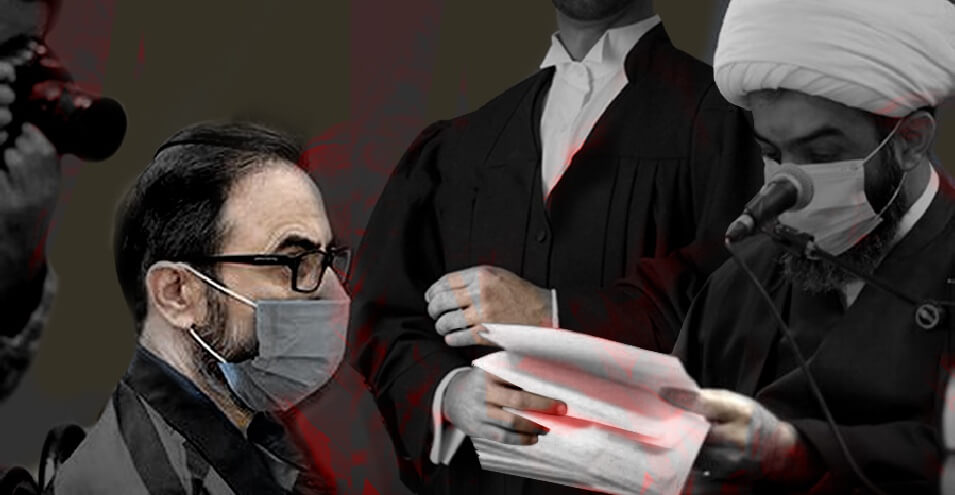
After the first trial session was held, Rasoul Taghadossi, the court-appointed lawyer for Habib Asiyoud’s case, stated that because “his client has confessed and we have accepted it, we are not pursuing the acquittal of the defendant.” The statements of this court-appointed lawyer by the Judiciary for Habib Asiyoud clearly show how unlawful and theatrical the course of judicial proceedings and trial is, contrary to law and the rights of the defendant. Saeed Dehqan, a human rights lawyer and member of the International Union of Lawyers, wrote on his Twitter page, referring to the statement of Mr. Asiyoud’s court-appointed lawyer about not pursuing acquittal: “If the government considers someone a terrorist, why doesn’t it try the defendant with an independent and chosen lawyer in a legal court openly so that everyone supposedly forgets about the kidnapping and sympathizes with his punishment! With a lawyer who doesn’t even know that coerced confessions in solitary confinement are not ‘confession,’ there is no point!”
In Iran’s laws, there are repeated references to the conditions of “confession” and the issue of coerced confession and confession under torture; Article 38 of the Constitution prohibits any form of torture to obtain confession and gain information, or Article 218 of the Islamic Penal Code explicitly states: if the defendant claims that his confession was obtained under threat, intimidation, or torture, such claim is accepted without need for evidence and oath, or Article 169 of the same law emphasizes that not only is the extraction of confession under coercion, compulsion, torture, and psychological or physical abuse devoid of value and credibility, but it obliges the court to re-investigate the defendant. Also in this law, it is emphasized that “a confession has religious credibility only if it is made before the judge in court.”
Apart from these cases in the trial process of Habib Asiyoud, other instances are also evident in the form and manner of discrimination applied to this defendant; Arash Sadeghi, a former political prisoner, upon publishing a photo from Habib Asiyoud’s trial that shows court officials placing a photo of one of the teenagers killed in the attack on the military parade in Ahwaz on the table in front of Mr. Asiyoud, wrote on his Twitter page: “This is a symbolic image that should be reproduced; they placed a photo of a child killed in the ISIS attack on the Ahwaz parade in front of an abducted defendant. With this very image, this mock court has lost the credibility of justice, justice-seeking, and impartiality.” In a text, he addressed the ambiguities and the government’s distorted narrative regarding Habib Asiyoud’s role in the attack on the Ahwaz parade and, while emphasizing the acceptance of responsibility for that attack by the ISIS group and statements by media close to the government supporting this fact, wrote: “Habib Asiyoud has no connection to the attack that ISIS claimed responsibility for. He is a defenseless defendant who has neither a chosen lawyer nor the possibility of justice-seeking.”
Deprivation of the right to choose a lawyer and the imposition of court-appointed lawyers by the Judiciary on activists and political opponents who have been abducted by security forces and transferred to Iran was previously raised during the abduction and detention of Jamshid Sharmahd, an imprisoned Iranian-German citizen, and had increased concerns about the manner of handling of this case.
Source: Iran Human Rights Campaign