Police Silence Over Brain Death of Mahsa Amini “Due to Beatings by Morality Police Officers”
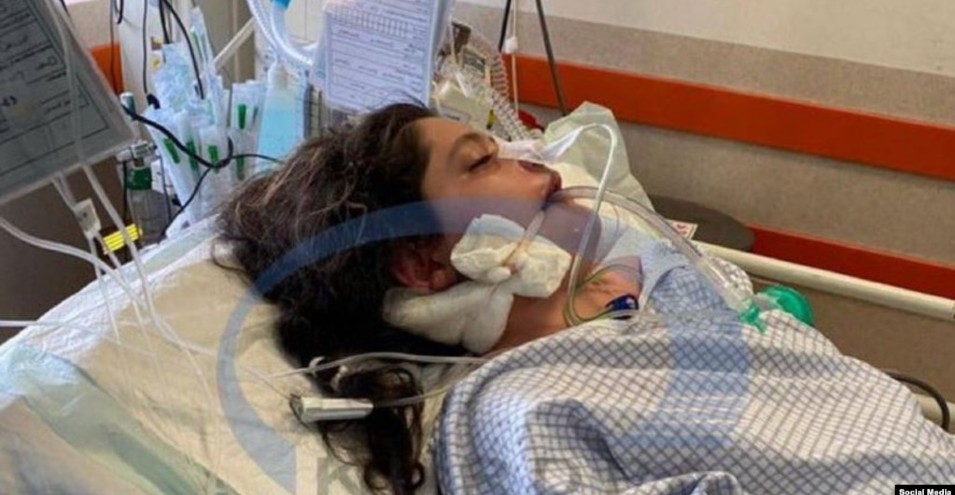
The “brain death” of a 22-year-old woman in Tehran due to beatings by “police officers in a morality police patrol vehicle and at the Vezarat detention center” has sparked widespread reactions on social media. However, Tehran’s police command in its statement did not mention the beatings and claimed she had suffered a cardiac condition.
The user account “1500 Images” identified the young woman as Zhina (Mahsa) Amini and wrote that she was from Saghez and had traveled to Tehran with her family to visit relatives.
According to reports published on social media, Ms. Amini was arrested on the evening of September 13 near Shahid Haghani metro station by morality police officers.
However, the Tehran police command’s media center issued a statement without detailing the circumstances, saying that Ms. Amini “suffered a cardiac condition” and was under treatment in a hospital.
The statement read: “A woman named Mahsa Amini who had been directed to one of Tehran’s police departments for guidance and education suddenly suffered a cardiac condition and was immediately transferred to a hospital and placed under treatment and care.”
Sajjad Khoda Karmi, a journalist, told Iran International television: “One of the detainees who was in the patrol vehicle confirms that beatings occurred in the vehicle, and when they arrived at the detention center, her general condition was poor, but she had good consciousness levels.”
According to reports, after detention center officers’ “negligence” regarding this woman’s condition and protests from other detainees, a confrontation occurred, and eventually an ambulance arrived late to transfer Mahsa Amini to Kasraii Hospital.
Kiarash Amini, Mahsa’s brother, also told the Iran Wire website: “When I arrived in front of the [Vezarat] building, about 60-70 people in civilian clothes were waiting for the arrested girls. A few who had been released suddenly let out loud screams and shouts. We were all pounding on the building doors. We went up through the upper door. But they didn’t open it. Suddenly the officers came out with tear gas and batons and attacked us… Five minutes later an ambulance left the building.”
He added: “Every girl who came out was saying someone was killed. I was showing Mahsa’s photo to the girls. One of them said this happened to Mahsa in her arms. I was shocked and terrified. I asked one of the officers what happened. He said one of their soldiers was injured. They lied.”
According to Mahsa’s brother, doctors shortly after 8 p.m. on Tuesday informed the Amini family that they had lost hope of saving their daughter. “They diagnosed cardiac and brain stroke for Mahsa, and although her heart is still beating, her brain is no longer conscious.”
Mahsa Amini’s uncle also told the Faraz news site on Thursday that “the hospital atmosphere is secure and the Amini family is sitting behind the intensive care room door praying.”
He added: “Thursday morning I called Kasraii Hospital to inquire about Mahsa’s condition. The hospital receptionist said the patient’s name was not registered in the system and there is no patient by this name admitted to Kasraii Hospital. Then they hung up.”
Mahsa Amini’s uncle said about his niece’s condition: “Her brain had failed. Her heart is now only half-functioning and her kidneys no longer work. The doctors said just pray.”
He added: “Yesterday the police commander came with a few of his colleagues to visit us. They came and said don’t worry; we’ve arranged for lunch and dinner to be provided to you. It’s unclear who brought this calamity upon Mahsa; I told them this problem cannot be solved. Today it was our daughter’s turn, tomorrow it will be another girl’s turn. You’re just whitewashing the issue.”
Following increased enforcement of mandatory hijab rules in Iran this summer, violent treatment of women on the streets has increased.
Following the televised forced confession of Sepideh Rashno, a young woman protesting mandatory hijab whose face showed signs of beating, Mahsa Amini’s beating is another example of violence against women inside detention centers.
Social media users have written that when live-capture hooks are used on streets to arrest women opposed to mandatory hijab and they are forcibly loaded onto morality police vans, the level of violence against detainees in the closed space of detention centers is likely far beyond what is imagined.
Source: Radio Farda