Iran News

Protests by Residents of Chaharmahal and Bakhtiari Against Water Shortage Enter Second Day
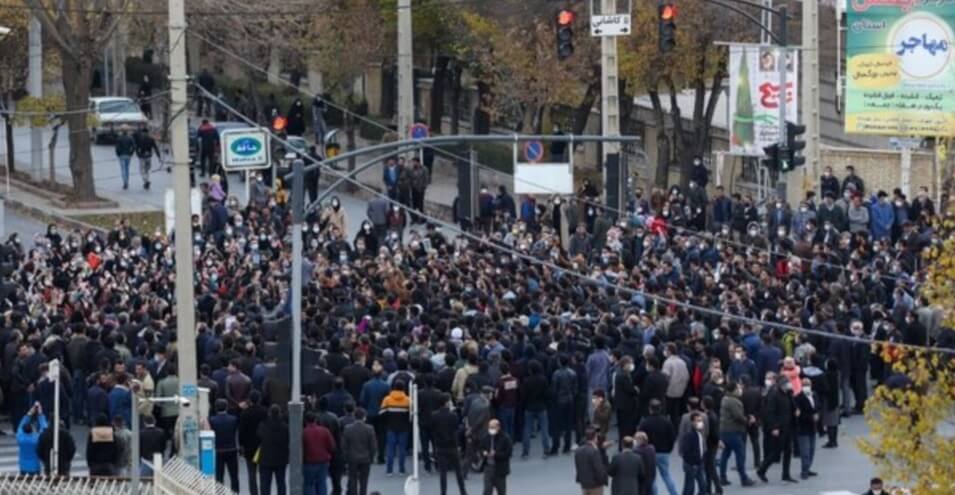
Protesters against water mismanagement in Chaharmahal and Bakhtiari province took to the streets of Shahr Kord, the provincial capital, on Monday, November 23, for the second consecutive day.

A large number of protesters, in addition to chanting “Here is Chaharmahal, taking water is impossible,” repeatedly chanted “Death to the mafia.” “Shame on us, shame on us, our radio and television” and “Woe if our tribe takes matters into its own hands” were among other slogans heard in the protest rallies in Shahr Kord.

Videos received show that a large number of protesters gathered in front of the provincial governorate and, while chanting anti-protest slogans against the so-called “Behesht Abad” plan, were also carrying placards with the message “The Behesht Abad plan, with or without permission, is against the law.”

The “Behesht Abad” plan is the name for transferring water from Chaharmahal and Bakhtiari to the provinces of Isfahan, Yazd, and Kerman. In this plan, which was approved in 2011 by the High Water Council following the pursuits of officials and representatives of Isfahan province, it is scheduled that through the construction of a tunnel, 1.1 billion cubic meters of water annually be transferred to Iran’s central plateau.

Charahmahal and Bakhtiari, which previously provided 11 percent of the country’s water supply, is now facing a water crisis, and water supply to more than two hundred villages in this province is currently being carried out by tanker trucks.

Qodratollah Hamzeh, representative of Ardal, Kuhrang, Farsan, and Kiar districts in Parliament, said on Sunday: “To solve the water shortage problem, the discussion of transferring water from the sea should be considered; there is no water left in Chaharmahal and Bakhtiari to be transferred to desert provinces.”

He said that the people of this province in many cities, villages, and even nomadic areas face drinking water problems, and “all plains of this province are in a critical and crisis-prohibited state,” but did not allude to governmental mismanagement in addressing the water situation of this province.

The representative of four districts from Chaharmahal and Bakhtiari province, however, subsequently threatened that “the people of this province will not allow the drilling of a single meter of tunnel for water transfer.”

Officials of the Islamic Republic have consistently cited insufficient rainfall as the main reason for this situation in most parts of the country, but this is while the repeated warnings of environmental activists regarding the necessity of stopping rice cultivation in desert provinces and preventing unauthorized well digging and fixing corruption in the country’s water supply pipes continue to be ignored.

Unfulfilled promises by officials and their neglect of providing water to the people of Chaharmahal and Bakhtiari, since Sunday, have led to protests in this regard, and this is while Isfahan province also witnessed major protests in recent days against water mismanagement in the province.

Starting from November 8, Isfahan witnessed gatherings of farmers protesting the cut-off of water rights and the drying of the Zayanderud River. These protests gradually expanded with the support of other sections, until November 19, when the largest gathering with thousands of people from Isfahan was held. During this gathering, many people in the dry bed of the Zayanderud River chanted protest slogans.

During this summer, widespread protests were also held in Khuzestan focusing on the water shortage problem, which security forces violently suppressed. There is still no accurate count of the number of deaths and wounded from these suppressions.

Ali Akbar Mohammadi, the Minister of Power in Ibrahim Raisi’s government, had previously emphasized “the necessity of praying for rain,” and Vahid Niradi Pargali, the head of religious and cultural affairs at the Ministry of Power in Khuzestan province, in a letter addressed to a number of water and electricity managers in the province, reported “Engineer Mohammadi’s order, the Minister of Power, for the benefit of rain-bringing supplications (the 19th supplication from the Sahifah Sajjadiyyah).”


Source: Radio Farda

Related Articles

Back to top button