Rouhani: Depriving Iran of Oil Sales Would Be Very Dangerous
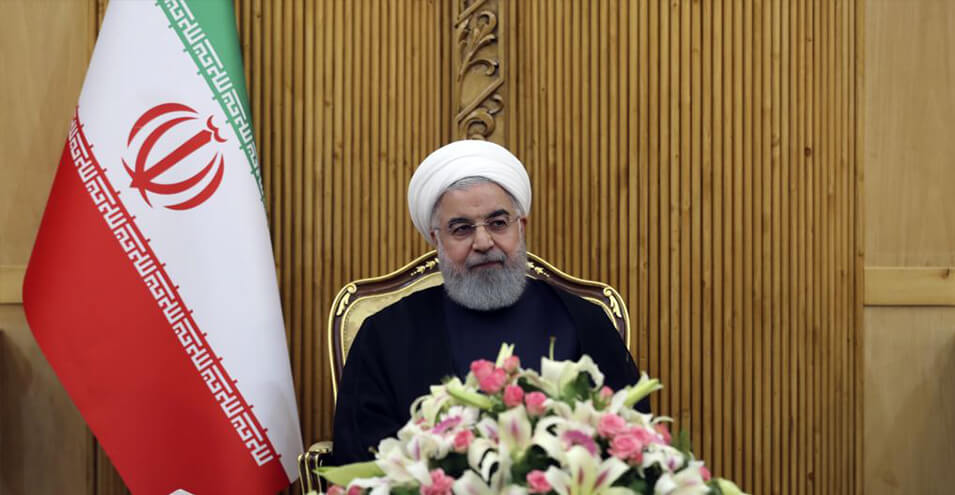
Iran’s president, while ruling out the possibility of meeting with Donald Trump, his American counterpart, described Washington’s plan to impose sanctions on Iran’s oil sales as “impractical” and at the same time “dangerous”.
Hassan Rouhani on Monday, September 24, in a meeting with a group of American media managers emphasized that the Donald Trump administration’s plan to sanction Iran’s oil sales is “not only impractical but would be very dangerous, and I hope we can continue trade with friendly countries within the framework of international regulations”.
He stressed that American sanctions have not only harmed Iran, but have also “harmed international companies”.
Mr. Rouhani did not provide further explanation about his remarks and his description of the sanctions on Iran’s oil sales as “dangerous”.
Iran’s president had also threatened on July 2 that if Iran’s oil is not to be exported, other countries’ oil should also not be exported from the Persian Gulf.
Following these remarks and other threats by Islamic Republic officials, Admiral John Richardson, commander of U.S. Navy operations, warned Iran that the United States will preserve freedom of navigation for ships in the Strait of Hormuz, even by force if necessary.
Concurrently with tensions between Iran and America, Shiite rebels in Yemen targeted two Saudi oil tankers in the Bab al-Mandab Strait, which caused Saudi Arabia to suspend oil exports from this strait for a period.
Following this incident, Nasser Shabani, head of the Defense and Security Research Center of Imam Khomeini Comprehensive University, on August 6 made a controversial remark saying that the Islamic Republic asked Yemeni rebels to attack two Saudi Arabian oil tankers and they did so.
“America’s Dream Will Not Come True”
Bijan Zanganeh, Iran’s oil minister, has also announced that “America’s dream of cutting off Iran’s oil exports will not come true”.
Oil prices in global markets on Monday jumped approximately 2.5 percent compared to the previous day, reaching $81 per barrel, which is the highest level in the past four years.
In the OPEC monitoring committee meeting, the American request to Middle Eastern Arab countries and OPEC to increase production was rejected.
Meanwhile, Hussein Kazempour Ardabili, Iran’s representative to OPEC, said that contrary to Donald Trump’s expectations, OPEC and its allied countries want to increase their production “partially and with delay”.
The United States reinstated the first round of its suspended sanctions against Iran starting August 6 and announced that in the next phase of sanctions, which begins November 4, it will attempt to reduce Iran’s oil sales to zero.
From the perspective of some analysts, sanctions on oil sales and banking sanctions will be the most important sanctions against Iran, a point that some Islamic Republic officials have also acknowledged.
Meanwhile, Iran’s Supreme Council of Economic Coordination approved on September 18 to counter American sanctions that the private sector can purchase and export petroleum products from the government.
Mr. Rouhani also, in response to a question, did not consider the issue of a meeting between the American president and the North Korean leader comparable to a possible meeting between the presidents of Iran and America.
Mr. Rouhani said that Donald Trump’s actions, including withdrawal from the JCPOA and “sanctions and threats” against Iran, are “not simply overlooked”.
He added in another part of his remarks: “A meeting by itself has no merit, because a meeting takes place when we hope that disagreements have decreased and we will reach positive points. But today we have no hope regarding the behavior of the American president and we see no point or effect in this”.
He stressed that “if one day we see that America is sincerely seeking to rebuild relations, then we will decide and we will have a fresh atmosphere”.
Donald Trump, who has withdrawn America from the nuclear agreement with Iran to resume sanctions against Tehran, has said he is ready to negotiate with Tehran officials without preconditions in order to reach another agreement with Iran.
Mr. Trump, emphasizing that Iran’s economic situation is rapidly deteriorating, predicted that Islamic Republic officials will soon enter negotiations with the American government.
However, Ayatollah Ali Khamenei, the leader of the Islamic Republic, rejected this proposal and says that like Ayatollah Khomeini, the founder of Iran’s current government, he forbids negotiations with America.
Nevertheless, the U.S. Secretary of State on September 23 announced the interest of this country’s president in meeting with Ayatollah Ali Khamenei and said: “It is negotiations that would be interesting and important”.
A number of hardline representatives of the Iranian parliament, including Javad Karimi Qodousi, have emphasized that Iran’s president and foreign minister on their trip to New York “have no right to any meeting” with American officials.
Mr. Rouhani in his first trip to New York had a telephone conversation with Barack Obama, the American president.
Source: Radio Farda