By tightening the blockade, Washington has placed Iran between nuclear surrender or economic collapse.
The siege is tightening, and Washington, by intensifying military and economic pressure, has placed Iran between nuclear surrender or economic collapse.
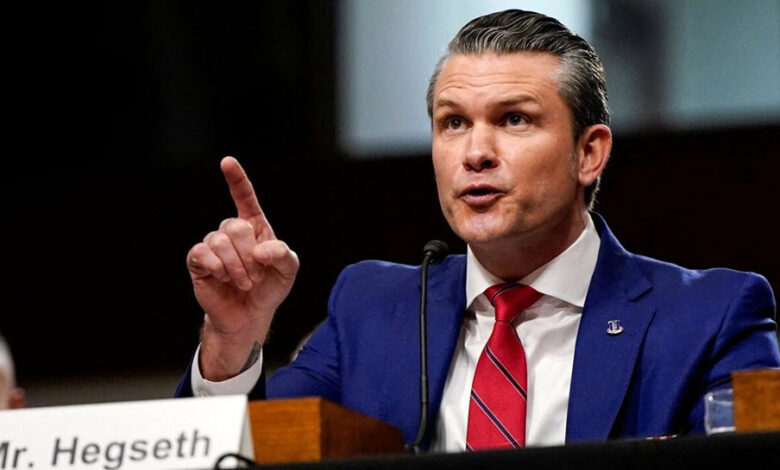
In a development that could take regional equations to a new level, Pete Hegsett announced the indefinite continuation of the naval blockade against Iran and emphasized that Washington is in no hurry to reach an agreement with Tehran; a position that indicates a shift in focus from diplomacy to multi-layered maximum pressure.
In a press conference at the Pentagon, he painted a dual picture of Iran's future, stating: "Iranian authorities have only two paths forward: either give up nuclear weapons in a meaningful and verifiable manner, or witness the complete collapse of their fragile economy under the relentless pressure of American power and a long-term blockade."
These statements clearly show that the Donald Trump administration is seeking to force Tehran to back down by combining military and economic tools.
According to the report, the ongoing operation is not limited to the waters of the Persian Gulf, but has also extended to the Indo-Pacific Ocean, where US forces are seeking to contain what is called Iran’s “shadow fleet.” This approach shows that the new US strategy has acquired a trans-regional dimension and aims to cut off Iran’s vital economic routes globally.
Meanwhile, Dan Keane announced that dozens of vessels have been forced to divert or turn back as a result of the blockade, and several Iranian-linked vessels have been seized in international waters. Such actions, in addition to direct economic pressure, send a clear message to other maritime actors about the costs of cooperating with Tehran.
Hegsett also sought to distinguish the operation from past US wars of attrition, claiming that the confrontation had reached a decisive military outcome in a short period of time. However, some international analysts believe that any prolonged siege, even without widespread conflict, could gradually lead to unpredictable tensions in the region, especially in a sensitive passage like the Strait of Hormuz.
In the wake of these developments, the dispatch of another aircraft carrier to the region is also seen as a sign of Washington's readiness to intensify its military presence. This move comes at a time when explicit warnings have been issued about any Iranian action in shipping lanes. The US Secretary of Defense has emphasized that in the event of a threat to maritime security or mine laying, the military response will be "decisive and immediate."
Despite the limited openness of routes to some non-Iranian vessels, the overall framework of this policy represents a targeted and controlled blockade that, if continued, could significantly increase domestic economic pressures on Iran. Past experience has also shown that such pressures often affect the lives of ordinary citizens more than they do governments.
Internationally, reactions to this approach are still mixed. Some countries see it as a deterrent against the expansion of Iran's nuclear program, while others have expressed concerns about the humanitarian consequences and the risk of escalating conflict.
Ultimately, what is now taking shape is not simply military pressure, but part of a broader strategy to change Iran’s behavior or decision-making structure; a strategy whose success or failure could have profound implications for the future of regional security and even international order.