Three European Powers: Iran’s 20 and 60 Percent Enrichment Has No Acceptable Non-Military Justification
Three European powers involved in the JCPOA issued a joint statement expressing deep concern about the escalating development of the Islamic Republic’s nuclear program, while warning about the consequences of Iran’s 20 percent and 60 percent enrichment.
Simultaneously, the United States, criticizing “Iran’s escalating actions beyond JCPOA limits,” cautioned Iran against provocative measures in this field and called for the implementation of verification and monitoring measures within the framework of the nuclear agreement.
In a joint statement addressed to the Board of Governors of the International Atomic Energy Agency, France, Britain, and Germany emphasized that “Iran has no acceptable non-military justification for 20 percent and 60 percent enrichment, and the production of enriched uranium at these levels is unprecedented for a country without a weapons program.”
The statement also expressed deep concern that by upgrading its nuclear capabilities “permanently and irreversibly,” Iran has “placed the international community at serious risk.”
In the statement of the three European countries, it was stressed that “as a result of concerning production speed, Iran’s total stockpile today contains sufficient fissile material that, if further enriched, could be used to produce more than one nuclear weapon.”
The three European countries also warned that “the accumulation of enriched uranium at 20 and 60 percent enrichment further reduces the time to produce the first nuclear weapon.”
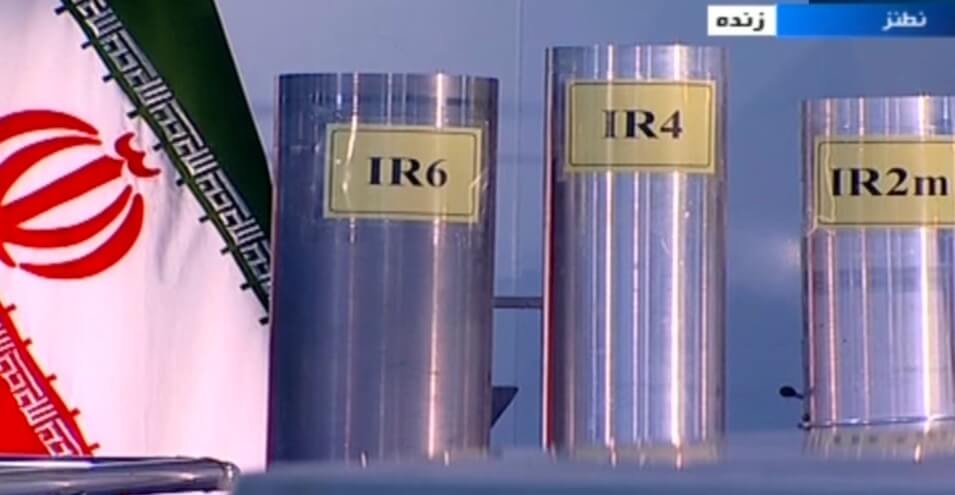
The statement described “the installation of modular infrastructure for advanced centrifuge cascades” as a concerning measure that would give Iran the ability to “more easily configure operational cascades of this type” and access higher enrichment levels.
“The development of knowledge necessary to produce nuclear weapons, particularly in the field of uranium metal” and “research and development with natural and enriched uranium metal” are other matters described in this statement as having “no acceptable non-military justification in Iran”; a matter which, from the perspective of the three European powers involved in the nuclear agreement, “provides Iran with knowledge usable in weapons.”
The three European countries warned that research and development in this field and the widespread use of advanced centrifuges have “permanently improved” Iran’s enrichment capabilities and thus the continuation of Iran’s escalating measures “irreversibly reduces the non-proliferation value of the JCPOA.”
In the statement of France, Britain, and Germany, the concurrence of the expansion of Iran’s nuclear activities with a significant decrease in vital cooperation with the Agency, the nine-month halt of transparency and verification measures of the JCPOA, the suspension of the Additional Protocol, and Iran’s continued refusal to formally extend transparency measures are among other matters of concern, strongly urging Iran to “restore access to the International Atomic Energy Agency and fully cooperate.”
The three European countries considered Iran’s return to full implementation of the Agency’s monitoring arrangements, including the implementation of the Additional Protocol, as necessary, and stated that the return of full transparency and monitoring arrangements would help build international community confidence in the peaceful nature of Iran’s nuclear program.
Meanwhile, all three countries emphasized that they will return to Vienna with good faith for negotiations to resume the work where it had stopped in June during the sixth round of talks.
Simultaneously, the U.S. representation at the Agency, in its own statement, referring to Iran’s escalating actions beyond JCPOA limits, including work with uranium metal and the production of enriched metal up to 20 percent and the use of advanced centrifuges for 60 percent uranium enrichment, stated that “only countries possessing nuclear weapons have undertaken such actions in relation to enrichment.”
This statement recalled that the continuation of Iran’s significant nuclear program expansion beyond JCPOA limits and the continuation of escalating nuclear tensions “moves us further from returning to mutual compliance with the JCPOA, not closer to it.”
The statement referenced remarks by the U.S. Secretary of State, stating that “the opportunity to return to full mutual compliance with the JCPOA will not last forever.”
The U.S. statement emphasizes that if Iran is genuinely interested in returning to mutual compliance with the nuclear agreement, it should “refrain from provocative actions that far exceed JCPOA limits,” and instead “implement the verification and monitoring measures contained in the agreement.”
The U.S. representation stated in this statement that in the event of Iran’s resumption of compliance with all its obligations under the JCPOA, the United States is ready to lift all sanctions inconsistent with the agreement.
The Board of Governors of the International Atomic Energy Agency began its routine session on Wednesday, including to review the Islamic Republic’s nuclear program, and according to reports, Rafael Grossi told the Agency’s Board of Governors that the talks held this week in Tehran regarding Iran’s nuclear program yielded no concrete results.
He emphasized, however, that he “will not give up efforts to reach some form of understanding with Iran.”
Grossi’s remarks about the fruitlessness of his Tehran visit prompted a reaction from one of the U.S. State Department spokespersons, who described the stalemate in Iran’s cooperation with the Agency as a “bad sign” of how seriously the Iranian side is pursuing successful Vienna negotiations.
Iranian officials claim that during the IAEA Director General’s visit to Tehran, the two sides reached “a principled agreement to resolve technical issues with the Agency,” and Iran’s Foreign Minister noted in this regard that “we are pursuing the issuance of a joint statement [with the Agency] at the earliest possible opportunity.”
Iran’s nuclear negotiations with the remaining JCPOA powers, which have been suspended since June this year due to Ebrahim Raisi’s election as president, are set to resume in Vienna on December 29th. The United States, due to its withdrawal from the JCPOA, has so far participated indirectly in these negotiations.
The purpose of these negotiations is to persuade Iran to resume implementing its obligations under the JCPOA and lift Washington’s sanctions against Tehran.
On Wednesday, the U.S. National Public Radio (NPR) published an interview with Robert Malley, the U.S. Special Representative for Iran Affairs, in which it was emphasized that if Iran does not agree in next week’s nuclear negotiations to return to the JCPOA and comes “very close” to building a nuclear bomb, the United States will not stand idle.
Mr. Malley stated that if it continues the course it is currently pursuing—abandoning the negotiating table and accelerating its nuclear program—it will face a proportionate response.
Source: Radio Farda