Tough Days Ahead for Iran’s “Disrupted” Economy
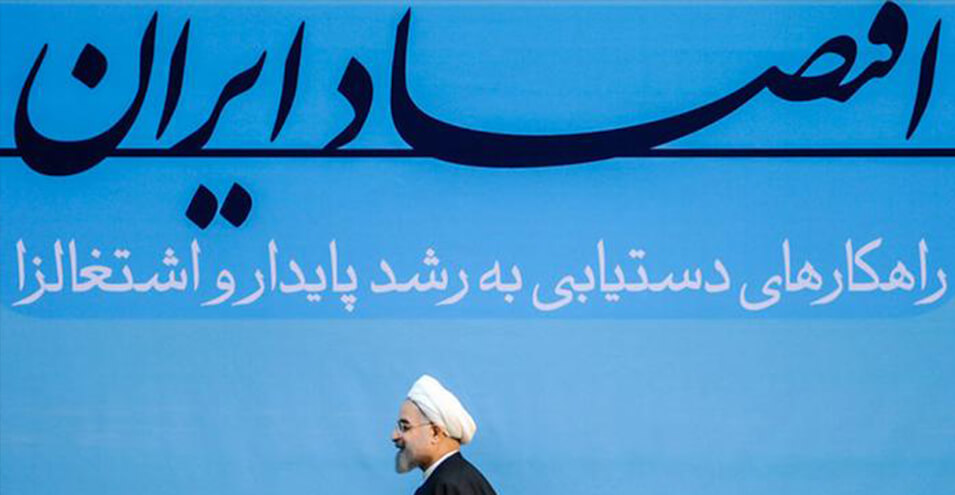
According to economic activists, domestic problems have disrupted Iran’s economy more than sanctions have. Asadollah Asgaroladi predicts “a very difficult season” for Iran’s exports. Hassan Rouhani also says there is not a week that goes by without him “crying out” in government.
Asadollah Asgaroladi, one of the most prominent economic activists and head of the Iran-China Chamber of Commerce, said on Tuesday, December 25 (January 15): “Our forecast is that the coming spring will be a very difficult season for exports, and we hope that with the follow-up of the Central Bank, at least some of the exporters’ problems will be solved, because otherwise there will be no possibility of continuing operations.”
Asgaroladi said: “Unfortunately, exporters today face serious challenges, and issues such as repatriating export revenues have forced many of them to stop their exports.”
Suspension of Iran’s Most Famous Dried Fruit Exporter
Iran’s most famous dried fruit exporter added that he himself, due to “serious challenges” facing exporters, has suspended his own activities in this field “after 64 years of export operations” for the past two months.
This member of the Iran Chamber of Commerce also said, referring to the fact that “foreigners have no knowledge of the NIMA system”: “We cannot expect exporters to enter their money into the NIMA system in the shortest time, because when a foreign buyer wants to return money, he asks us to give him a bank account.”
Asadollah Asgaroladi added: “Foreign buyers ask exporters to introduce a bank to them for depositing the proceeds from the purchase of Iranian goods so that it is approved, while NIMA is not a bank but only a currency exchange organization of the Central Bank, which has created serious problems for exporters and forced many of them to close their businesses.”
Currently, there are effectively three dollar exchange rates in Iran’s foreign exchange market: the official rate of 4,200 tomans for essential goods and medicine, the fluctuating dollar rate in the secondary market or the rate set in the “NIMA system,” and finally the dollar rate in the free market.
NIMA (Integrated Foreign Exchange Trading System) determines the exchange rate in the secondary market, and SANA (Foreign Exchange Surveillance System), in which authorized exchange dealers’ foreign exchange transactions are registered, determines the third exchange rate in Iran’s free market.
Rouhani: Not a Week Goes by Without Me Crying Out in Government
While Asgaroladi reported the suspension of activities by “many exporters,” Hassan Rouhani, Iran’s president, emphasized the importance of exports and said: “We need exports and we also need technology, otherwise we will not achieve development.”
Rouhani, referring to the obstacles in overcoming Iran’s economic problems, said: “Not a week goes by that I don’t speak, don’t yell, and don’t cry out in government.”
Iran’s president also said, referring to the current state of Iran’s economy: “We are under sanctions and our situation is not a normal and natural situation; of course, it is not that we are afraid of sanctions or retreat and give up our goals, but now we are in specific conditions of economic sanctions.”
The Cause of Deterioration; Sanctions or “Domestic Problems”?
Simultaneously with Rouhani’s remarks, however, Masoud Khansari, head of the Tehran Chamber of Commerce, attributed the disruption of Iran’s economy more to “domestic problems” than to sanctions and said: “Many complaints are received daily at the Chamber of Commerce declaring obstacles to production and business; especially since these obstacles have disrupted Iran’s economy.”
This economic activist added: “Although the problem of sanctions is not hidden from anyone, domestic problems hurt Iran’s economy more than sanctions, and if not managed, Iran’s economy will be severely affected.”
According to Mehr news agency, the head of the Tehran Chamber of Commerce, while requesting the organization of order registration from the Ministry of Industry, said: “The circulation of order registration has created many problems which is now one of the main obstacles to the country’s production and trade, so its period should be extended to six months; while it is currently three months. Of course, the issue of raw materials should not be overlooked either; this is while machinery has arrived at customs, but order registration problems have hindered their clearance.”
Masoud Khansari also pointed out, referring to the problems arising from the stages of passing order registration through the “NIMA system” and the need to “conduct imports without currency transfer”: “Manufacturing units face many problems in securing their raw and intermediate materials, so if order registration and its lengthy procedures are to be carried out in the NIMA system, it will create many problems, and therefore it is suggested that imports of raw materials be conducted without currency transfer.”
The “Boom” of Workforce Adjustments in Manufacturing Units
Masoud Khansari, in another part of his remarks today, referring to the correspondence of the Tehran Chamber of Commerce with the Minister of Industry, added: “This ministry is asked to solve the problems and crises facing the country’s industry and production; because if we don’t move, we will add another knot to the existing knots; because now many industries and manufacturers are in trouble and every day manufacturing units are laying off workers and facing problems.”
In recent months, hundreds of thousands of auto parts workers in Iran have lost their jobs. Arash Mohabbinezhad, secretary of the Association of Iranian Homogeneous Industries and Auto Parts, confirmed this news last Wednesday to the ILNA news agency saying: “If the prevailing relations do not change, this destruction will continue.”
Mohabbinezhad said: “Since the beginning of this year, 280,000 auto parts workers have been laid off, of which 130,000 people have been adjusted, meaning they have either been fired or new contracts have not been made after the termination of their contracts; 150,000 people are also in a state of suspension; meaning they are currently on forced leave.”
The secretary of the Association of Iranian Homogeneous Industries and Auto Parts also said regarding the fate of 150,000 suspended auto parts workers: “Their situation is unclear; it is possible that they may be able to return to work, and there is also a possibility that they may not return to work.”
This representative of employers in the auto parts industry reminded: “The condition of the auto parts industry is very poor, and if something is not done about this industry, it will soon completely collapse and stop.”
Arash Mohabbinezhad, also referring to the fact that “400 auto parts units are currently fully or partially closed,” warned that unless the current problems of automakers and auto parts manufacturers are addressed, “the auto parts industry will be completely shut down within the next two weeks.”
Rouhani: We Give Casualties in Economic War
While economic activists see the cause of Iran’s economic turmoil more in “domestic problems” than sanctions, Hassan Rouhani today emphasized that “no one can say we stand against the enemy and give no martyrs and casualties.” According to Iran’s president, the country’s situation is “not normal and natural,” and America has launched an “economic war” with the help of Israel and “reactionary countries in the region” against Iran, and “in these circumstances we suffer losses and casualties.”
According to Tasnim, Rouhani, in a session of the Administrative Council of Golestan Province, listed America’s objectives in this regard as including “separating people from the Islamic system,” “isolating” the Islamic Republic at the global level, “diminishing” Iran’s role in the region, and also “extorting” Iran in the fields of “nuclear, missile or regional” affairs.
Rouhani also added, referring to confirmation of Iran’s commitment to the JCPOA by the International Atomic Energy Agency: “We must make it clear to the Americans that this path is wrong. People should be respected and sanctions should be lifted. We have never been reluctant to talk, but talk that is within the framework and principles.”
The head of the twelfth government also added: “In these circumstances, the pressure of the economy is on the people. We cannot completely eliminate this pressure and problems. Saying we cannot do anything is also wrong. American pressure is on the banking system, foreign exchange revenues and transportation. These 3 bottlenecks are, from their perspective, places where they have intervened.”
Rouhani, in another part of his remarks today, also addressed “domestic problems” and announced that “the government and the system” alone are not capable of solving these problems: “It is not possible that everyone voted for this government in the elections and now the government corrects everything, but does the government and the system have all this capability? The principle is people, and they must enter the scene and help.”
“Betrayals Occur That Cannot Even Be Described”
Iran’s president then went on to explain the process of “single-rate” currency pricing and said he had opposed the 4,200 tomans dollar rate, but agreed with it due to the opinion of “all economists.” Rouhani, stating that “it was a good plan, but some brokers did what they did,” added: “Some people registered orders and took money from the Central Bank, coordinated with a team of foreign brokers, took 100 million dollars, imported 50 million dollars of goods and brought the rest to the market, the judiciary and supervisory apparatus should investigate.”
Hassan Rouhani then, referring to “the government being forced to change the plan,” continued: “We now give 4,200 tomans for essential goods. Not a week goes by that I don’t speak, don’t yell, and don’t cry out in government, our ministers and deputy ministers are also not up to the challenge. The person goes to import a raw material for a drug, goes and buys a material that has three months left in its expiration date and they erase its expiration date. Betrayals occur that cannot even be described.”
Iran’s president finally said: “We have triumphed everywhere, we fell short in one place and must make up for it, and that is in morality, sacrifice and devotion to people and fulfilling trusts. A manufacturer took money from us to import raw materials, but stored the goods in a village warehouse so it would not produce and the goods would become expensive. Why did some of us sew big pockets for the public treasury? We must pass through this difficult path of sanctions.”
Despite Rouhani’s emphasis on the “abnormal” conditions resulting from the return of American sanctions against Iran and the need to pass through the “difficult path of sanctions,” many critics consider “domestic problems” and the government’s inability to manage economic problems as the main reason for the current chaotic situation, widespread protests against it, and the spread of public distrust.
This public distrust, which especially increased significantly after the December 2017 and August 2018 protests, has sounded the “alarm bell” for government officials, and many of them after these unrest have warned of the increasing spread of public discontent and the danger of “collapse” and “disintegration.” Including Ali Rabiei, former Iran’s Minister of Labor who also has intelligence and security background, who last Sunday put the number of cities involved in December 2017 protests at “160 cities” and said: “The nature of the 2017 unrest is a limited but dangerous and regional type of revolt and sounds an alarm that could expand.”
Although the nationwide December 2017 protests began with raising livelihood demands and in protest of the dire economic situation, the slogans of the people during them quickly took on a political color and targeted senior Iranian officials such as the leader of the Islamic Republic and the entire structure of the system. Dozens were killed in these protests, thousands were arrested, and some of the arrested also suspiciously died in prison.
Source: DW